
Southern Machinery EMS Curing Oven: Process Support for Smart PCB Assembly
How an EMS curing oven fits a PCB assembly line: curing conformal coating, SMT adhesive and underfill with repeatable thermal profiles. Southern Machinery, Shenzhen.
Aug 7, 2026 · Updated Aug 7, 2026 · Southern Machinery
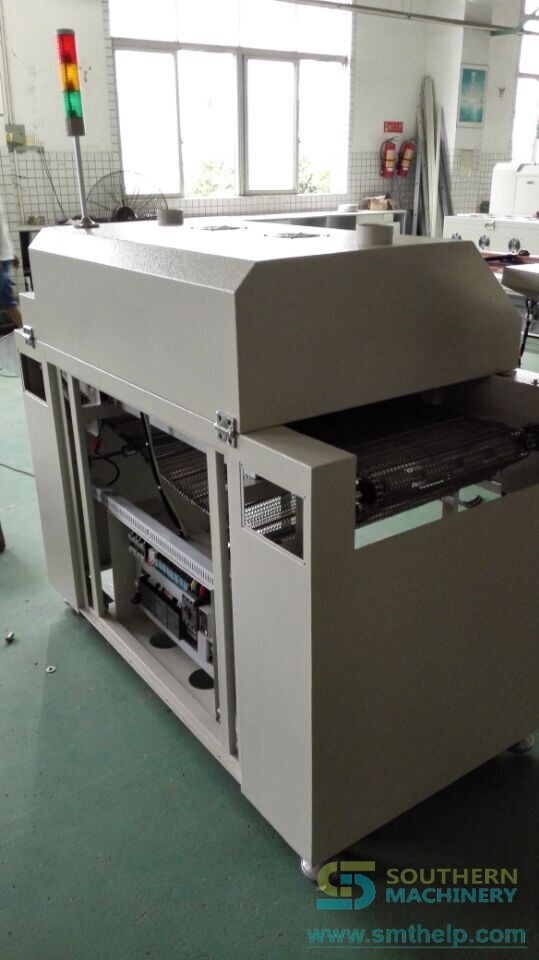
Southern Machinery EMS Curing Oven: Process Support for Smart PCB Assembly
Curing is one of the most underrated steps in electronics manufacturing. After the pick-and-place machines, reflow ovens and wave solderers have done their work, the materials that protect and strengthen the assembly — conformal coatings, SMT adhesives, underfill and potting compounds — still have to be cured. If that cure is inconsistent, yield suffers in the field, not on the line.
Southern Machinery (Shenzhen, China, established 2011, 237+ global customers) supplies EMS curing oven solutions as part of a complete SMT, THT and PCB assembly automation ecosystem. This article explains what an EMS curing oven is used for, where it belongs in the line, and how buyers should evaluate one without overbuilding their process.
What is this machine used for?
An EMS curing oven applies controlled, uniform heat to cure process materials applied to PCBs after — or alongside — soldering. In practical buyer terms, it is the machine that turns a freshly coated or glued board into a finished, reliable product:
- Conformal coating curing — hardening protective acrylic, silicone or polyurethane coatings that shield boards from moisture, dust and vibration.
- SMT adhesive (red glue) curing — fixing small SMD components in place before wave soldering on double-sided boards.
- Underfill curing — strengthening BGA, CSP and flip-chip joints against mechanical and thermal stress.
- Potting and encapsulation curing — securing transformers, power modules, sensors and connectors.
- Adhesive and sealant curing — for module-level assembly in LED, automotive and appliance electronics.
For an EMS factory, the curing oven is not a luxury. Any line that applies conformal coating or SMT glue without a controlled cure step is shipping a process risk. Buyers should treat the oven as the partner of their dispensing and coating equipment: coating without repeatable curing is an incomplete process.
Typical applications
1. Conformal coating lines. Selective coating or spray coating of PCBA, followed by oven curing to achieve the required protection level for industrial, automotive or outdoor electronics. Curing profile must match the coating chemistry's datasheet.
2. Glue-on-wave soldering. SMD adhesive is printed or dispensed, components are placed, and the board passes through the curing oven before wave soldering. This is the classic double-sided mixed-technology flow.
3. Underfill for advanced packages. BGA/CSP assemblies that need mechanical reinforcement — common in memory modules, power electronics and handheld devices.
4. Potting and encapsulation. Power supplies, ballasts, LED drivers and automotive modules where liquid potting compound must be cured into a solid protective block.
5. Module and sub-assembly bonding. Structural adhesives, thermally conductive interface materials and gaskets in consumer and industrial electronics.
How it fits into a complete PCB assembly line
The curing oven belongs in the "process support" segment of a PCB assembly line, and Southern Machinery designs it to work with the surrounding ecosystem:
- Before the oven: stencil printing, SMT pick-and-place, reflow soldering, or THT insertion and wave soldering. For glue-on-wave lines, the curing oven sits between SMT placement and the wave soldering machine (for example Southern Machinery's S-WS450 or S-WS350B lead-free dual wave systems).
- After the oven: board handling, cleaning, AOI/SPI inspection and final assembly.
A typical flow looks like this: solder paste printing → SMT placement → reflow → conformal coating → curing oven → board handling → AOI → wave soldering (THT side) → final inspection. The curing oven is the bridge that locks in the protection added by the coating or adhesive step, so the value created upstream is not lost downstream.
Southern Machinery also supplies the surrounding automation — board handling systems, PCB cleaning machines, 3D SPI / AOI, THT insertion machines, feeders and nozzles — so the curing oven can be specified as part of one coherent line rather than an isolated island.
Key selection parameters
Because curing requirements vary by material chemistry and board mix, buyers should evaluate these categories with their actual process data (specific values depend on your coating/adhesive and production volume — request a configuration review from Southern Machinery):
- Thermal performance: number of heating zones, temperature uniformity across the working width, ramp and soak control, maximum process temperature.
- Throughput format: inline continuous conveyor versus offline batch oven — batch is often the right fit for high-mix, low-volume (HMLV) EMS production.
- Conveyor and loading: belt, mesh or chain transport; maximum board width, weight and product height.
- Control and data: recipe storage for different materials, real-time temperature profiling, data logging and MES connectivity for traceability.
- Environment and safety: exhaust/venting requirements, over-temperature protection, interlocks and applicable electrical safety compliance.
- Footprint and energy: installed power, heat-up time, floor space and insulation quality — all direct operating costs.
- Service and spares: availability of heating elements, motors and controls, plus local support for commissioning and training.
ROI and quality perspective
From a buyer's perspective, the case for a curing oven is made on three fronts:
Quality and reliability. A repeatable cure means fewer coating delamination issues, adhesive failures and field returns. For EMS companies serving automotive, industrial or medical customers, documented temperature profiles are often an audit requirement — a controlled oven with data logging supports that evidence.
Labor and consistency. Manual curing (ovens without profile control, or operators guessing times) produces batch-to-batch variation. An automated oven removes the human variable and lets one operator manage more output.
Process completeness. If you already invest in conformal coating or SMT adhesive, the curing step is a small fraction of the line cost — and it protects the entire investment. Adding the right process-support step is far cheaper than reworking boards or absorbing field failures.
Southern Machinery's approach is to help customers add the right process-support step without overbuilding the main line: batch curing for HMLV production, inline solutions for higher volumes, and clear guidance on what to measure before you buy.
FAQ
What is an EMS curing oven used for in PCB assembly?
It cures process materials applied to PCBs — conformal coating, SMT adhesive (red glue), underfill and potting compounds — using controlled, uniform heat so the materials reach their specified mechanical and electrical properties.
What is the difference between a curing oven and a reflow oven?
A reflow oven melts solder paste to form solder joints at peak temperatures for a short time. A curing oven holds boards at a lower, controlled temperature for a longer duration to polymerize or harden coatings and adhesives. They serve different process steps.
How long does conformal coating take to cure?
It depends entirely on the coating chemistry and the manufacturer's datasheet — typically a specified temperature and dwell time. The oven's job is to hold that profile accurately and repeatably across the whole board.
Can a curing oven handle double-sided boards with SMT adhesive?
Yes. In glue-on-wave soldering flows, the oven cures the adhesive that holds SMD components on the bottom side before the board passes through the wave soldering machine.
Should I choose a batch or inline curing oven?
Batch ovens suit high-mix, low-volume production and flexible scheduling. Inline ovens suit continuous, higher-volume flows. Your coating volume, board mix and floor space determine the right format.
How do I get a catalog or configuration advice for a curing oven?
Contact Southern Machinery at jasonwu@smthelp.com. The full machine catalog is available at file.autoinsertion.com, and product images can be found at ph.smthelp.com.
Contact Southern Machinery
Southern Machinery (Shenzhen, China, established 2011) has served 237+ global customers with SMT, THT and PCB assembly automation. Whether you need a curing oven for conformal coating, SMT adhesive or underfill — or a complete process-support solution around it — the team can help you specify the right equipment.
- Email: jasonwu@smthelp.com
- Website: https://www.smthelp.com
- Machine catalog: https://file.autoinsertion.com
- Product images: https://ph.smthelp.com
- AI assistant: https://ai.smthelp.com
<iframe width="560" height="315" src="https://www.youtube-nocookie.com/embed/WJrGRQe-wuE?rel=0" title="High-Performance EMS Curing Oven Solution for Smart EMS factory PCB assembly" frameborder="0" allow="accelerometer; autoplay; clipboard-write; encrypted-media; gyroscope; picture-in-picture; web-share" referrerpolicy="strict-origin-when-cross-origin" allowfullscreen></iframe>
Tags: EMS Manufacturing, PCB Assembly Automation, Cleaning, Coating & Process Support, Conformal Coating, Smart EMS Factory
Comments