
FUJI SMT Nozzle for NXT H01-H24 Heads by Southern Machinery
FUJI NXT nozzle selection for H01 to H24 heads: match the tip diameter, MELF and rubber-pad variants, and reproduce the matrix code before you quote spares.
Oct 6, 2026 · Updated Oct 6, 2026 · Southern Machinery
What is a FUJI NXT nozzle used for? A FUJI NXT nozzle is the vacuum, gripper or dispenser tip that fits a FUJI placement head - the last millimetre between the head and a good board. Southern Machinery designs and manufactures FUJI-compatible SMT nozzles for smart EMS PCB assembly, from a ø0.3 mm micro-tip on the NXT H08 and H08M heads up to a ø15.0 mm large-component tip on the H04, matched to the NXT H01 to H24 heads and the CP4, CP6, QP, IP-3 and XP inserters.
Which FUJI NXT nozzle fits your head?
Start with the head, not the nozzle
The head fixes the shank, the holder interface and the vacuum take-off, so record it first: NXT H01, H04, H04S, H08, H12, H08M or H24, a CP4, CP6, QP, IP-3 or XP inserter, or a GL dispenser head.
The FU-AAxxxx part number tells you the series
FUJI NXT nozzles carry part numbers in the FU-AAxxxxx series; CP, QP and IP nozzle assemblies are quoted under codes that are R, S, M and B coded. Those codes encode which head family a nozzle belongs to, and therefore which tip diameters and materials exist inside it.
Which series covers which head
- NXT H01 - FU-AA0xxx, ø1.0 to ø7.0 mm, ceramic / MELF / rubber-pad (G), 0402 to MELF and IC.
- NXT H04 and H04S - FU-AA06xxx and FU-AA8xxx, ø1.0 to ø15.0 mm, 0603 to 3216, IC and SOP/QFP.
- NXT H08 and H12 - FU-AA05xxx and FU-AA20xxx, ø0.3 to ø5.0 mm, ceramic and MELF, 0201 to 1608 and MELF.
- NXT H08M - FU-AA8Lxxx and FU-AA8Mxxx, ø0.4 to ø5.0 mm, ceramic / MELF / G, 0402 to 1608 and MELF.
- NXT H24 high-density - FU-AAxxxx (H24) multi-tip, ceramic, 0402 to 1608 and IC.
- CP4, CP6, QP, IP-3 and XP - FU-AMPH and FU-AWPH assemblies, ø0.4 to ø7.0 mm, fluorescent and black bodies, R/S/M/B coded.
AAxxxx, AMPH and AWPH are series prefixes - send the full number and the head for a dimensional match.
Why does a worn FUJI nozzle quietly decide your yield?
A NXT head does not pick a component; it picks a position through a tip. When the tip is too wide, too narrow or the wrong material for the part, the head reaches for the centre of gravity and misses it, and the placement becomes marginal. Mispicks, skewed parts and tombstoning trace back to a tip that was never matched to the component - and none of them appear on the machine spec sheet.
The matrix code is not decoration
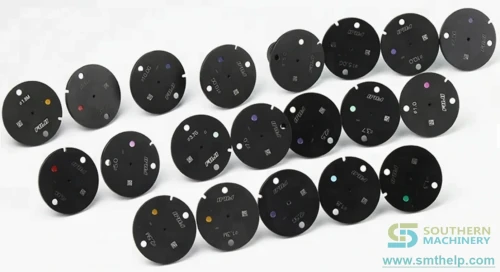
Genuine FUJI nozzles carry an OEM data-matrix and colour-matrix identification code so the head knows which tip sits in which position. A replacement without the correct code can be mis-read, rejected, or silently used at the wrong height or speed, and the reject rate climbs while the program still looks perfect. Southern Machinery reproduces both codes.
Separate the nozzle from the program
Freeze the program and the feeder, fit a known-good nozzle of the correct series, and re-run the same part. If the mispick follows the nozzle, the tip was the cause. If the pick reads true and the part still mispicks, the feeder is the next suspect.
Ceramic, metal or rubber-pad: which FUJI nozzle material should I choose?
Material is a wear-and-grip decision, and the component makes it. Ceramic suits fine-pitch 0201, 0402 and 0603 work: low static, hard and wear-resistant, so the pick centre does not drift. Metal, tungsten or spring steel, suits rugged larger parts where a ceramic edge would chip. Rubber-pad (G) tips grip sensitive bodies and LEDs that a hard tip would mark, and MELF bores at ø1.3M, ø1.8M and ø2.5M hold a glass-bodied part evenly.
What does the FUJI nozzle specification state?
Quoted from Southern Machinery's Fuji Nozzles & Consumables document and cross-referenced against the FUJI NXT head reference.
- NXT heads covered: H01, H04, H04S, H08, H12, H08M and H24.
- Machine series: NXT, CP4, CP6, CP7, CP8, QP, IP-3, XP, AX and GL dispenser.
- Tip diameter window: ø0.3 mm micro-tip up to ø15.0 mm large-component tip.
- Component coverage: 0201, 0402, 0603, 1005, 1608, 2012, 3216, 4532, MELF, SOP, QFP, IC and LED.
- Part-number format: FU-AAxxxxx NXT series; CP, QP and IP assemblies R, S, M and B coded.
- Tip variants: standard, MELF (M/ML), rubber-pad (G), single bore and double bore.
- Tip materials: ceramic; metal in tungsten and spring steel; rubber pad; fluorescent and black bodies.
- Identification: OEM data-matrix and colour-matrix code reproduced natively.
- Shank and fit: dimensional match to the head holder - drop-in, no head rework, no re-teaching.
- Custom design: a documented 5-day design service from a part photograph, no CAD drawing required.
- MOQ and lead time: single piece to full production batch; documented one-day lead time on the standard family.
- Other brands supported: Yamaha, JUKI, Panasonic NPM, ASM/Siemens, Hitachi and custom.
FUJI nozzle vs genuine OEM: cost and quality
Genuine FUJI nozzles are expensive and often carry long lead times, so factories run them past their useful life rather than stop a head - a false economy, because one stopped head costs more in an hour than a matched set of nozzles. What matters is the matching discipline, not the brand.
- Fit: dimensional match to the head holder, so no re-tramming and no re-teaching.
- Identification: the OEM data-matrix and colour-matrix code is reproduced.
- Verification: tip diameter, bore, concentricity, matrix code and shank fit checked before ship.
- Supply: single piece to full production batch, with a one-day lead time on the standard family.
- Coverage: the programme also covers Yamaha, JUKI, Panasonic NPM, ASM/Siemens and Hitachi.
- Warranty: against manufacturing defects, per the quoted order terms.
How do FUJI SMT nozzles fit into a complete PCB assembly line?
A nozzle is a spare-part layer, so integration is about what sits around the placement head. Southern Machinery covers the SMT machine range, the THT machine range, the board handling system and the odd-form insertion machines that frame those heads. The nozzles sit inside the wider FUJI spare parts and SMT nozzle ranges, and the full mapping is published in the SMT Nozzle Supplier document. Changing the standard NXT head filters on schedule and cleaning the vacuum channel between swaps stretches tip life honestly, instead of running a worn tip until it fails mid-shift.
What does a FUJI nozzle spares programme actually save?
Nozzle savings are purchase price plus changeover downtime, and both lines are driven by your own numbers:
Annual purchase saving  = nozzles replaced per year x (OEM price - Southern price) x share switched
Annual downtime avoided = changeover hours saved per year x downtime cost per hour
Total annual saving     = annual purchase saving + annual downtime avoided
A worked example - illustrative placeholder inputs, not a quotation. Take a line that replaces 150 FUJI NXT nozzles a year, at a placeholder OEM price of $120 against a placeholder Southern price of $65, switching 60 percent of that spend: 150 x ($120 - $65) x 0.60 = $4,950 of purchase saving. If the programme also avoids 40 changeover hours at a placeholder $60 an hour, the downtime line adds $2,400, for $7,350 in total. The source calculator hard-codes no price; its defaults are placeholders for the arithmetic, not claims about your factory. Treat these figures as an example only - they depend on configuration and are subject to final technical confirmation.
The method deliberately leaves out the harder-to-prove savings: fewer tombstoned and skewed parts, the rework and scrap they cause, and the reject spikes a drifting nozzle hides until reflow.
Frequently asked questions
Do these nozzles fit genuine FUJI NXT heads? Yes. The shank and holder interface are matched dimensionally to the OEM nozzle for the head you run, and the matrix codes are reproduced so the head recognises it.
What is the minimum order and the lead time? From a single replacement piece to a full production batch. The standard family carries a documented one-day lead time; custom tips follow the quoted schedule.
Can you make a nozzle that is not in the list? Yes. The documented 5-day design service starts from a photograph, not a drawing: send the part, the board and your daily volume, and a nozzle concept follows - geometry, bore, material, matrix code and head interface.
How do I find my FUJI nozzle part number? It is normally laser-marked on the nozzle body - a FU-AAxxxx NXT prefix - or listed in your spares register, and the tip diameter (ø0.7, ø1.3, ø2.5) is printed on the flange. If it has worn off, the head model, the head position, the component you place and a clear photo are enough to cross-reference it.
Do you supply nozzles for other mounters? Yes. The same capability covers Yamaha, JUKI, Panasonic NPM, ASM/Siemens and Hitachi nozzles, plus customised gripper and vacuum tips.
How do I get more life out of a FUJI nozzle? Keep the vacuum channel clean, change the NXT head filters on schedule and track cycle counts, then swap from a named part number rather than waiting for a reject spike.
Next step
Send the machine model, the head position and the part number printed on the nozzle - or a clear photograph of the tip and flange. Southern Machinery will match it against the FUJI taxonomy, confirm the tip, bore, material and matrix code for the component you place, and quote a matched replacement. Email info@smthelp.com or message WhatsApp +86 13602562576.
Shenzhen Southern Machinery Sales and Service Co., Ltd. has supplied SMT and THT automation equipment, spare parts and nozzles for smart EMS factories worldwide since 2011.
Comments