
DVD Player PCB Assembly: Automating Radial and Odd-Form Insertion on the DIP Line
Hand insertion still sets the pace on DVD player PCBA lines. See how automated radial and odd-form insertion machines stabilize DIP assembly output.
Sep 16, 2026 · Updated Sep 16, 2026 · Southern Machinery
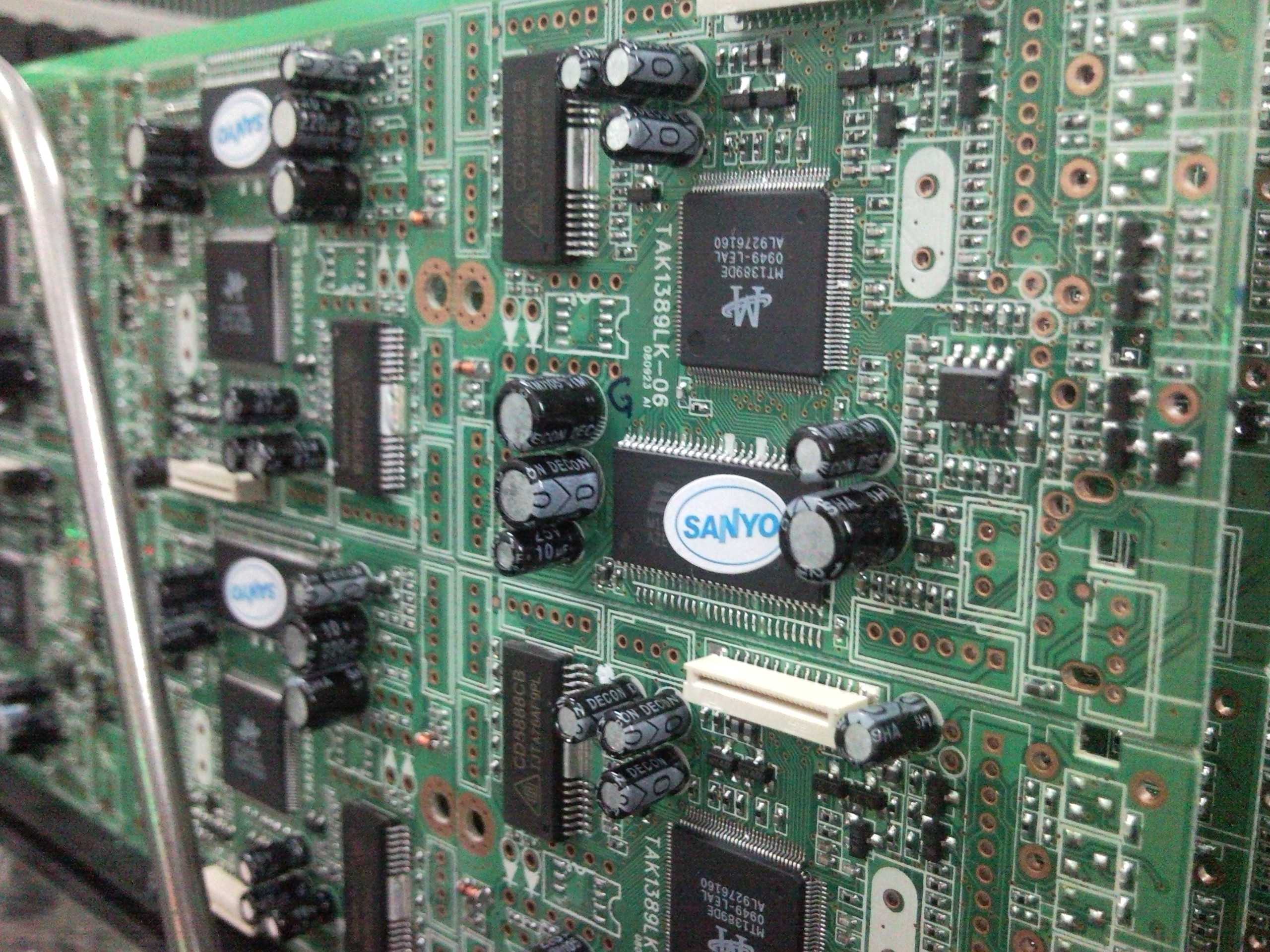
DVD Player PCB Assembly: Automating Radial and Odd-Form Insertion on the DIP Line
DVD and disc-player mainboards are a classic mixed-technology board. The tuner, decoder and memory sections sit on SMDs, while the parts that carry real current and real weight — electrolytic radial capacitors, transformers, relays, jacks and connectors — are through-hole. On most DVD player PCBA lines, that second half is still hand-inserted, and it is the hand insertion, not the pick-and-place, that sets the line's real output.
This page walks through how radial and odd-form auto insertion machines close that gap on a disc-player DIP line, what the machines actually do, how they connect to wave soldering, and what to confirm before you specify one.
Watch a radial DVD board being auto inserted
What is this machine used for?
A radial auto insertion machine sequences and inserts through-hole radial components — electrolytic capacitors, radial-leaded resistors and similar parts — into pre-programmed hole positions at production speed, then clinches the leads under the board so the part stays seated for wave soldering. On a DVD player mainboard this covers the bulk of the electrolytic capacitor population.
An odd form insertion machine handles the components that do not fit a standard radial or axial tape format: connectors, transformers, relays, fuse holders, terminal blocks and mechanically special-shaped parts. These are the components that most often stay in a manual cell, because they arrive in tubes, trays or bulk rather than on tape.
Together they replace the manual plug-in cell on the DIP side of a mixed-technology board — the same function Southern Machinery has been building for electrical appliances, power supplies, LED drivers and audio/video boards since 2011.
Typical Application Scenarios
- Consumer audio/video electronics — DVD and disc players, set-top style video boards, amplifier and receiver mainboards, where electrolytic capacitors, transformers and RCA/connector blocks dominate the through-hole population.
- EMS and ODM factories running mixed SMT/THT lines, where the DIP side is the last manual bottleneck after pick-and-place, reflow and AOI have already been automated.
- Electrical appliances — air conditioners, TVs, microwave and small-appliance control boards, where radial electrolytics and relays are inserted in volume.
- Power supplies and adapters — vehicle power supplies, energy-saving power supplies and ballast boards, where odd-form components carry the mains-side current.
- LED lighting and display boards — driven boards that combine a radial capacitor population with odd-form wire and connector parts.
Across these segments the pattern is identical: an SMT side that is already fast, feeding a through-hole side that is not.
How It Integrates into a Complete PCB Assembly Line
A radial or odd-form insertion machine sits upstream of wave soldering in the THT flow, not beside it. The standard sequence is:
- Solder paste printing and SMT placement for the surface-mount portion of the DVD board.
- Reflow soldering and AOI to close out the SMT side.
- Radial insertion for the tape-reeled radial capacitor population.
- Odd form insertion for connectors, transformers, relays and remaining special-shaped parts.
- Wave soldering (a dual-wave lead-free machine in a modern line) for the through-hole joints.
- Post-solder cleaning and inspection — inline PCBA cleaning where flux residue matters, plus AOI or X-ray downstream.
The handshake between stations is the part that determines whether this actually runs unattended. Southern Machinery's insertion machines support SMEMA communication with adjacent conveyors, so the existing wave soldering, cleaning and conveyor hardware does not need to be replaced to add insertion upstream of it.
For lines that need to change over between multiple board variants, the insertion head and sequencer configuration are programmed per product rather than tooled per product — which is what makes a mixed-model DVD/appliance line practical.
Key Selection Parameters
The exact configuration depends on your board, so confirm these points with a supplier rather than assuming a catalogue number:
- Component types and package formats — which parts on your board are radial tape, which are odd form, and how each arrives (tape, tube, tray, bulk).
- Board size, thickness and panel format — including whether you run single boards or multi-up panels.
- Insertion span requirements — Southern Machinery's S-3000 radial platform publishes lead span capability up to 10 mm, with single, dual, triple and quad span variants.
- Sequencer capacity and changeover — the S-3000 platform publishes over 100 available inputs on an expandable sequencer, and allows component replenishment without stopping the machine.
- Loading method — manual PCB load or automatic load/unload, depending on whether the machine runs standalone or inline.
- Clinch options and component verification — the clinch style determines hole fill and joint quality after wave soldering; a component verifier adds a check before insertion.
- Facility fit — power, air and footprint. Be explicit about available floor space: odd-form cells generally need a clear working envelope around the machine.
- Compliance documentation — request the RoHS documentation for the specific model you are quoted (a RoHS-listed radial variant exists on the S-3000 platform, for example, but confirm the exact configuration being offered to you).
ROI, Quality & Throughput Perspective
The business case for automating the DIP side is not about peak speed — it is about removing variability.
Southern Machinery's published figures on hand insertion put a single odd-form component at 4 to 10 seconds to insert by hand, depending on how familiar the operator is with that part. On a run of 5,000 boards with four odd-form components each, that spread alone accounts for roughly 8 to 16 hours of unplanned labour per shift. Machines do not have a fast day and a slow day.
Quality is where the return compounds:
- A single non-seated pin on a 6–10 pin transformer can produce a field failure whose repair cost is cited at 20 to 50 times the board's assembly value.
- Odd-form rework runs about 3 to 5 minutes per board and frequently damages adjacent components in the process.
- Common manual defects — floating high, leakage, misinsertion and reverse insertion — are position and force errors, which is exactly what a programmed insertion position and a component verifier are designed to catch.
Consistency also protects the SMT investment. An SMT line that has been optimized for speed and first-pass yield loses that advantage if the DIP cell behind it ships boards with intermittent through-hole joints.
Is auto insertion the right fit for your run?
Southern Machinery's own fit criteria are worth applying honestly before you invest:
- Good fit: 500+ boards per run with repeat orders; standard odd-form component families (connectors, transformers, relays, fuse holders, terminal blocks); several PCB variants that share component families.
- Poor fit: fewer than 100 boards per run; components with hand-wound coils or lead protrusion beyond 2.5 mm; installations with under 2 m² of floor space available.
If your DVD or appliance board profile sits in the first group, the payback case is straightforward. If it sits in the second, a semi-automatic station is usually the more sensible step.
FAQ
What is a radial auto insertion machine used for?
It inserts tape-reeled radial components — most commonly electrolytic capacitors and radial-leaded resistors — into a PCB at programmed hole positions and clinches the leads before wave soldering. It replaces the manual plug-in step for that component population.
What is the difference between radial insertion and odd form insertion?
Radial insertion handles components supplied in standard radial tape format. Odd form (also called special-shaped) insertion handles components that arrive in tubes, trays or bulk — connectors, transformers, relays, fuse holders and terminal blocks — which generally cannot be fed from a radial tape feeder.
Does an insertion machine integrate with an existing SMT and wave soldering line?
Yes. Insertion machines sit upstream of wave soldering and use SMEMA communication to hand off boards to adjacent conveyors, so existing wave soldering, cleaning and conveyor equipment is normally retained rather than replaced.
Which industries use radial and odd-form insertion machines?
Consumer audio/video electronics (DVD and disc players), home appliances, power supplies and adapters, LED lighting and displays, automotive electronics and general industrial control boards — anywhere a mixed SMT/THT board carries a significant through-hole component population.
How does automation improve quality compared with manual insertion?
Manual insertion defects are position and force errors: parts floating high, misinserted or reversed, and pins that are not fully seated. Programmed insertion positions, controlled insertion force and component verification reduce those errors, and each board is built to the same parameters regardless of operator experience.
Can I see these machines running before I specify one?
Yes. Southern Machinery publishes product videos for radial and odd-form insertion, including DVD player PCBA assembly runs, and can arrange a demonstration plus a configuration review against your actual board.
Contact Southern Machinery for Configuration Advice
Southern Machinery (Shenzhen Southern Machinery Sales And Service Co., Ltd) has built SMT and THT PCB assembly automation equipment from Shenzhen, China since 2011, serving 237+ customers worldwide. Beyond insertion machines, the range covers wave soldering, board handling, cleaning, dispensing, depaneling and inspection — which means an insertion recommendation can be made against the whole line rather than in isolation. Spare parts, retrofit kits, training and overhaul support are part of the standard offering.
Tell us your DVD player or appliance board: component list, board size, run quantity and current DIP throughput. We will come back with a configuration recommendation and the selection parameters to confirm.
- Contact: Jason Wu — jasonwu@smthelp.com
- Website: https://www.smthelp.com
- Machine photos: https://ph.smthelp.com
- Product catalogues: https://file.autoinsertion.com
Comments