
Desktop Solder Robot Family: S-C5331R Dual-Table & S-HX331R Four-Axis Rotary by Southern Machinery
Hand-soldered THT joints are where quality quietly leaks out of an EMS line: tip temperature drifts, dwell time varies, and defects only show up at electrical test. Southern Machinery's desktop solder robot family puts that discipline on a machine. The S-C5331R dual-table robot runs two work tables in one cycle for steady same-board volume, while the S-HX331R four-axis rotary robot adds a 360-degree R axis, 0–800 mm/s travel, ±0.02 mm repeatability and RS232 control for angled and rotary joints. Both offer 0–500 °C temperature control, high-precision tin feeding, teaching-box programming and no compressed air requirement. Replace manual soldering stations, cut rework and build a repeatable THT soldering cell inside your PCB assembly line.
Aug 27, 2026 · Updated Aug 27, 2026 · Southern Machinery
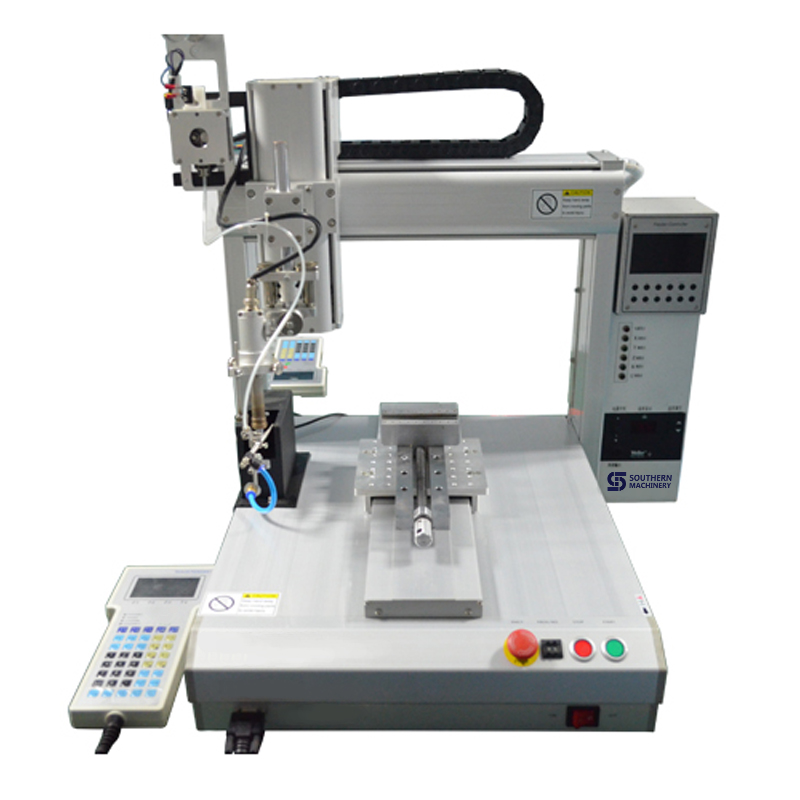
Desktop Solder Robot Family: S-C5331R Dual-Table & S-HX331R Four-Axis Rotary by Southern Machinery
Every hand-soldered joint is a quality lottery: the same solder, the same iron, different hands. Tip angle, dwell time and feed rate drift with every operator and every hour, and cold joints or bridges only become visible at electrical test. Southern Machinery's desktop solder robot family moves that variability from the operator to the machine — with the S-C5331R dual-table robot for steady same-board volume and the S-HX331R four-axis rotary robot for angled and high-mix work.
What is this machine used for?
The S-C5331R and S-HX331R desktop solder robots automate the soldering step in THT and mixed PCBA production: spot soldering, drag soldering and rotary soldering with 0–500 °C temperature control, high-precision tin feeding and handheld teaching-box programming. Instead of relying on operator skill, the robot repeats the same temperature, path and feed rate on every board — the control discipline of an SMT line, at bench scale.
Why hand soldering is the weak point of a THT line
Manual soldering benches leak quality, labor and material at the same time:
- Cold joints and bridges — insufficient heat makes dull, grainy joints; excess heat bridges adjacent pads. Both are invisible until electrical test.
- Tip temperature guesswork — irons cool under load, and operators compensate by pressing harder or waiting, which degrades the joint.
- Training and turnover — a good solderer takes months to train, and the skill walks out the door.
- Wire and tip waste — solder wire is overfed by hand and tips are burned by over-temperature.
- Throughput capped by headcount — output scales with people, and skilled soldering labor is getting harder to find.
Two robots, two ways to scale
S-C5331R dual-table desktop solder robot
Two work tables run in one cycle, so the operator loads one table while the robot solders the other. The S-C5331R covers spot and drag soldering with X/Y1/Y2/Z axes, 0–400 mm/s movement, and a rotatable option for angled joints — a productivity choice for steady volume on the same board type.
S-HX331R four-axis rotary robot
The S-HX331R adds a Z + R rotary axis with 360-degree rotation, 0–800 mm/s movement and ±0.02 mm repeat accuracy, with 3-axis interpolation and program capacity of more than 100 sets. It feeds tin and breaks oxidized wire (solder breaker option), supports RS232 external control, and records production with DVR video, remote control and HDMI output.
Quick comparison (official Southern Machinery datasheets)
| Parameter | S-C5331R (dual table) | S-HX331R (four-axis rotary) |
|---|---|---|
| Work tables | 2 | 1 |
| Effective travel | X 300 mm · Y 300 mm | X 300 · Y 300 · Z 100 mm · R 360° |
| Movement speed | 0–400 mm/s | 0–800 mm/s |
| Temperature range | 0–500 °C | 0–500 °C (±2 °C) |
| Solder feed | High-precision tin feeding | Feed tin + broken tin (solder breaker) |
| Soldering methods | Spot solder, drag solder | Various methods incl. rotary |
| Repeat accuracy | ±0.02 mm | ±0.02 mm |
| Program capacity | — | 100+ sets, 3-axis interpolation |
| Control interface | HD teaching box | Teaching box + RS232 external control |
| Max load | — | 15 kg |
| Power | 220 V | Full-voltage AC110–220 V |
| Dimensions / weight | — | 530×580×650 mm · 69 kg (S-C5331R 68 kg) |
Specification values come from the official Southern Machinery S-C5331R and S-HX331R datasheets; final configuration is confirmed after technical review of your boards, joint types and volume.
Typical application scenarios
The family is designed for mixed THT work where hand soldering is currently the bottleneck: ICs, PCBs, LCDs, relays, loudspeakers, USB connectors, LED strips, terminals and automotive parts. Typical floor setups include:
- EMS high-mix lines — quick program changes between board types without retraining operators.
- Automotive electronics — repeatable joints on connectors, relays and terminal blocks where traceability matters.
- Medical and industrial control — dense, fine-pitch boards where ±0.02 mm repeatability protects sensitive assemblies.
- Bench-to-line migration — turning a manual soldering station into a supervised robot cell while keeping the same footprint.
How to integrate the family into a complete PCB assembly line
The robots slot in as flexible soldering cells between THT insertion and test:
- SMT front end — stencil printer, pick-and-place and reflow produce the SMD side of the board.
- THT insertion — radial, axial or odd-form insertion places through-hole components.
- Soldering cell — the desktop solder robot joins the THT joints; the dual-table configuration lets the operator load while the robot solders.
- Volume soldering — for higher volumes, Southern Machinery also offers desktop and inline selective soldering and automatic dip soldering.
- Board handling and inspection — conveyors, buffer and inspection stations move boards through the rest of the line.
The S-HX331R's RS232 external control supports integration into automated cells, and no compressed air is required for standard operation — 220 V mains power (full-voltage AC110–220 V on the S-HX331R), soldering wire, tips and a stable workbench with your PCB fixture are enough. Southern Machinery supplies SMT, THT, wave soldering, board handling and inspection equipment as one complete-line partner.
Key selection checklist
- Board and travel — compare X/Y/Z travel and maximum board size against your panel mix.
- Joints per board — decide single-head or dual-head, and single, dual or back-to-back tables.
- Soldering methods — spot and drag on the S-C5331R; rotary and angled access on the S-HX331R.
- Speed and accuracy — 0–400 mm/s vs 0–800 mm/s, ±0.02 mm repeat accuracy.
- Temperature control — 0–500 °C with fast tip recovery.
- Drive type — stepper for standard joints, servo for fine-pitch and dense work.
- Utilities — 220 V power; no compressed air for standard operation.
- Options — protective cover, solder breaker, cleaning box, custom tips and PCB fixtures designed from your samples.
ROI, quality and capacity value
The business case is a reference estimate that depends on your board mix, joint count and volume — Southern Machinery will prepare a line-specific ROI calculation, typically within 24 hours of your inquiry:
- Labor — one desktop solder robot replaces at least three manual soldering stations in typical dual-table setups (1 robot ≥ 3 workers, verified on the S-HX331R).
- Quality — automated soldering operates in the ≤2‰ reject-ratio class, subject to board and process validation, because temperature is controlled to ±2 °C and the tip returns to set point quickly.
- Capacity — a reference cycle of about 27 seconds solders 18 pads across both S-C5331R tables, depending on board layout and joint configuration.
- Supervision — one operator can supervise several robots, removing the soldering bench from the critical headcount path.
FAQ
What can a desktop solder robot replace?
A single robot replaces at least three manual soldering stations in typical setups. It handles spot, drag and rotary soldering on ICs, PCBs, LCDs, relays, loudspeakers, USB connectors, LED strips, terminals and automotive parts — removing the hand-soldering quality lottery from the line.
Which robot should I choose: S-C5331R or S-HX331R?
Choose the S-C5331R dual-table robot when you have steady volume of the same board and want the highest output per station — two tables run in one cycle. Choose the S-HX331R four-axis rotary robot when joints need angled or rotary access, higher speed (0–800 mm/s) or external RS232 control. Send your boards and Southern Machinery will recommend the configuration.
How is a new product programmed?
With the handheld teaching box: set the soldering temperature (0–500 °C), teach the solder path point by point, and store the program. The S-HX331R stores more than 100 programs with 3-axis interpolation.
What utilities does a solder robot need?
220 V mains power (full-voltage AC110–220 V on the S-HX331R). No compressed air is required for standard operation. Prepare soldering wire, tips and a stable workbench with your PCB fixture.
What defect rate can I expect?
On the S-HX331R the verified reject ratio is ≤2‰; because temperature is controlled to ±2 °C and the tip returns to set point quickly, cold joints and over-burn — the two most common hand-soldering defects — are eliminated at the source. Final results depend on your board, solder alloy and process setup.
How do I get a quote and ROI estimate?
Email info@smthelp.com or WhatsApp +86 136 0256 2576 with your board samples or drawings, joint count per board and monthly volume. Southern Machinery replies with a robot recommendation, configuration, quotation and ROI estimate — typically within 24 hours.
Next step: send your boards for a soldering demo
Tell Southern Machinery which boards you hand-solder today, the joint count per board and your monthly volume. You will receive a robot recommendation, configuration options and a payback estimate within 24 hours.
Founded in 2011 in Shenzhen, China, Southern Machinery serves 237+ customers worldwide with high-efficiency, cost-effective SMT and THT PCB assembly automation equipment. Beyond desktop solder robots, the company provides SMT, THT, wave soldering, board handling and inspection equipment for complete-line solutions, backed by global service, spare parts support and professional training.
Request a quote: [info@smthelp.com](mailto:info@smthelp.com) · WhatsApp +86 136 0256 2576 · www.smthelp.com
Comments