
Custom Feeders and Nozzles for SMT & THT Lines from Southern Machinery
Odd-form components, tube-packed parts, labels, and fragile special parts can turn an otherwise capable SMT/THT line into a manual bottleneck. This Southern Machinery guide explains how customized axial, radial, tube, bo
Jul 2, 2026 · Updated Jul 2, 2026 · Southern Machinery
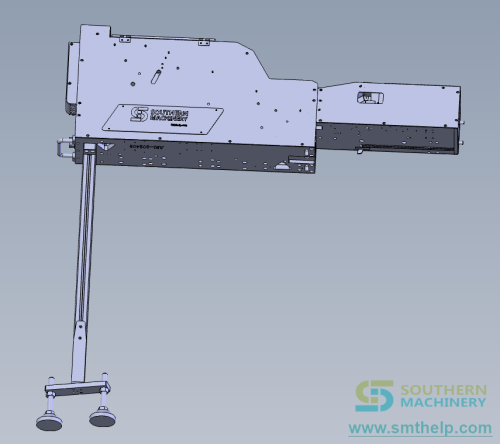
Custom Feeders and Nozzles for SMT & THT Lines from Southern Machinery
When a PCB assembly line starts handling odd-form components, tube-packed parts, radial or axial parts, labels, or fragile special components, standard feeders and nozzles often become the limiting factor. This article draws on Southern Machinery's range of customized feeder and nozzle solutions for SMT and THT production—including axial tape feeders, radial tape feeders, tube feeders, bowl feeders, label feeders, and custom nozzles or grippers.
Founded in Shenzhen, China in 2011, Southern Machinery specializes in SMT/THT PCB assembly automation. For global EMS, ODM, automotive electronics, medical electronics, and industrial control manufacturers, we support complete line planning covering SMT, THT automation, wave soldering, board handling, inspection, material flow, spare parts, and professional training.
What is this equipment used for?
A customized feeder and nozzle solution comes into play when standard SMT feeders, standard nozzles, or manual loading cannot reliably present a special component to the placement or insertion process. Instead of relying on operators to hand-place difficult parts, the feeder prepares the component and the nozzle or gripper picks it in a repeatable, controlled manner.
Typical use cases include:
- Axial components such as resistors, diodes, and similar taped THT parts.
- Radial components that require feeding, shaping, or cutting before placement or insertion.
- Tube-mounted parts like DIPs, transistors, and connector-type devices.
- Bulk or odd-form components that need sorting and orientation before robotic handling.
- Labels, QR codes, or FPC reinforcement sheets where repeatable placement supports traceability.
- Custom nozzles and grippers for special SMT or THT parts that are difficult to handle with standard tooling.
Why standard feeding often falls short for smart EMS factories
A modern SMT line may already boast a fast pick-and-place machine, stable reflow oven, and inline AOI. The issue arises when the product mix includes parts not designed for standard tape-and-reel feeding. Operators then compensate with manual feeding, manual placement, or unstable temporary tooling.
This creates several practical risks:
- Production speed depends on operator skill rather than a controlled process.
- Component orientation becomes inconsistent.
- Fragile or odd-shaped parts may be damaged during pickup.
- Changeover times increase when each product requires manual adjustments.
- Traceability suffers when labels or special parts are handled outside the normal line flow.
Southern Machinery's approach is to engineer the feeder and pickup tooling together. The final configuration depends on the component package, lead shape, pickup surface, host machine interface, required output, and inspection plan.
Main feeder and tooling options from the source document
SAF1001 axial tape feeder
The SAF1001 Axial Tape Feeder is designed for taped axial components. It supports automated insertion workflows and can include component preparation such as forming or U-shaping when needed.
For buyers, the key takeaway isn't just the feeder name. The critical question is whether the axial component can be reliably advanced, prepared, presented, picked, and inserted without damaging the leads.
SRF1001 radial tape feeder
The SRF1001 Radial Tape Feeder handles radial components, with functions for automated feeding, shaping, cutting, and customization for odd-form parts.
This feeder is relevant for products like power supplies, LED drivers, industrial control boards, and other assemblies using radial capacitors, LEDs, or similar THT components.
STF1003 tube feeder
The STF1003 Tube Feeder serves tube-mounted components, including DIPs and transistor-style parts. For high-mix EMS production, tube feeding reduces repetitive manual loading and makes pickup more consistent.
SBF1001 bowl feeder
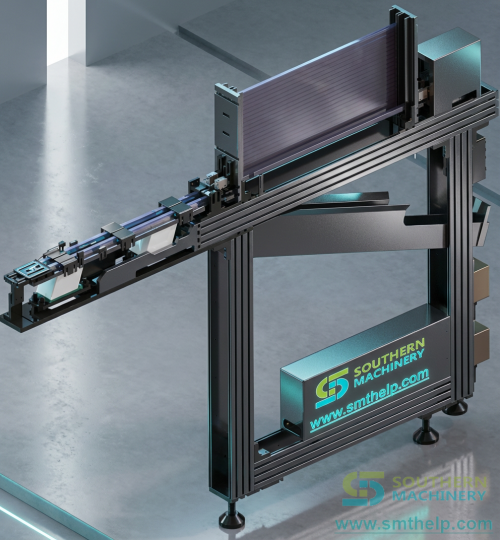
The SBF1001 Bowl Feeder handles bulk component feeding, sorting, and screening. It is useful when parts arrive loose rather than in tape or tube format. The final recommendation depends heavily on component geometry, orientation requirements, noise tolerance, and changeover needs.
SLF1001 label feeder
The SLF1001 Label Feeder is designed for QR labels and FPC reinforcement sheets. It is especially valuable when the production line needs barcode traceability, MES data collection, or repeatable label placement without manual error.
Custom nozzles and grippers
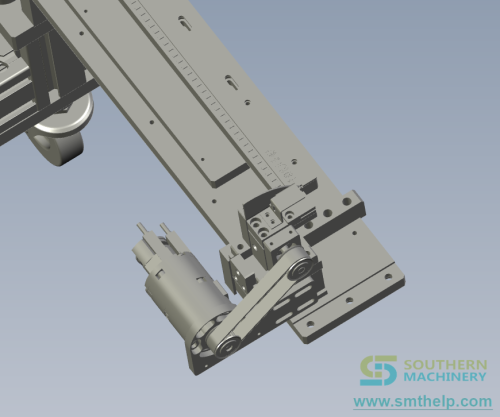
The range also includes custom nozzles and grippers for odd-form components, THT parts, and special applications. In practice, the pickup tool must match the component's size, surface, center of gravity, fragility, and placement orientation.
How this fits into a complete PCB assembly line
Customized feeders and nozzles are not isolated accessories; they should be planned as part of the entire PCB assembly process.
A typical Southern Machinery integration discussion might include:
- SMT section: loader, stencil printer, pick-and-place machine, reflow oven, AOI, and conveyors.
- THT section: radial insertion, axial insertion, odd-form insertion, or manual assist stations.
- Soldering section: wave soldering or selective soldering, depending on product design.
- Board handling: loader, unloader, conveyors, buffers, PCB inverter, and NG/OK sorting.
- Inspection and traceability: barcode scanning, label feeding, AOI, ICT/FCT, MES connection, and data collection.
For instance, a factory producing industrial control boards might use SMT placement for chip components, a custom tube feeder for connector-related parts, a radial feeder for THT capacitors, and wave soldering after insertion. The optimal solution is a line configuration, not just a single feeder.
Key selection parameters to confirm
Before Southern Machinery can match the right feeder, nozzle, or gripper configuration, the engineering team should confirm:
- Component supply format: tape, tube, bulk, tray, label roll, or custom packaging.
- Component body size, lead shape, pitch, weight, and pickup surface.
- Whether the component requires cutting, bending, forming, or orientation before pickup.
- Host equipment brand and interface requirements (e.g., SMT mounter, odd-form inserter, SCARA robot, or custom station).
- Required output per shift and acceptable cycle time.
- PCB size, panelization, product mix, and changeover frequency.
- Quality targets and inspection method after placement or insertion.
- Need for barcode, MES, or traceability integration.
- Maintenance access, spare tooling, and operator training requirements.
Without these details, any exact model selection would be guesswork. The safe approach is to first define the component handling process, then match the feeder and pickup tooling from Southern Machinery's catalog or custom engineering options.
ROI, quality, and capacity value
A customized feeder/nozzle project typically creates value in three areas.
Labor reduction
Manual loading, hand placement, and operator corrections can be reduced when the feeder presents components consistently. Actual labor savings depend on current manual steps, production volume, and line balance, so ROI should be calculated from real factory data.
Quality stability
The biggest benefit is often repeatability. Stable component presentation and suitable pickup tooling reduce mis-picks, part damage, orientation errors, and placement variation.
Line capacity
If a special component slows down the entire SMT/THT line, solving that feeding bottleneck can unlock additional capacity from already installed equipment. That's why feeder engineering should be reviewed together with the overall line takt time.
Typical applications
Customized SMT/THT feeder and nozzle solutions are suitable for:
- EMS factories with high-mix products and frequent changeovers.
- Power supply, LED driver, and industrial control board production.
- Automotive electronics lines with special connectors, terminals, or odd-form parts.
- Medical electronics where controlled handling and traceability are critical.
- Smart factory projects needing label placement, barcode flow, and MES-ready material handling.
- Retrofit projects where an existing SMT mounter or robotic cell must process a new component type.
FAQ
Can one customized feeder work for every component?
No. The feeder must match the component package, supply format, body size, lead geometry, and pickup method. Tube feeders, radial tape feeders, bowl feeders, and label feeders solve different problems.
Can Southern Machinery support existing SMT machine brands?
The source document shows examples around common SMT platforms and customized integration. Final compatibility must be confirmed based on the host machine interface, feeder mounting, signal requirements, pickup height, and software constraints.
Should I choose a bowl feeder or a belt/tube/tape feeder?
It depends on how the component is supplied and how much orientation control is needed. Bulk parts may require bowl or belt feeding. Tube-packed ICs are often better handled by tube feeding. Taped axial or radial parts typically need a tape feeder with preparation functions.
Do I need a custom nozzle if I already have a custom feeder?
Often yes. A feeder can present the part, but the nozzle or gripper must still pick it without slipping, damaging the body, or changing orientation. For odd-form parts, feeder and pickup tooling should be designed together.
Can this be integrated with a full Southern Machinery PCB assembly line?
Yes. Southern Machinery can review the feeder or nozzle alongside SMT placement, THT insertion, soldering, board handling, inspection, and traceability requirements, then propose a cost-effective line configuration.
What information should I send for evaluation?
Please send component photos, package drawings, supply format, sample parts if available, host machine model, target output, PCB photos, and a short description of your current manual process or bottleneck.
Talk to Southern Machinery
If your SMT or THT line is slowed down by odd-form components, tube parts, radial/axial parts, labels, or fragile special components, Southern Machinery can help review your component handling process and recommend a practical feeder, nozzle, gripper, or complete line solution.
Share your product type, component photos, target output, PCB size, and current bottleneck. We'll use that information to propose a high-efficiency, cost-effective configuration backed by global service, spare parts support, and professional training.
Comments