
Custom SMT Nozzles and Grippers for Odd-Form PCB Assembly by Southern Machinery
Custom SMT nozzles and grippers help EMS factories automate components that standard vacuum tooling cannot handle reliably, including jumper wires, special connectors, shields, and odd-form parts. Southern Machinery designs customized pickup and gripping solutions for SMT and mixed SMT/THT assembly lines, supporting more stable pickup, cleaner placement, reduced manual intervention, and easier integration with complete PCB assembly automation. Final tooling dimensions, materials, gripping range, and pickup performance should be confirmed against the customer component sample, PCB layout, machine platform, and line takt requirement.
Jul 25, 2026 · Updated Jul 25, 2026 · Southern Machinery

Custom SMT Nozzles and Grippers for Odd-Form PCB Assembly by Southern Machinery
When an SMT line starts handling jumper wires, special connectors, shields, terminals, or other irregular components, the limitation is often not the placement machine itself. The real bottleneck is the contact point between the machine and the component: the nozzle, gripper, or custom pickup tooling.
Southern Machinery's customized SMT nozzle and gripper solutions are designed for these difficult pickup and placement tasks. The source page positions them as precision-engineered tooling for odd-form components, special connectors, unique assembly requirements, and mixed SMT/THT production where standard vacuum nozzles are not enough.
What is this machine used for?
Custom SMT nozzles and grippers are used to automate the pickup, transfer, and placement of components that are difficult to handle with standard SMT tooling. In practical PCB assembly, this includes odd-form components, jumper wires, THT-related parts, connectors, shields, and components with shapes or surfaces that do not create a stable vacuum pickup.
The goal is simple: reduce manual handling, improve placement consistency, and make difficult components fit into a repeatable SMT or mixed-technology assembly process.
Why standard nozzles become a bottleneck
A standard nozzle works well when the component has a predictable shape, stable pickup surface, suitable weight, and enough area for vacuum contact. Odd-form assembly breaks those assumptions.
Typical problems include:
- Poor pickup rate caused by irregular surfaces or unstable center of gravity.
- Components sticking, rotating, or shifting before placement.
- Clogging or contamination in small passages.
- Fragile or sensitive components requiring controlled mechanical support.
- Manual rework around connectors, jumper wires, shields, and special parts.
The selected source page highlights customization, material selection, anti-static properties, self-cleaning or large-passage design concepts, and broad compatibility with SMT platforms including JUKI, FUJI, Panasonic, Yamaha, and Samsung.
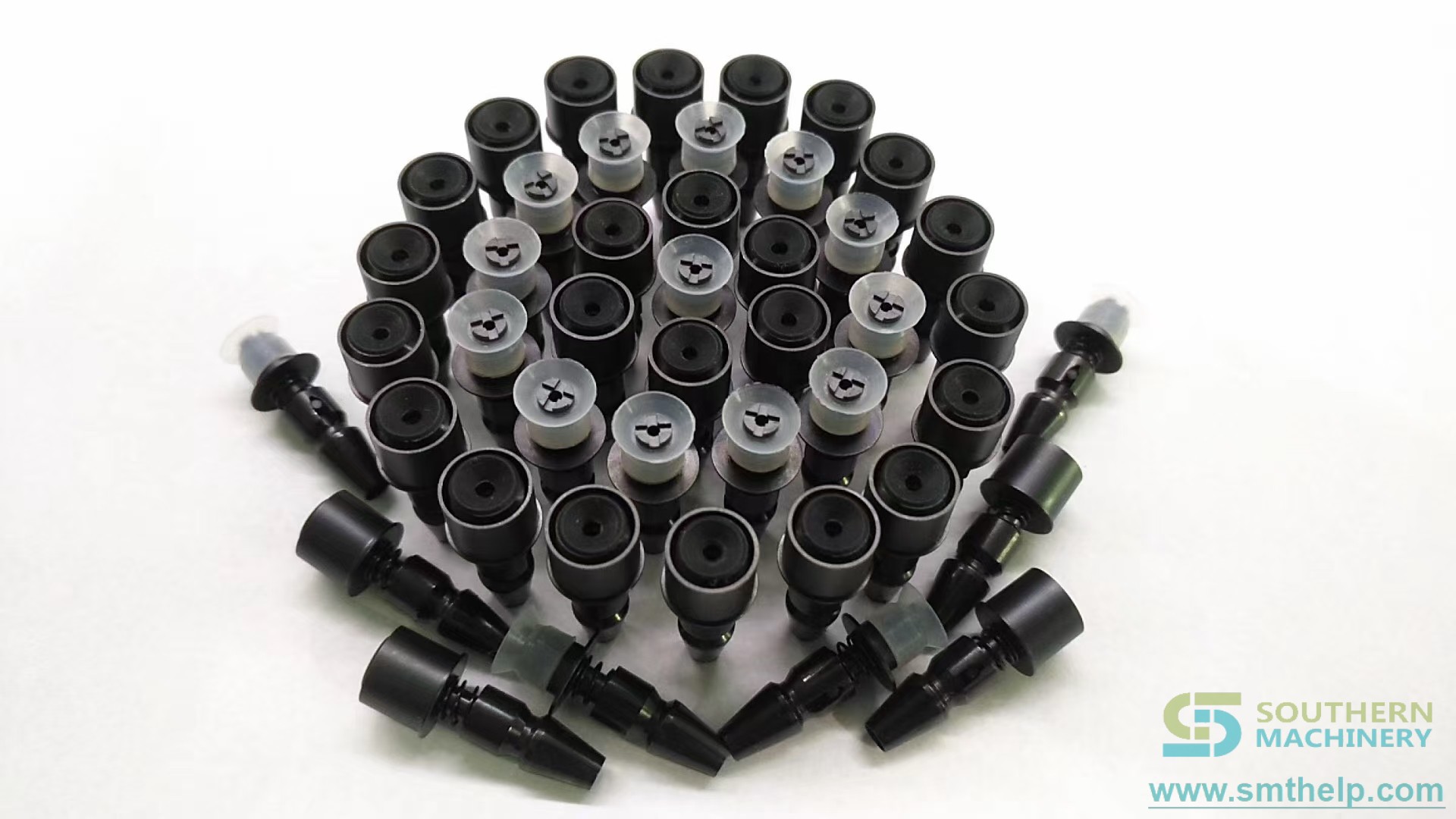
Southern Machinery customized nozzle solutions
Southern Machinery designs customized SMT nozzles around the actual component and production process, instead of forcing every part into a standard catalog nozzle. The source material describes nozzles for jumper wires, special connectors, and other challenging component types.
Key design considerations include:
- Component geometry and available pickup area.
- Vacuum path design and passage size.
- Anti-static requirements for sensitive components.
- Material choice, including ceramic or diamond steel as stated in the source page.
- Machine interface compatibility.
- Placement stability during acceleration, transfer, and final positioning.
The source page states that custom-fit tooling can enhance pickup rates up to 99.99%. This should be treated as a source-page performance claim and confirmed with real component samples, SMT machine settings, feeder condition, board design, and production testing before being used as a project guarantee.
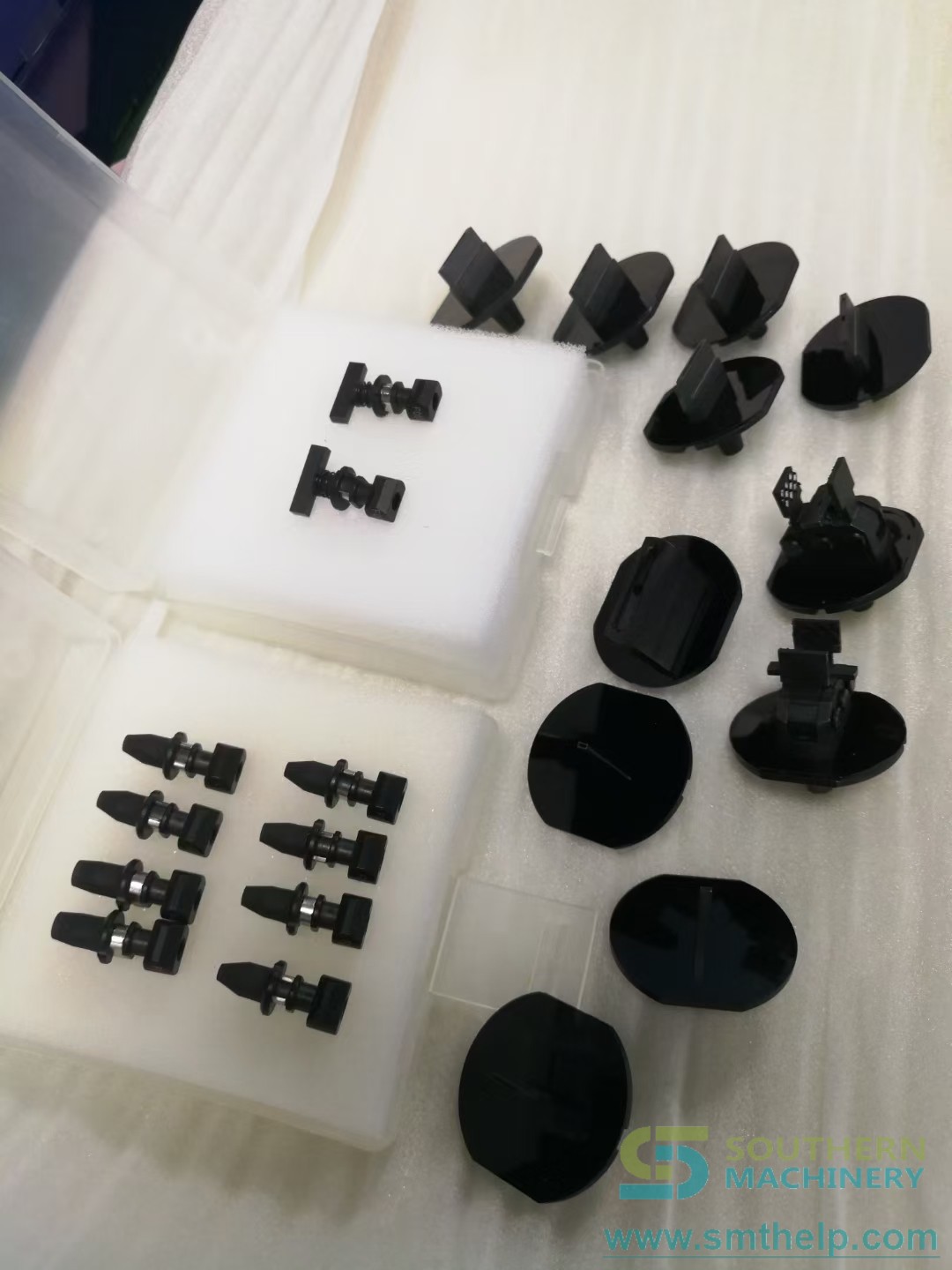
When to use customized grippers instead of vacuum nozzles
For some components, vacuum pickup is not the right mechanical principle. When the component has an uneven surface, limited suction area, higher mass, or a geometry that needs side support, a gripper can be more stable.
The source page describes Southern Machinery custom grippers using a mechanical fixed-and-swing-arm concept for irregular or delicate components. It also lists applications around THT components, connectors, and shields.
Customized grippers are especially useful when:
- The part cannot maintain reliable vacuum contact.
- Orientation control matters during transfer.
- The component is delicate and needs controlled contact points.
- The application needs secure handling before insertion, placement, or downstream assembly.
- The factory wants to reduce manual positioning around difficult components.
The source page mentions a 0.8 mm to 5.2 mm gripping range. Treat this as source-page information that must be checked against the final gripper design and component sample.
Typical application scenarios
Southern Machinery customized SMT nozzles and grippers are suitable for EMS, ODM, automotive electronics, industrial control, power electronics, and mixed SMT/THT assembly environments where component variety is high and manual odd-form handling creates inconsistency.
Common scenarios include:
- Jumper wire pickup and placement.
- Special connector handling.
- Shield and cover placement.
- THT component handling before insertion or soldering.
- Mixed SMT/THT lines where odd-form components interrupt an otherwise automated process.
- Component families that require dedicated tooling to stabilize pickup and placement.
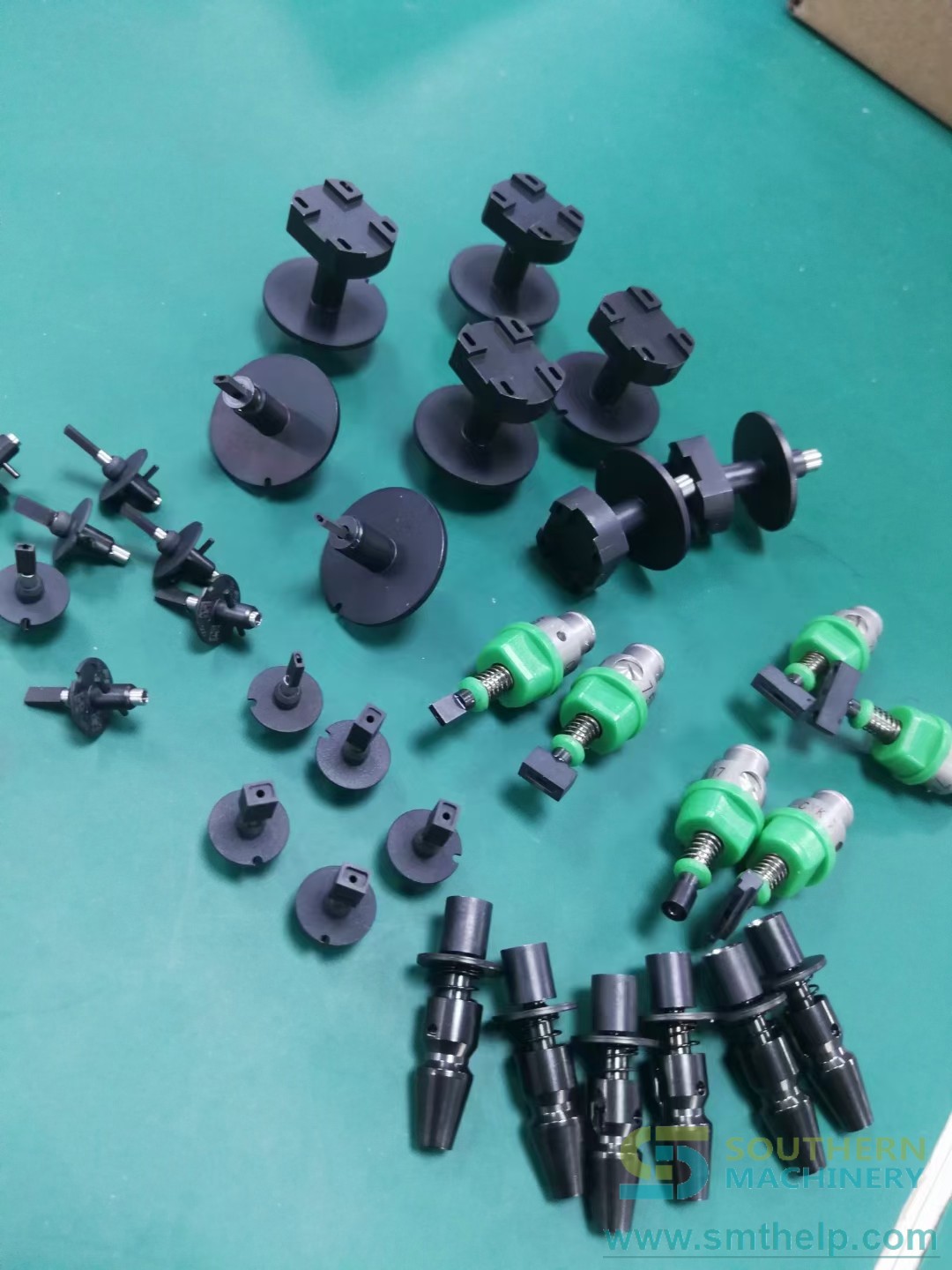
How this fits into a complete PCB assembly line
A custom nozzle or gripper is a small tooling item, but it affects the performance of the whole line. If a difficult component requires manual placement, it can slow the SMT section, create uneven work-in-process, and increase the inspection burden after reflow or soldering.
Southern Machinery can help position customized tooling inside a complete PCB assembly automation plan:
- SMT section: loader, printer, SPI if required, pick-and-place, reflow oven, AOI, and unloading.
- THT section: radial insertion, axial insertion, odd-form insertion, terminal insertion, or manual assist where automation is not yet justified.
- Wave or selective soldering: configured according to board design, component thermal mass, soldering window, and fixture needs.
- Board handling: conveyors, buffers, magazine loaders/unloaders, NG/OK sorting, and line linking.
- Inspection and traceability: barcode scanning, process records, AOI, and MES connection depending on factory requirements.
For factories trying to automate one difficult component family, the practical starting point is to send the component sample, PCB placement location, machine brand/model, feeder condition, and current defect or downtime problem for review.
Key selection parameters for buyers
Before specifying a custom nozzle or gripper, prepare these details:
- Component photos, drawings, and physical samples.
- Component dimensions, weight, material, surface finish, and pickup area.
- Required orientation and placement tolerance from the PCB process.
- Existing SMT machine brand and model.
- Feeder type or current feeding method.
- PCB layout constraints around the placement area.
- Expected output per shift and acceptable downtime target.
- ESD, cleanliness, or material restrictions.
- Whether the part is handled by vacuum, mechanical gripping, or a hybrid concept.
- Validation requirement: trial pickup, placement test, sample board run, or acceptance testing.
These parameters determine whether a vacuum nozzle, mechanical gripper, larger passage nozzle, ceramic contact surface, anti-static material, or a more specific tooling structure is appropriate.
ROI, quality, and capacity value
The business case for customized tooling usually comes from several measurable improvements:
- Less manual intervention around difficult components.
- More stable pickup and placement repeatability.
- Lower rework caused by skewed, dropped, or incorrectly seated parts.
- Better line balance when odd-form tasks no longer interrupt automated flow.
- Reduced operator dependency for special components.
- Easier scaling when a product family moves from pilot production to volume manufacturing.
ROI should not be calculated from tooling cost alone. The real comparison is the total cost of manual handling, downtime, rework, quality variation, and delayed throughput. Final payback depends on product mix, component complexity, output target, labor cost, and line utilization.
Why work with Southern Machinery?
Southern Machinery was founded in Shenzhen, China in 2011 and focuses on high-efficiency, cost-effective SMT and THT PCB assembly automation equipment. The company supports more than 237 global customers and can provide not only single-machine recommendations, but also full-line planning across SMT, THT insertion, wave soldering, board handling, inspection, and traceability.
For customized nozzles and grippers, this matters because tooling must work with the real production line, not only look correct in a drawing. Southern Machinery can review the component, machine platform, feeding condition, and full process flow before recommending a tooling direction.
FAQ
Can one customized nozzle handle every odd-form component?
No. A custom nozzle or gripper should be matched to the component geometry, surface condition, machine interface, and required placement stability. Similar components may share tooling, but this must be confirmed by testing.
Is a gripper always better than a vacuum nozzle?
No. Vacuum nozzles are efficient when the pickup surface is stable. Grippers are useful when vacuum contact is unreliable or when the component needs mechanical support. The right choice depends on the component sample.
Can Southern Machinery design tooling for JUKI, FUJI, Panasonic, Yamaha, or Samsung machines?
The source page states broad compatibility with leading SMT machine brands including JUKI, FUJI, Panasonic, Yamaha, and Samsung. Final interface confirmation should be made against the exact machine model and nozzle holder.
What information is needed for a quotation?
Send component drawings or samples, photos, PCB placement location, current machine model, feeder method, production target, and the current pickup or placement problem. This allows the tooling design to be reviewed with fewer assumptions.
Can this tooling be part of a full SMT/THT automation project?
Yes. Southern Machinery can integrate customized nozzles and grippers into broader SMT, THT insertion, wave soldering, board handling, inspection, and traceability solutions, depending on the factory's automation level and budget.
Are pickup rate and gripping range guaranteed?
The source page includes performance and range statements, including up to 99.99% pickup rate and 0.8 mm to 5.2 mm gripping range. These should be confirmed through component-specific design review and production validation before being treated as final project specifications.
CTA: review your difficult component before choosing equipment
If your SMT or mixed SMT/THT line still depends on manual handling for connectors, jumper wires, shields, or irregular parts, send Southern Machinery the component details and current process issue. Our engineering team can help evaluate whether a customized nozzle, mechanical gripper, feeder adjustment, or broader automation upgrade is the most practical path.
Contact Southern Machinery / SMThelp for a component review and line integration suggestion for your PCB assembly process.
Comments