
Custom SMT Nozzles and Grippers for Odd-Form Component Handling by Southern Machinery
Odd-form and custom components often force SMT teams to slow machines down, add manual handling, or accept placement errors caused by ill-fitting standard nozzles. This guide explains how custom-engineered SMT nozzles and grippers from Southern Machinery can help EMS and OEM factories protect first-pass yield, automate difficult parts, reduce rework, and evaluate total cost of ownership without overclaiming speed or ROI. It is written for production managers, process engineers, and buyers who need a practical way to decide when standard tooling is no longer enough.
Jul 25, 2026 · Updated Jul 25, 2026 · Southern Machinery
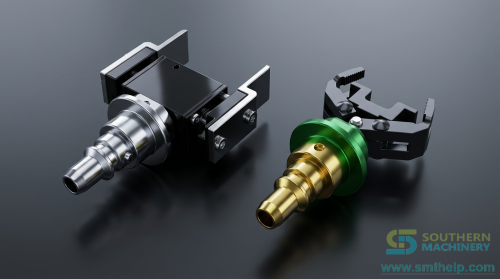
Custom SMT Nozzles and Grippers for Odd-Form Component Handling by Southern Machinery
Odd-form and custom components are often where an otherwise stable SMT line starts to lose rhythm. The pick-and-place machine may be capable, the feeder setup may be mature, and the production plan may look realistic, but the actual component body, lead shape, weight balance, surface finish, or available pickup area can make a standard nozzle unreliable.
The source problem is simple: standard tooling assumes a component geometry that does not always exist in real production. When that assumption fails, factories usually compensate with slower machine speed, manual intervention, repeated trial adjustment, or extra inspection and rework. Those workarounds may keep production moving, but they also create hidden cost.
Southern Machinery designs and manufactures customized SMT nozzles and grippers for these exact handling challenges. For EMS, ODM, automotive electronics, medical electronics, industrial control, and power electronics teams, the goal is not to add a special tool for its own sake. The goal is to make difficult components behave predictably inside the full PCB assembly process.
What is this machine used for?
Strictly speaking, a custom SMT nozzle or gripper is not a standalone machine. It is a purpose-built handling tool used on an SMT placement process to pick, hold, move, and place components that standard nozzles do not handle well.
It is used when a factory needs to automate odd-form or custom components without sacrificing placement quality, component safety, or line speed more than necessary. Typical use cases include components that are difficult to grip with a flat vacuum nozzle, parts that are easily damaged by poor contact, and components that previously required manual assistance or unusually slow machine settings.
In practical production language, custom nozzles and grippers help answer one question: can this difficult part be handled consistently enough to belong in the automated SMT flow?
Why standard nozzles become a bottleneck
The weak point is usually not the pick-and-place platform itself. The weak point is the interface between the machine and the component. If that interface is wrong, several production issues can appear:
- The component is not picked consistently.
- The component shifts during movement.
- The placement position becomes unstable.
- The part is damaged by an unsuitable contact point.
- The machine must run slower to compensate.
- Operators add manual handling to protect output.
- Rework and scrap increase after inspection.
The cold-email source material behind this article frames the issue directly: production managers often face ongoing challenges when handling odd-form and custom components without giving up speed or quality. That is the correct starting point. A custom nozzle or gripper should not be justified by a catalogue feature list. It should be justified by the cost of the bottleneck it removes.
How Southern Machinery approaches custom SMT tooling
Southern Machinery, established in Shenzhen, China in 2011, focuses on SMT/THT PCB assembly automation equipment and supports 237+ global customers. For custom nozzles and grippers, the practical value is purpose-built fit: the tool is designed around the actual component and line requirement rather than forcing the component to match a standard nozzle.
The source document highlights three engineering outcomes:
- Higher first-pass yield by reducing placement errors and component damage linked to ill-fitting standard nozzles.
- Increased throughput by automating parts that previously needed manual intervention or slower machine settings.
- Lower total operating cost through reduced waste, less rework, and longer-lasting tooling materials such as diamond steel and ceramic.
These are not automatic guarantees. They depend on the component geometry, machine compatibility, feeder stability, placement program, inspection standard, and operator process. But they are the right categories to evaluate before deciding whether custom tooling is worth the effort.
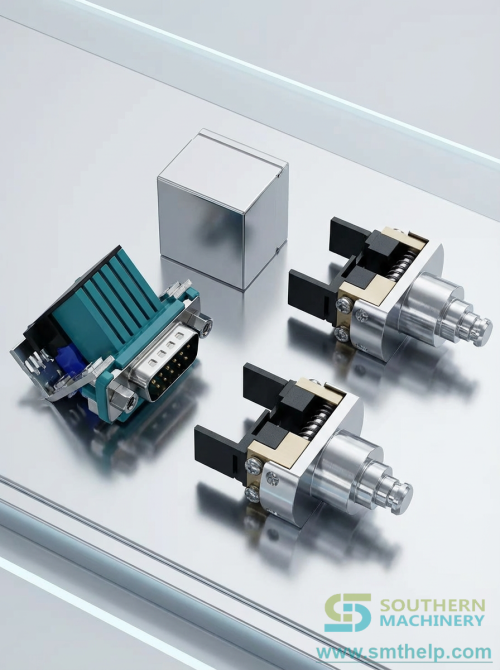
Typical application scenarios
Custom SMT nozzles and grippers make the most sense when the component cannot be handled reliably by standard tooling, or when the workaround is expensive enough to affect output and quality.
Common scenarios include odd-form components with non-standard pickup surfaces, custom parts used in industrial control boards, high-mix EMS production where new component formats appear frequently, and boards where a small number of difficult components slow the whole line.
They are also relevant when a factory is trying to move from manual assistance to a more automated process. If the component was previously inserted, positioned, or supported by an operator, the key question becomes whether a custom handling tool can create a stable automated method.
How it fits into a complete PCB assembly line
A custom nozzle or gripper is only valuable if it supports the complete line flow. In a typical PCB assembly environment, it sits inside the broader process:
- Material preparation and component verification.
- Feeder or tray setup for the target component.
- SMT placement using the custom nozzle or gripper.
- Reflow or downstream soldering process depending on the component and board design.
- AOI, inspection, or functional quality checks.
- Traceability and process improvement based on defect and rework data.
Southern Machinery can support broader SMT, THT, wave soldering, board handling, inspection, and traceability line planning. That matters because a custom nozzle solves only one part of the line. If the feeder is unstable, the component package is inconsistent, or the downstream process cannot tolerate the placement variation, the tooling alone will not fix the full problem.
Key selection parameters before requesting a custom design
Before asking for a custom SMT nozzle or gripper, buyers and engineers should prepare a short technical brief. The better the input, the more realistic the tooling recommendation.
Confirm these items first:
- Component type and application.
- Component dimensions, weight, body material, lead style, and available pickup surface.
- Photos or drawings of the component from multiple angles.
- Current pick-and-place machine brand and model.
- Current feeder, tray, tube, or manual loading method.
- Current failure mode: missed pick, dropped part, skew, damage, slow cycle, or rework.
- Required production volume and acceptable changeover method.
- Inspection criteria and quality standard used on the line.
- Whether the component is currently handled manually or by a standard nozzle.
- Any material limitation, such as risk of scratching, deformation, or electrostatic sensitivity.
This checklist keeps the discussion grounded. Without it, the conversation tends to become a generic request for a custom tool, which is not enough to judge feasibility.
ROI, quality, and throughput value
The business case should be built from measurable pain, not vague automation enthusiasm. A custom nozzle or gripper may create value in four areas.
First, it can protect first-pass yield by reducing placement errors and component damage caused by poor fit. Second, it can improve throughput if the line no longer needs to slow down for the difficult component. Third, it can reduce rework and scrap when the placement process becomes more stable. Fourth, it can reduce labor dependency when a previously manual step becomes machine-handled.
The source email mentions measurable ROI through reduced waste, less rework, and improved tool longevity. That is a useful direction, but the final payback depends on the actual defect rate, production volume, labor cost, component value, and tooling life. For external buyer communication, the correct wording is: ROI should be calculated from your component data and confirmed through technical review.
Material and durability considerations
The source material references diamond steel and ceramic as premium tooling material options. The first-principles reason is straightforward: the tool surface, rigidity, wear resistance, and component contact behavior affect repeatability over time.
A tool that performs well for a short trial but wears quickly can become expensive in production. A tool that protects the component but cannot survive normal line use is also not a good solution. Material selection should be matched to the component body, pickup method, expected usage, and maintenance plan.
FAQ
When should we consider a custom SMT nozzle or gripper?
Consider it when standard nozzles cause missed picks, placement errors, component damage, excessive speed reduction, or manual intervention for odd-form or custom components.
Can custom tooling improve first-pass yield?
It can help when the current yield issue is linked to poor component handling or an unsuitable standard nozzle. Final improvement depends on the component, machine, feeder, program, and inspection process.
Is this only for new SMT lines?
No. Custom nozzles and grippers are often considered for existing lines when a new component creates a bottleneck or when the factory wants to automate a manual handling step.
What information is needed for a technical recommendation?
Prepare component drawings or photos, machine model, current feeding method, failure mode, target output, and quality requirement. Southern Machinery can then review whether a custom handling solution is technically reasonable.
Does a custom nozzle guarantee ROI?
No responsible supplier should guarantee ROI without production data. ROI depends on reduced rework, lower scrap, labor savings, line speed impact, tool life, and actual production volume.
Can Southern Machinery support broader line integration?
Yes. Southern Machinery focuses on SMT/THT PCB assembly automation and can discuss how custom tooling fits with SMT placement, THT automation, wave soldering, board handling, inspection, and traceability requirements.
Next step
If odd-form or custom components are slowing your SMT line, send Southern Machinery the component photos or drawings, your pick-and-place machine model, current failure mode, and target output. Our team can review whether a custom-engineered SMT nozzle or gripper is the right path, or whether the bottleneck is actually in feeding, programming, inspection, or downstream process control.
For a practical discussion, contact Southern Machinery / SMThelp and request a brief technical review for your specific component handling challenge.
Comments