
Custom SMT Nozzles and Grippers Buyer Guide by Southern Machinery
Odd-form components, heavy connectors, shields, jumper wires, and non-standard THT parts often create the gap between a theoretically automated SMT line and a stable production line. This guide explains how Southern Machinery custom SMT nozzles and mechanical grippers help EMS, ODM, automotive electronics, medical electronics, and industrial control manufacturers reduce manual handling, stabilize pick-and-place performance, and connect odd-form placement into a broader PCB assembly automation strategy. The right tooling depends on component geometry, weight, surface material, feeder method, placement machine model, and final line layout, so every project should be confirmed with samples and technical drawings before production release.
Jul 25, 2026 · Updated Jul 25, 2026 · Southern Machinery
Custom SMT Nozzles and Grippers Buyer Guide by Southern Machinery
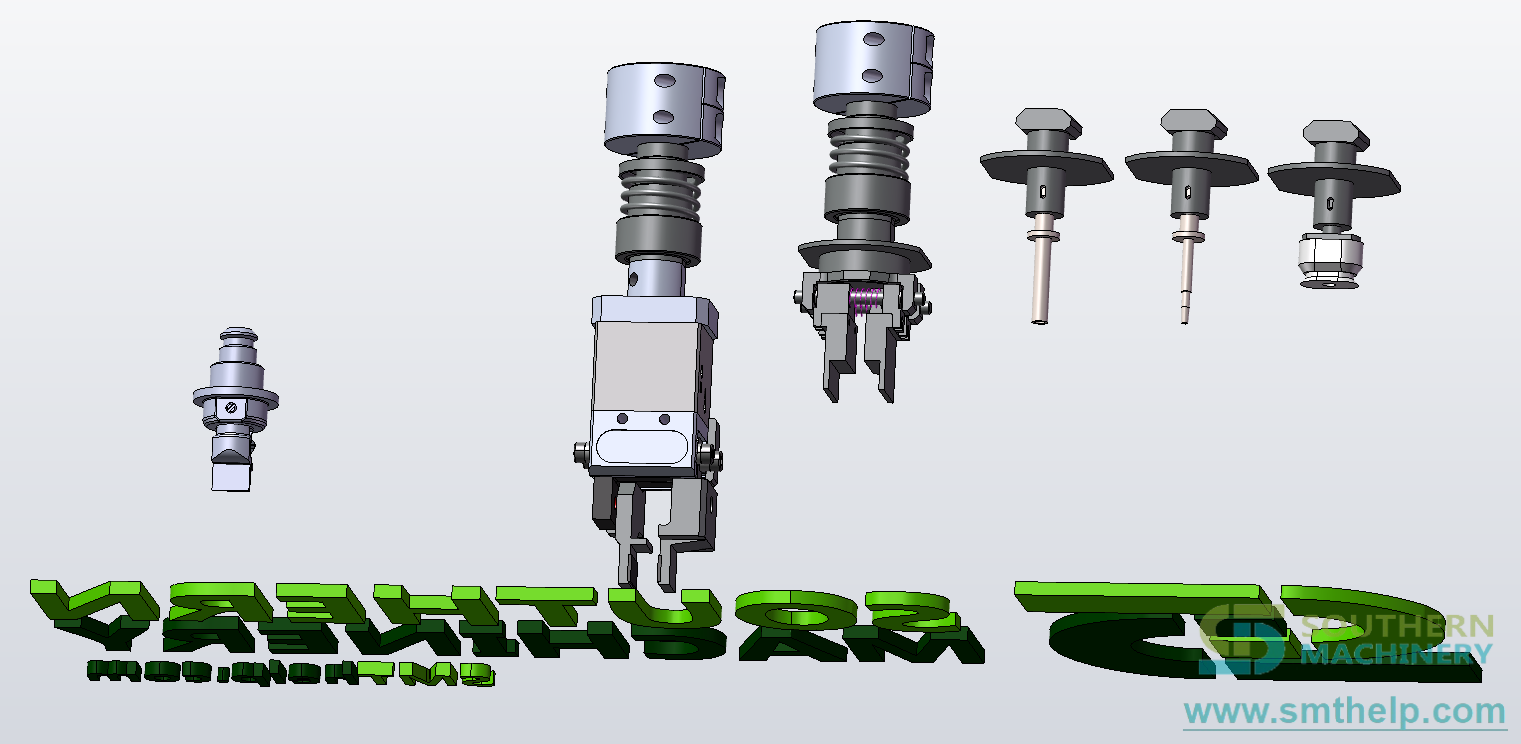
Odd-form parts are where many SMT automation projects slow down. Standard vacuum nozzles work well for common SMD packages, but they can struggle with large connectors, shields, jumper wires, porous surfaces, heavy components, or parts with irregular pickup areas. The source page for this article presents Southern Machinery's customized SMT nozzle and gripper solutions as a way to turn those difficult components into repeatable automated placement steps.
Southern Machinery was established in Shenzhen, China in 2011. The company focuses on SMT and THT PCB assembly automation equipment and supports 237+ global customers with cost-effective equipment, line integration, spare parts support, professional training, and complete solutions covering SMT, THT, wave soldering, board handling, inspection, and traceability.
What is this machine used for?
Custom SMT nozzles and grippers are used to pick, hold, transfer, and place components that cannot be handled reliably by a standard nozzle. In practical PCB assembly, they help automate parts such as odd-form connectors, through-hole components, jumper wires, shields, larger mechanical parts, and components with shapes or materials that make vacuum pickup unstable.
They are not a standalone production line by themselves. They are precision tooling installed on a compatible SMT mounter or odd-form placement process, normally combined with the right feeder, component presentation method, machine program, and inspection plan.
Why standard nozzles fail on odd-form components
A standard nozzle assumes that the part has a predictable pickup area, stable surface, suitable weight, and enough vacuum sealing area. Odd-form components break one or more of these assumptions. A connector may be too tall, a shield may deform under vacuum, a THT part may have an uneven body, and a jumper wire may need mechanical control rather than suction.
The bottom-line engineering issue is simple: if the tool cannot acquire and hold the component repeatably, the machine cannot place it repeatably. Southern Machinery's custom tooling approach starts from the component, machine model, and production challenge rather than forcing the part into a standard nozzle catalog.
Two solution paths: custom nozzles and mechanical grippers
Custom SMT nozzles
Custom nozzles are suitable when a component can still be picked by vacuum but needs a special contact surface, geometry, height, or material interface. The source page highlights their role in handling anything from delicate micro-LEDs to bulky connectors. For a buyer, the key question is not only whether vacuum pickup is possible, but whether it stays stable across real production variation.
Typical evaluation points include component body shape, pickup surface flatness, weight, center of gravity, placement orientation, package tolerance, board clearance, and compatibility with the target pick-and-place machine.
Mechanical grippers
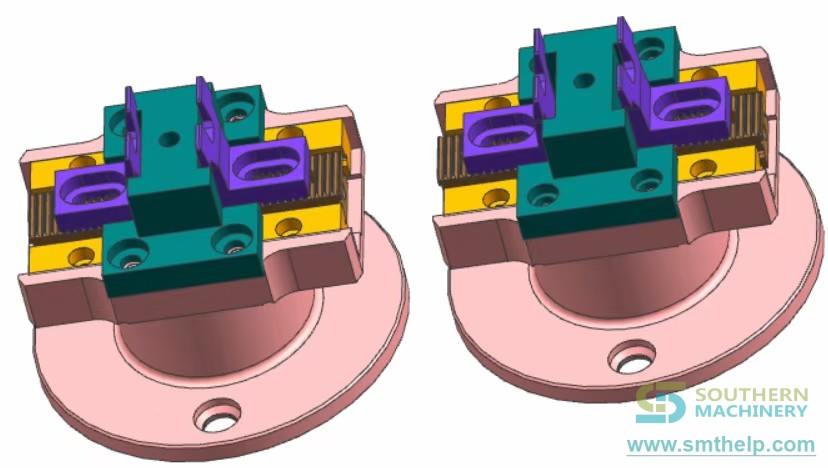
Mechanical grippers are used when vacuum pickup is unreliable or physically unsuitable. The source page describes grippers for components that are too heavy, porous, or irregularly shaped for vacuum nozzles. A fixed-and-swing-arm style gripper can provide controlled holding for THT components, shields, and large connectors.
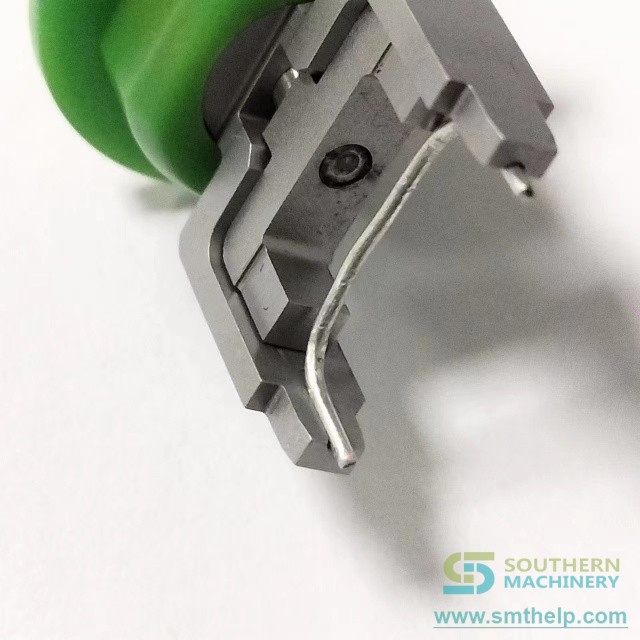
For EMS factories, the real value is not just picking one difficult component. It is removing a manual station, reducing operator-dependent variation, and making the odd-form step part of a repeatable takt-time plan.
Typical applications in EMS and PCB assembly
Custom SMT nozzles and grippers are commonly considered when a product has mixed SMT and THT assembly requirements. The source page points to odd-form parts, THT components, shields, large connectors, and jumper wire applications. In real line planning, these tools are especially relevant for:
- Automotive electronics with connectors, relays, terminals, and robust mechanical parts.
- Industrial control boards with transformers, terminal blocks, headers, and mixed-height components.
- Power supply and LED driver boards where through-hole parts remain important.
- Medical and instrumentation electronics where placement consistency and traceability are important.
- High-mix EMS production where manual odd-form placement creates training, quality, and scheduling pressure.
How custom tooling connects into a complete PCB assembly line
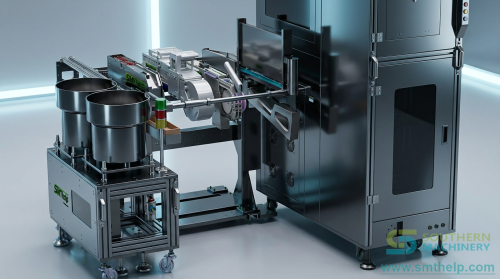
Custom nozzles and grippers should be specified as part of the full process, not as isolated accessories. A practical Southern Machinery configuration can include SMT loader, solder paste printer, SPI, pick-and-place process with custom tooling, reflow oven, AOI, THT insertion or odd-form placement, wave or selective soldering, board handling conveyors, buffers, NG/OK sorting, and traceability options.
For high-mix production, the tooling choice must also align with changeover time, feeder setup, component replenishment, operator access, spare tooling, and maintenance procedures. For higher-volume production, the priority usually shifts toward stable cycle time, robust feeding, inspection coverage, and minimizing manual rework.
Southern Machinery's customization process
The selected source page presents a four-step process:
- Consultation: confirm the component, machine model, production challenge, and expected automation goal.
- Design and proposal: create the custom tooling concept, including a 3D design where required, and define the quotation scope.
- Manufacturing: produce the tool using precision CNC machining and suitable materials for the application.
- Delivery and support: provide the solution and support line integration.
For serious projects, buyers should treat this as an engineering validation loop. The correct next step is to provide component samples or drawings, target machine model, feeder method, PCB layout constraints, and production target so the design can be checked before final manufacturing.
Key selection parameters checklist
Before requesting a custom nozzle or gripper, prepare the following information:
- Component type, photos, 2D drawing, 3D file if available, and physical samples when possible.
- Target SMT mounter or placement platform, including brand and model.
- Pickup location, placement orientation, tolerance window, and board clearance.
- Component weight, surface material, body geometry, and center of gravity.
- Feeding method such as tape, tube, tray, bowl, belt, radial tape, or custom feeder.
- Required output, shift model, product mix, and expected changeover frequency.
- Inspection method, reject handling, and whether traceability is needed.
- Whether the project is a new line, retrofit, or replacement for a manual workstation.
ROI, quality, and capacity value
The business case comes from replacing unstable manual handling with a repeatable machine process. Potential gains include lower operator dependency, fewer placement errors, more consistent takt time, better shift-to-shift repeatability, and easier integration with inspection and traceability.
The source landing page includes strong performance-oriented messaging such as high pickup rate, global service experience, and long service life. These should be treated as project-dependent claims unless confirmed against the exact component, machine, material, and production environment. Southern Machinery can help validate the practical result through sample review, tooling design, trial placement, and final technical confirmation.
FAQ
Can one custom nozzle handle many different components?
Sometimes, but it depends on geometry, pickup surface, weight, and placement tolerance. A shared tool may work for similar components, while very different parts normally need separate tooling.
When should we choose a gripper instead of a vacuum nozzle?
Choose a gripper when the part is too heavy, porous, unstable under vacuum, irregularly shaped, or requires mechanical support during transfer. The decision should be based on sample testing and machine compatibility.
Can Southern Machinery design tooling for existing pick-and-place machines?
Yes, the source page presents custom nozzles and grippers designed around specific production needs. For a real project, Southern Machinery needs the machine model, component data, and placement requirements before confirming compatibility.
Does custom tooling replace an odd-form insertion machine?
Not always. Custom nozzles and grippers can automate specific placement challenges on compatible platforms, while a dedicated odd-form insertion machine may be better for certain through-hole parts, high-volume workflows, or integrated feeding requirements.
What should we send before requesting a quotation?
Send component photos, drawings or samples, machine model, current process video if available, output target, feeding method, PCB layout constraints, and the main problem you want to solve, such as pickup failure, manual insertion labor, or unstable placement.
Are performance numbers guaranteed?
No universal number should be assumed before testing. Pickup rate, lifespan, takt time, and payback depend on component design, tool material, machine condition, feeder stability, maintenance, and production environment. Final figures should be confirmed technically for the specific project.
CTA: discuss your odd-form placement bottleneck
If your SMT or THT line still depends on manual handling for connectors, jumper wires, shields, terminals, or other odd-form components, Southern Machinery can review your component samples and propose a practical automation path. Share your component drawings, machine model, output target, and current bottleneck, and our engineering team can suggest whether a custom nozzle, mechanical gripper, feeder, odd-form insertion machine, or complete line adjustment is the right next step.
Source product page: Southern Machinery SMT Customized Nozzle & Gripper Solutions.
Comments