
Custom SMT Nozzle and Gripper Tooling for Mixed SMT/THT Lines by Southern Machinery
Custom SMT nozzles and mechanical grippers help EMS factories automate components that standard vacuum pickup cannot handle reliably. Based on Southern Machinery source material, this guide explains where customized tooling fits in a mixed SMT/THT assembly line, what component data buyers should confirm, and how engineered nozzle or gripper design can reduce stoppages, improve handling consistency, and support higher-efficiency PCB assembly automation without overpromising fixed CPH, yield, or ROI before technical validation.
Jul 24, 2026 · Updated Jul 24, 2026 · Southern Machinery
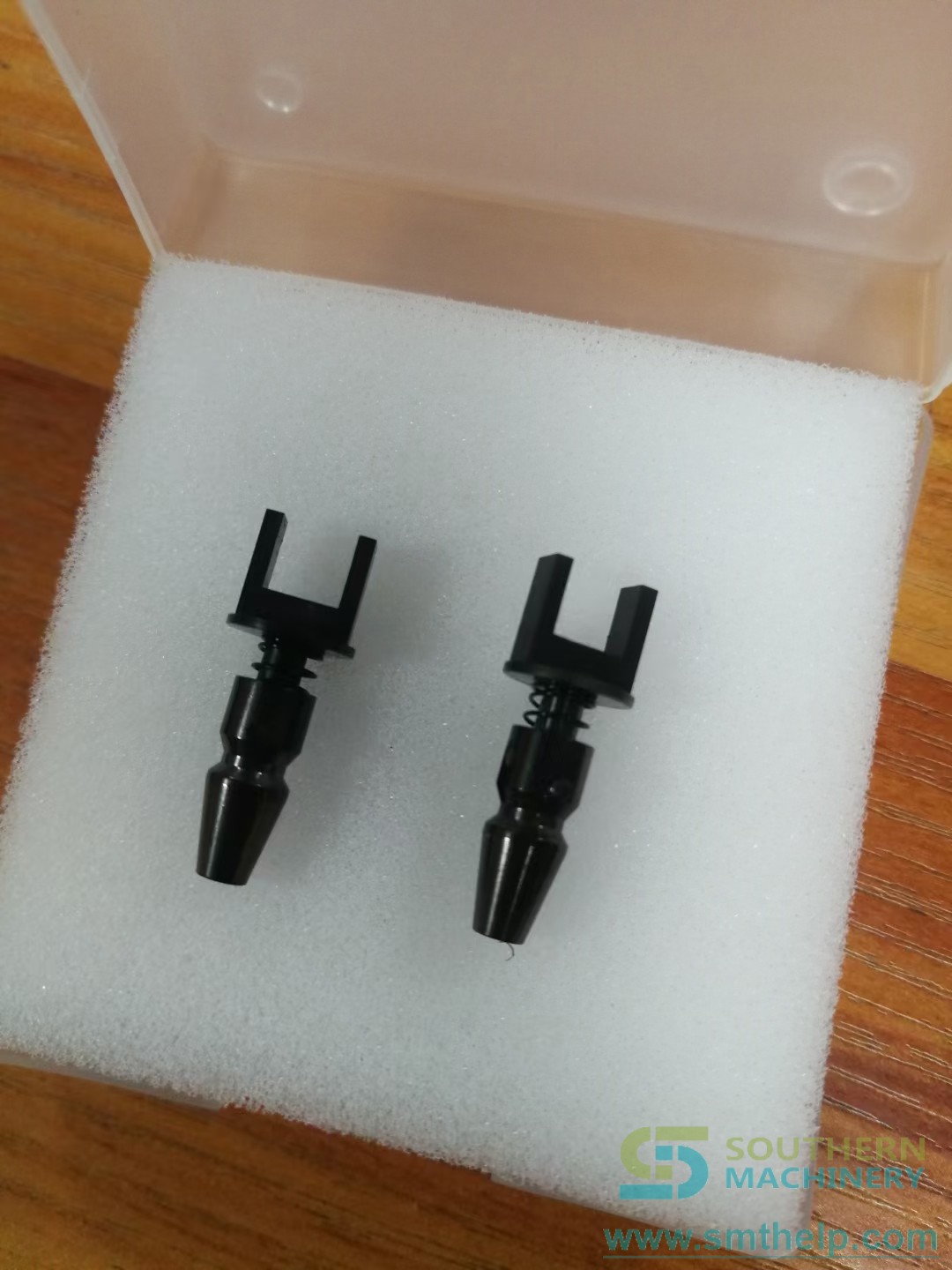
Custom SMT Nozzle and Gripper Tooling for Mixed SMT/THT Lines by Southern Machinery
For many EMS, ODM, automotive electronics, medical electronics, and industrial control factories, the difficult part of PCB assembly is not always the main pick-and-place platform. The bottleneck often appears at the interface between the component and the machine: a standard vacuum nozzle cannot hold the part consistently, a connector shape is too irregular, a jumper wire needs a special pickup surface, or a THT/odd-form component requires a mechanical grip instead of simple suction.
Southern Machinery, established in Shenzhen, China in 2011, focuses on SMT and THT PCB assembly automation equipment for global customers. Alongside full line solutions covering SMT, THT, wave soldering, board handling, inspection, traceability, spare parts support, and professional training, customized nozzles and grippers are a practical way to make existing assembly machines handle difficult components more reliably.
What is this machine used for?
Custom SMT nozzle and gripper tooling is used to pick, hold, transfer, and place components that cannot be handled well by standard vacuum nozzles. In real production, this can include odd-form components, jumper wires, large connectors, shields, special THT parts, delicate components, or parts with surfaces that are too small, porous, uneven, or unstable for normal suction pickup.
The goal is not to replace the whole SMT machine. The goal is to engineer the contact point between the machine head and the component so that the line can run with fewer pickup failures, fewer component drops, and less manual intervention. Depending on the component geometry and the target machine, the answer may be a redesigned vacuum nozzle, a large-passage nozzle, an anti-clogging concept, or a mechanical gripper with a fixed-and-swing-arm style holding mechanism.
Why Standard Tooling Fails on Difficult Components
A standard nozzle works well when the component has a predictable flat pickup area, stable orientation, suitable weight, and enough surface area for vacuum holding. Difficult components break one or more of those conditions.
Common failure modes include:
- The part rotates or tilts during pickup because the contact surface is uneven.
- The nozzle clogs or sticks when dust, flux residue, or material geometry interferes with airflow.
- The component is too large, tall, or irregular for a simple round pickup face.
- The placement head cannot maintain stable control during high-speed movement.
- Vacuum pickup risks damaging a delicate surface.
- A THT or odd-form component needs mechanical support rather than suction alone.
In these cases, the lowest-cost answer is not always another operator. A properly designed nozzle or gripper can remove a repeated handling problem from the line and make automation more stable.
Custom Nozzles: Better Vacuum Contact for Special Parts
The source page positions custom nozzles as precision tools for solving common assembly issues such as clogging, sticking, unstable pickup, and poor fit on unusual component shapes. For buyers, the useful question is simple: can the nozzle geometry match the real component rather than forcing the component into a standard tool shape?
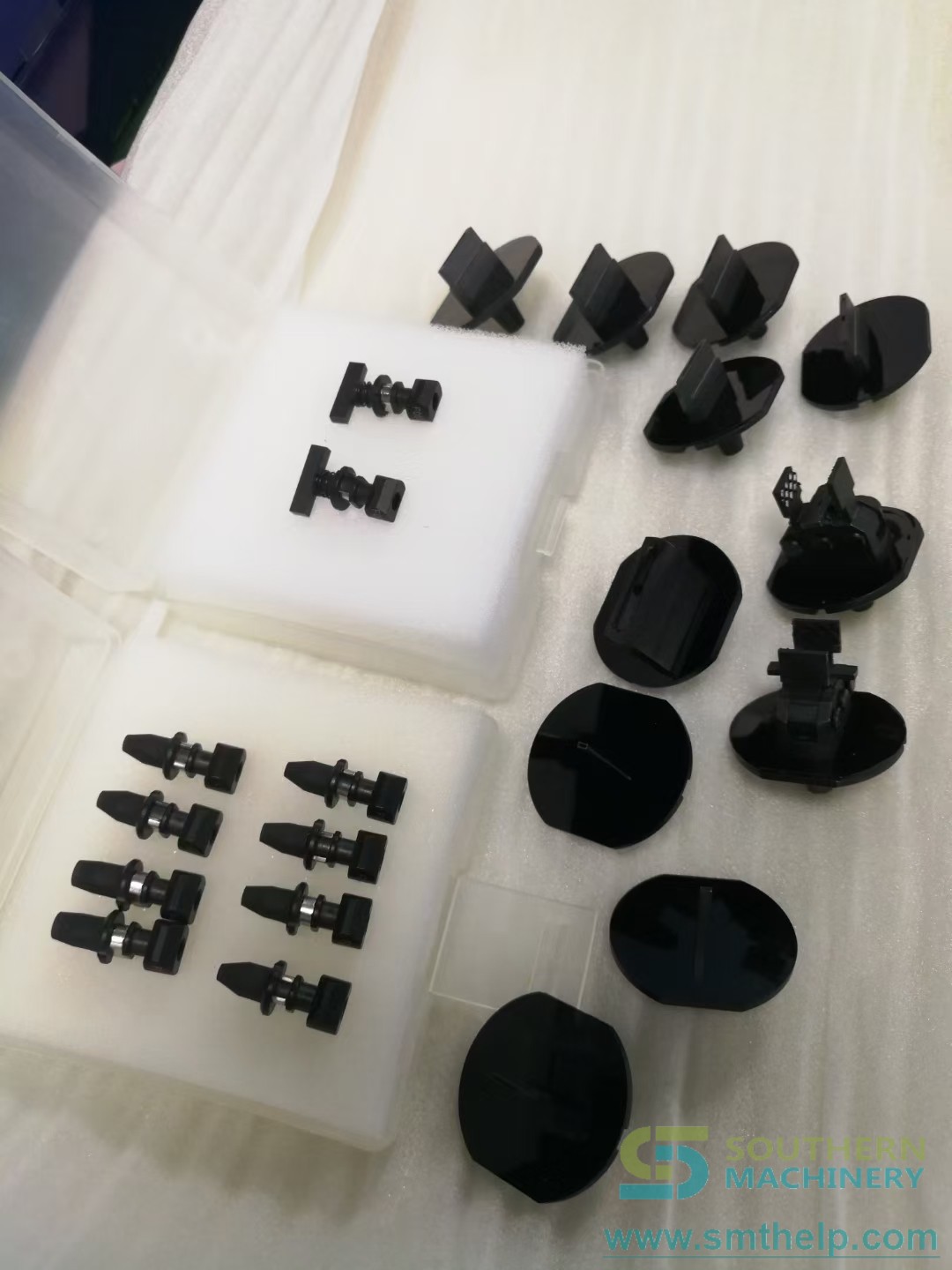
A custom nozzle may be considered when the component still supports vacuum handling but needs a better pickup profile. Southern Machinery source material highlights designs for odd-form components, jumper wires, special connectors, larger passages, self-cleaning concepts, anti-static properties, and material choices such as stainless steel, ceramic, and other durable tooling materials.
Any exact pickup rate, lifetime, or cycle-time improvement must be confirmed by sample testing on the customer's actual component, feeder, placement machine, and program. In a technical proposal, those figures should be treated as project-specific validation results, not universal promises.
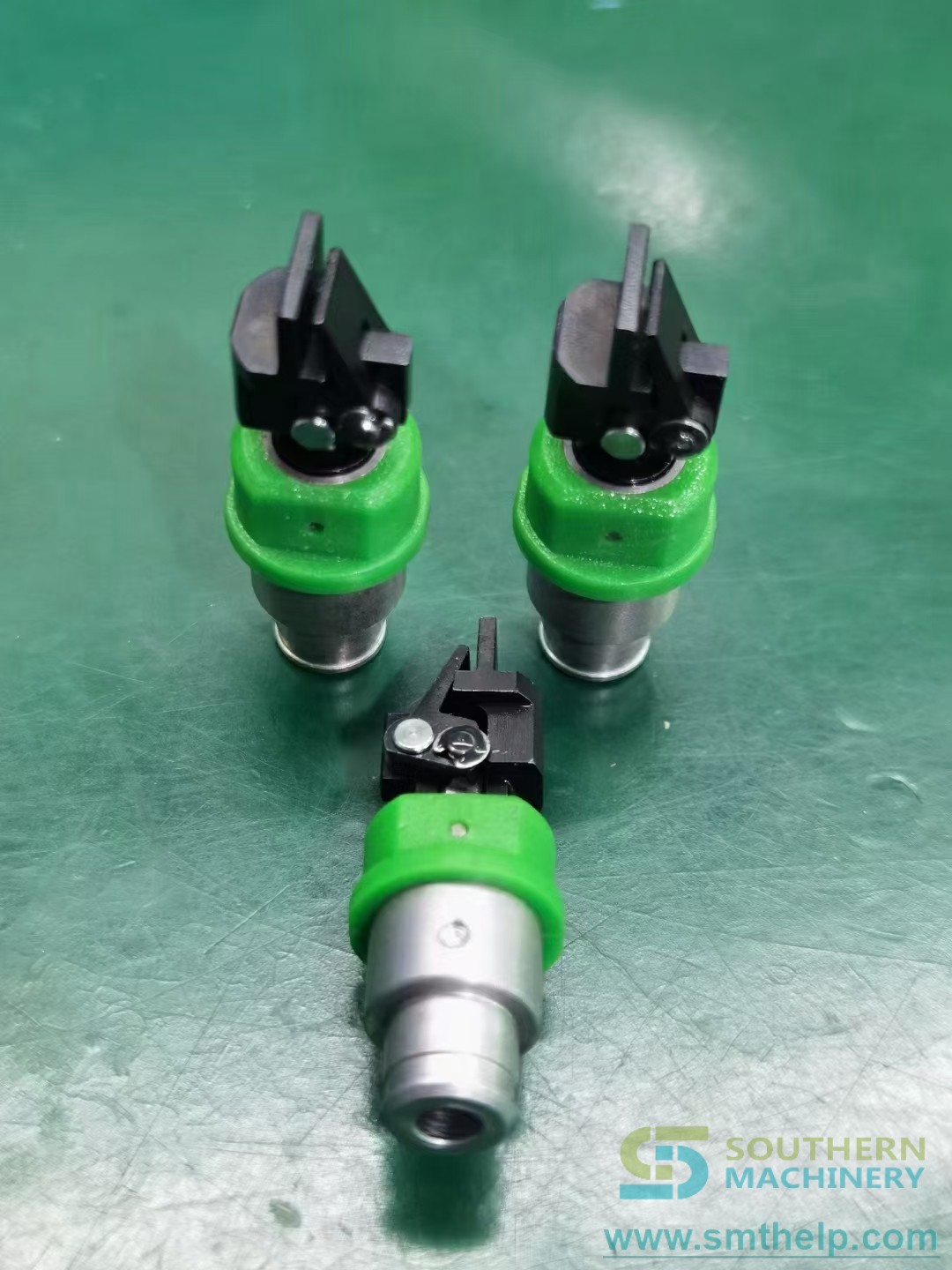
Custom Grippers: Mechanical Holding When Vacuum Is Not Enough
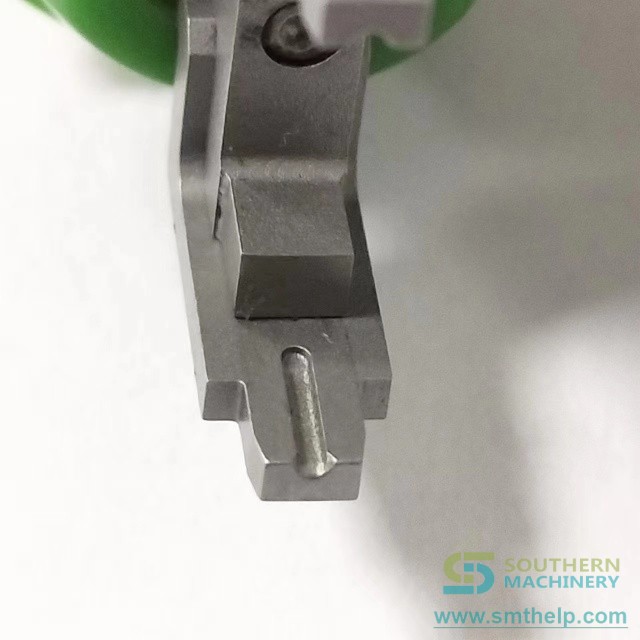
Some parts should not depend on suction. The source page describes mechanical grippers for irregularly shaped or delicate components, including a fixed-and-swing-arm style design. This type of tooling is useful when the component needs physical retention during pickup and placement.
Custom grippers can be relevant for:
- THT components with tall or non-flat bodies.
- Large connectors or shields.
- Parts where vacuum area is too small or unreliable.
- Components that shift under acceleration if only suction is used.
- Mixed SMT/THT processes where automation must handle parts with very different shapes.
The source page includes an example gripping range from 0.8 mm to 5.2 mm. Treat that as source-document guidance for the referenced design family, not as a guarantee for every project. Final jaw size, opening range, material, spring force, mounting interface, and machine compatibility should be confirmed from drawings and sample trials.
Typical Application Scenarios
Custom nozzle and gripper tooling is especially useful in high-mix production where the line must handle many component families without relying on manual rescue at every difficult position. Typical applications include consumer electronics, industrial control boards, automotive electronics modules, power supply boards, LED driver products, sensors, and mixed-technology PCB assemblies.
The strongest use cases are not generic. They usually have a repeated, measurable pain point:
- A specific connector causes frequent pickup errors.
- A jumper wire or formed lead component is still inserted manually.
- A shield or mechanical part cannot be held by a standard nozzle.
- Component variation causes unstable placement in NPI or high-mix production.
- Manual assistance limits the effective output of a higher-capacity SMT line.
How It Fits into a Complete PCB Assembly Line
Customized tooling should be evaluated as part of the complete assembly flow, not as a standalone accessory. In a typical PCB assembly line, the tooling decision connects to feeding method, placement machine, inspection, and downstream soldering.
A practical line integration path can look like this:
- SMT section: loader, printer, SPI where required, pick-and-place machine with custom nozzle or gripper tooling, reflow oven, and AOI.
- THT or odd-form section: manual-assisted insertion, radial insertion, axial insertion, odd-form insertion, or dedicated feeder/nozzle/gripper combinations depending on the component mix.
- Soldering section: wave soldering or selective soldering, selected according to board layout, component sensitivity, pallet requirement, and thermal constraints.
- Board handling: conveyors, buffers, PCB inverter, magazine loader/unloader, NG/OK sorting, and traceability scanning where required.
- Inspection and data: AOI, ICT/FCT, barcode tracking, MES connection, and production records depending on quality requirements.
Southern Machinery can support this broader equipment context, including SMT, THT, wave soldering, board handling, inspection, and traceability solutions. The customized nozzle or gripper becomes one engineered element inside a cost-effective, high-efficiency line configuration.
Key Selection Parameters Buyers Should Confirm
Before quoting or designing custom tooling, the engineering team should confirm the component and process facts that actually determine the tool design.
- Component drawing, 3D model, or clear dimensions.
- Pickup surface material, shape, height, weight, and center of gravity.
- Component packaging: tape, tube, tray, bowl, bulk, or special feeder.
- Target machine brand/model and head/nozzle interface.
- Required placement orientation and tolerance.
- Current failure mode: mispick, drop, rotation, sticking, clogging, damage, or low throughput.
- Expected production volume and changeover frequency.
- Whether anti-static, wear-resistant, ceramic, stainless steel, or other material requirements apply.
- Whether a vacuum nozzle, mechanical gripper, or combined feeder/tooling solution is more suitable.
These inputs matter more than generic catalog claims. Without them, any fixed performance statement would be speculation.
ROI, Quality, and Capacity Value
The business value of customized tooling comes from removing a repeatable constraint. If one difficult part causes line stops, operator rescue, rework, or manual insertion, the value is usually visible in reduced downtime and more predictable output.
The main benefits are:
- Fewer pickup and placement interruptions for difficult components.
- Less manual handling in mixed SMT/THT assembly.
- Better consistency when component shape or surface is challenging.
- Lower rework risk when the correct part is handled in a controlled way.
- Easier scaling from prototype or NPI builds toward stable batch production.
ROI should be calculated from actual line data: current defect/rework cost, operator time, downtime minutes, target output, component cost, and expected tooling life. For a buyer evaluation, Southern Machinery can review the component samples and line context, then recommend whether custom nozzle tooling, gripper tooling, feeder adaptation, or a broader automation change is the right path.
FAQ
Can a custom nozzle fit any SMT machine?
It may be designed for many major SMT platforms, but compatibility must be confirmed from the target machine model, nozzle mounting interface, head clearance, and placement program requirements.
When should we choose a gripper instead of a vacuum nozzle?
Choose a gripper when the part cannot be held reliably by suction, has an unstable pickup surface, is too irregular, or needs mechanical retention during movement. A sample review is the safest way to confirm.
Do you need component samples before designing tooling?
Yes, samples or accurate drawings are strongly recommended. The pickup face, center of gravity, material, packaging, and placement orientation directly affect the design.
Can this reduce manual insertion in a THT line?
It can help when the bottleneck is component handling or placement of specific odd-form or THT parts. The final solution may also require a feeder, insertion machine, or downstream soldering adjustment.
Are pickup rate and ROI guaranteed?
No fixed rate or ROI should be promised before technical validation. Results depend on component geometry, machine condition, feeder stability, program settings, and production environment.
Can Southern Machinery help with the complete line, not just tooling?
Yes. Southern Machinery provides SMT/THT PCB assembly automation equipment and can discuss a full configuration including SMT placement, THT insertion, wave soldering, board handling, inspection, traceability, spare parts support, and professional training for global EMS customers.
CTA: Send the Difficult Component First
If a standard nozzle cannot handle your component reliably, send the component drawing, machine model, packaging method, and a short description of the current failure mode. Southern Machinery can review whether a custom SMT nozzle, mechanical gripper, feeder adaptation, or complete line integration plan is the most practical route for your factory.
Comments