
Custom SMT Nozzle & Gripper Lead Time by Southern Machinery
Custom SMT nozzle and gripper sourcing: the published pickup rate, the stated build lead time, the six measurements a quote needs, and the lifetime cost model.
Oct 8, 2026 · Updated Oct 8, 2026 · Southern Machinery
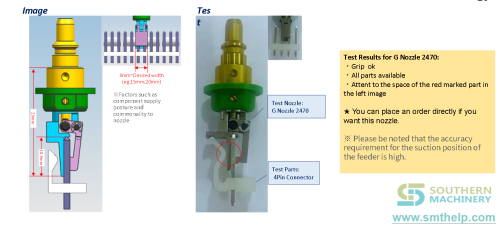
This article is built from that one specification document and prints its disagreements rather than averaging them away.
What does a custom SMT nozzle actually buy you?
A mounter can only place what its tooling can hold. When a head rejects a component, the reflex is to blame the machine or the part — almost always it is the interface between the two, and that interface is a part you can order.
Three ways suction stops working at the edge of the envelope
- Uneven top face — the part cannot form the seal the vacuum column needs.
- Too heavy — it slips under acceleration instead of travelling with the head.
- Fragile face — a rigid tip marks or cracks the surface it must bear on.
Those three failure modes account for most of the odd-form work still sitting on a manual bench.
The cost that never appears as a BOM line
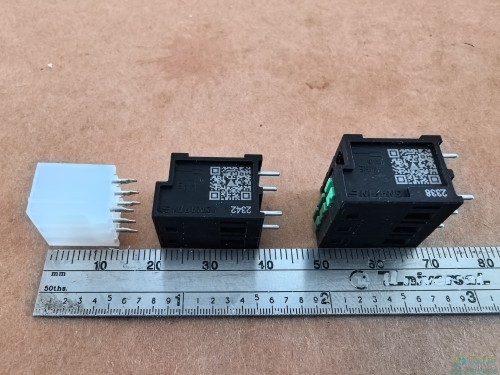
Manual odd-form placement is not a line item. It is an operator, a bench, a rework allowance and a first-pass yield that never quite reaches target, so the cost survives every review because nobody ever approved it as a cost. A gripper is designed around the external profile of one part family — which is why the same head places a 0402 chip and then needs a different tool for a 9.5 mm bobbin.
Which six measurements decide the design before anyone quotes?
The usual reason a custom nozzle quote takes two weeks is one missing dimension, normally on the face nobody photographs: the surface the tool bears on. That dimension decides the handling method, so getting it wrong sends the prototype back to the pickup-rate test.
The six numbers to send with the part
- Outside profile in the two axes the jaws or the tip close across.
- Face height — the height of the surface the tool bears on.
- Mass, to the nearest gram.
- Centre of gravity along the long axis, even roughly.
- Lead or pin pattern, if the part has one, including spacing.
- Package — tape width, tube or tray.
Six numbers let a designer propose a geometry without a sample in hand — the difference between a quote in days and a quote in weeks. A sample still earns its postage: production parts carry flash, moulding draft and a mass that is slightly off centre.
What will a supplier commit to in writing, and where do the figures conflict?
This is the part of a tooling purchase that procurement cannot read off a price list. Every figure below is printed with the source it comes from.
Values stated in the named source
- Pickup rate — 99.99%, published on the nozzle sheet.
- Support window — 7 x 24 hours for nozzle orders.
- Build lead time — one week on the nozzle sheet; two to four weeks in the design note; about one month in the custom solution sheet.
- Gripping range, gripper nozzles — 0.8 to 5.2 mm in the JUKI nozzle catalogue note; 9.5 to 17.5 mm on the 2071 CAD sheet.
- 2071 gripper geometry — arm 7 x 7 mm; jaws closed 8.5 mm, open 18.5 mm.
- Odd-form head capability — up to 100 N placement force, components to 300 g, footprints to 200 x 125 mm.
- Placement accuracy, standard vacuum — within 0.02 mm.
- Vacuum requirement — 400 mmHg general placement, 70 mmHg for large components.
The conflicts you should ask about by name
Six rows carry more than one value, and four are conflicts inside our own documents rather than differences with a third party. Lead time is one; gripping range is another; nozzle service life is printed both as several months and as more than 24 months; the part code appears as CN-SM-2713, Nozzle 2071 and JUKI-nozzle-customized across three of our own files. Ask for the current drawing for your configuration, and quote the part code so the drawing it maps to is confirmed.
What the document deliberately does not claim: no machine-level accuracy figure, because accuracy belongs to the head that carries the nozzle; and no cycle-time promise, because the tool decides whether a part can be picked while the head decides how fast.
What does a custom SMT nozzle cost over a year, not at the counter?
A nozzle is one of the cheapest items on a placement line and one of the few that can stop it. That asymmetry is why the counter price is the least useful number in the decision.
annual cost = (tool price / expected life in years)
            + (misses per 1,000 placements x cost of clearing one miss)
            + (cleaning and inspection minutes x labour rate)
            + (avoidable line stops x cost per stopped minute)
Three of those four terms are numbers your factory already holds. Only the tooling investment comes from the supplier.
Worked example — example only, depends on configuration
Example only, depends on configuration, subject to final technical confirmation. Take a line placing 120,000 odd-form components a month. Assume a tool change removes 8 misses per 1,000 placements against USD 6 to clear each miss, plus 20 minutes of cleaning and inspection at USD 25 an hour, and one avoidable line stop a year. The miss line alone is 960 misses a month, about USD 5,760; cleaning and inspection is roughly USD 8 a month. Substitute your own numbers, because every term belongs to your line and not to ours.
How do you commission and maintain a custom tool?
Six commissioning steps
- Fit and check the seating height against the head datum before running a cycle.
- Teach the pickup position in the machine's component data, then verify it with the head camera.
- Set the placement force low for a fragile part, then raise it until placement repeats rather than until it seats once.
- Run the pickup-rate test — fifty cycles at production speed, misses counted, before the tool enters the program.
- Write the inspection interval into the maintenance schedule instead of reacting to a fault.
- Keep the spare — a second tool turns a failure from a line stop into a changeover.
The inspection routine that catches the invisible failure
A custom tool fails in two ways. Breakage is visible from across the room; dimensional drift is not. The tip wears, the seating height moves by a few hundredths of a millimetre, and sample boards still look fine. The routine is four checks — the tip under magnification, the seating height against the head datum, the jaws closing squarely, and the O-ring and spring for compression set. Set the interval from the miss rate rather than the calendar, and record the first reading as the baseline every later comparison uses.
How does the tool fit an SMT or THT assembly line?
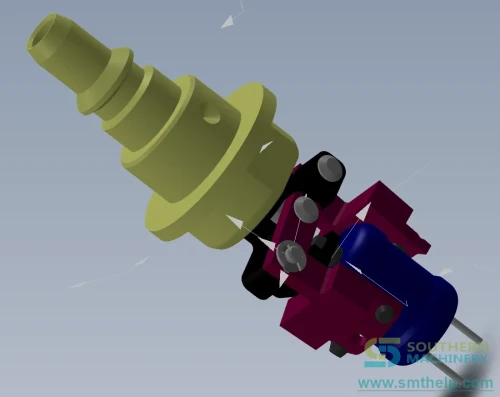
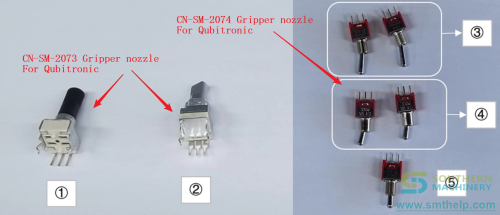
Tooling is one decision inside a line, not a standalone purchase. The handling method follows the part: vacuum for a flat, light body; a V-groove nozzle for MELF and cylindrical parts that would roll on a flat tip; friction jaws for electrolytic capacitors and bobbins, or for parts needing axial force such as pin-in-paste; a slot nozzle for terminals, pins and narrow ribbon connectors; a pipe nozzle with an interchangeable rubber tip for large ICs, sockets and shields. The tool is cut to the interface your head expects, so it seats without an adapter.
Explore SMT line equipment, THT automation and feeders alongside PCB assembly and board handling, or browse the machine catalogue.
Frequently asked questions
What do you need from me to quote a custom SMT nozzle?
The component itself — ideally four to six inches of tape or a tube — or a drawing with the outside profile and bearing face dimensioned. Photographs cannot replace a measurement.
Which machine brands can you build for?
Yamaha, Fuji, JUKI, Samsung, Panasonic, Hitachi, I-pulse, Siemens and ASM, Universal, Mirae, Sanyo and Sony. If your head is absent from that list, send the interface drawing.
Can you place a part that is too heavy for vacuum?
Yes, with friction jaws. An odd-form head in this class applies up to 100 N of placement force and carries components up to 300 g, so the jaw takes the load.
How long does a custom tool actually take?
Our own sheets disagree: one week on the nozzle sheet, two to four weeks in the design note, about one month in the custom solution sheet. Plan on two to four weeks.
How do I know the tool works before it ships?
It is run on your own component at production speed, and the pickup rate from that test ships with the tool.
Will a custom tool void my machine warranty?
That depends on your machine supplier, not on us. The tools are cut to the interface your head expects and need no machine modification, which is the usual condition.
Get a geometry, not a price range
Send the part you cannot place. Southern Machinery — founded in Shenzhen in 2011, with tooling shipped to EMS factories in more than 50 countries — designs, machines and inspects in the same building, so a quote from a sample comes back with a proposed geometry rather than a range. Request a quote, read the FAQ or contact us.
Comments