
Custom SMT Grippers for Odd-Form Placement Downtime by Southern Machinery
Odd-form and difficult-to-handle components often keep SMT lines dependent on manual placement, slower handling, and repeated rework checks. This buyer guide explains how Southern Machinery custom-engineered SMT nozzles and grippers can help automate challenging component handling, reduce manual intervention, and support more stable placement in high-mix PCB assembly. For EMS, ODM, automotive electronics, medical electronics, and industrial control manufacturers, the right tooling is not a small accessory decision; it affects uptime, operator workload, quality stability, and how easily the SMT process connects with downstream THT, inspection, and board handling equipment.
Jul 24, 2026 · Updated Jul 24, 2026 · Southern Machinery
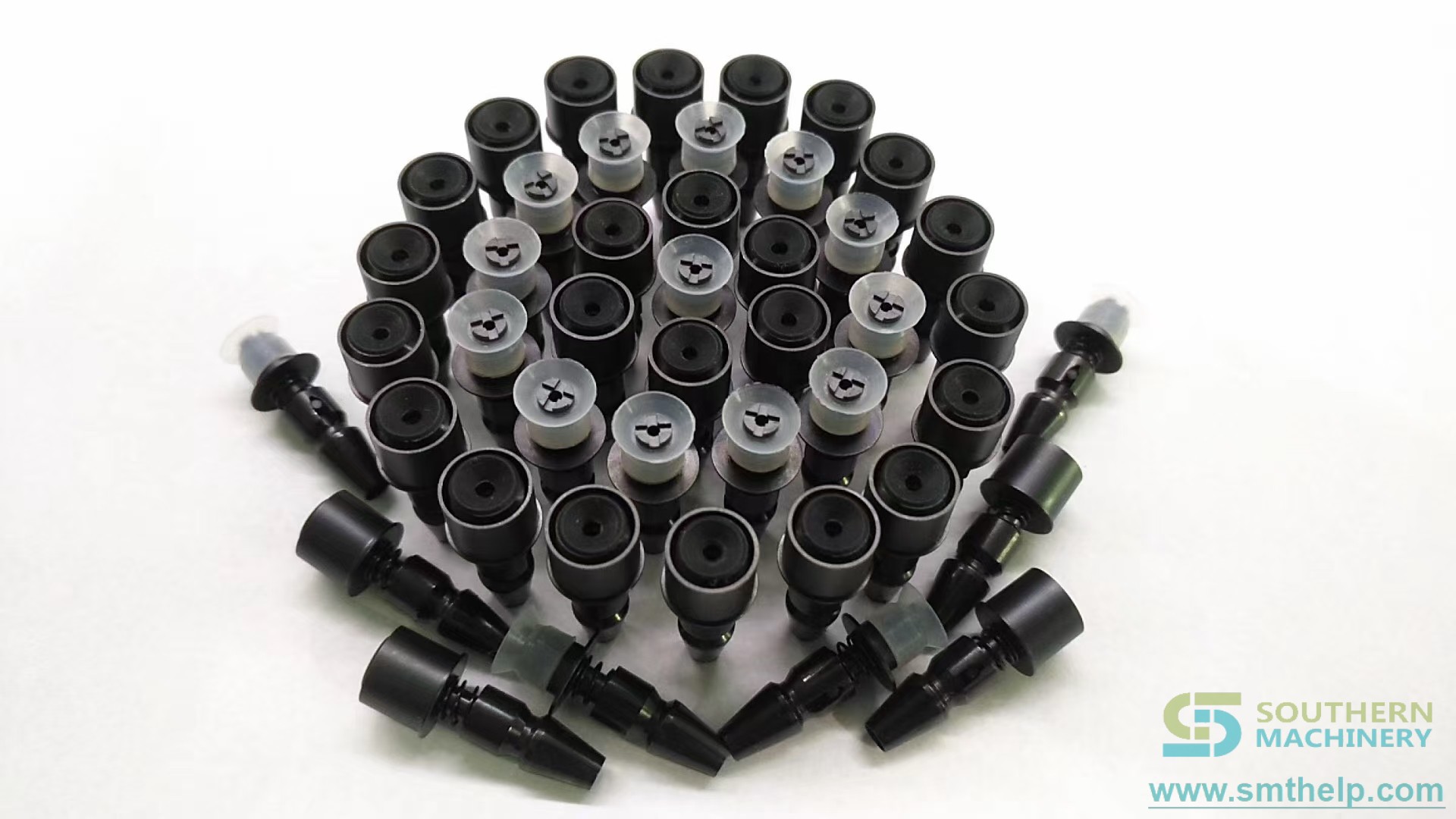
Custom SMT Grippers for Odd-Form Placement Downtime by Southern Machinery
Odd-form components create a simple but expensive problem: the SMT line may be technically automated, but the difficult parts still need manual handling, manual correction, or frequent operator attention. The source material for this article focuses on one practical question: how much more could an SMT line produce if the most challenging components could be handled automatically?
Southern Machinery approaches this problem through custom-engineered SMT nozzles and grippers. The goal is not to claim one universal tool for every component. The goal is to design a purpose-built pickup and placement solution around the actual part geometry, handling risk, and production line requirement.
What is this machine used for?
Custom SMT nozzles and grippers are used to automate the handling and placement of components that standard SMT tooling cannot pick, hold, orient, or release reliably. In practical EMS production, these parts may cause slow manual intervention, placement errors, line pauses, or extra rework inspection.
The source document describes Southern Machinery custom-engineered SMT nozzles and grippers as a way to turn these bottlenecks into automated processes. In a real PCB assembly line, this kind of tooling can support components that are too irregular, too tall, too fragile, or too unstable for a standard vacuum nozzle.
Why odd-form components slow down SMT production
A conventional SMT line depends on repeatable feeding, stable pickup, predictable vision recognition, accurate placement, and clean release. Odd-form components disrupt that chain because their shape, center of gravity, lead structure, or surface area may not match standard tooling.
When that happens, the factory usually absorbs the cost in one of four ways:
- Manual placement for the difficult components.
- Slower machine speed to reduce handling errors.
- Extra operator checks and manual correction.
- More rework when the component is not seated consistently.
The source email frames the issue as lost production time. That is the correct first-principles view: the cost is not only the tool itself. The real cost is the lost throughput, unstable process window, and operator dependency around one difficult part family.
How Southern Machinery custom nozzles and grippers help
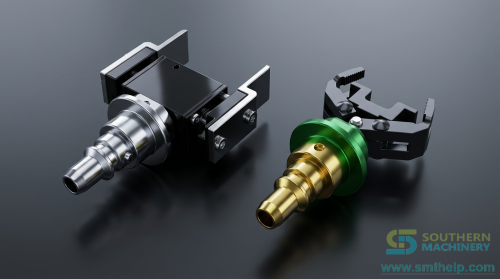
Southern Machinery designs custom SMT nozzles and grippers for components that need purpose-built handling. Based on the source document, the main value is to bridge the gap between difficult component geometry and automated SMT production.
The practical benefits are:
- Reduced manual handling: Components that previously needed slow manual intervention can be moved into an automated placement workflow where technically feasible.
- Better use of machine capability: A better-matched tool helps the SMT line run closer to its intended process speed instead of slowing down around one component type.
- More stable quality control: When the pickup, holding, and release process is more repeatable, factories can reduce avoidable placement variation and rework pressure.
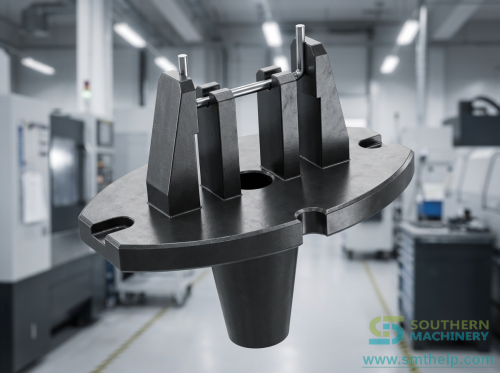
- Engineering fit around the part: The nozzle or gripper should be designed around the component body, available pickup surface, weight balance, and placement target.
These benefits still depend on the actual component, feeder condition, machine interface, PCB layout, and final technical confirmation. Southern Machinery should review samples, drawings, or production details before making a final recommendation.
Typical application scenarios
Custom SMT nozzles and grippers are most useful when the production team has already identified a repeatable bottleneck around specific component families. Typical scenarios include high-mix EMS production, industrial control boards, power electronics, LED products, automotive electronics modules, and medical electronics assemblies where reliability and traceability matter.
Common use cases include:
- Components that standard vacuum nozzles cannot hold reliably.
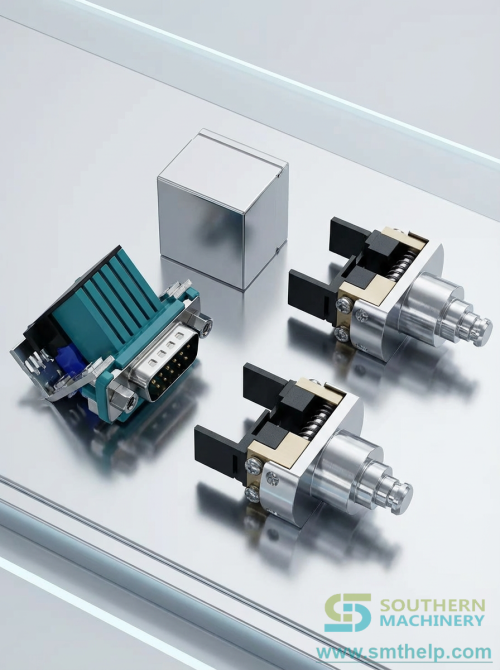
- Odd-form parts that require mechanical gripping instead of simple suction.
- Components that cause repeated placement errors or machine slowdowns.
- Parts currently inserted or positioned by operators after the SMT process.
- Product families where reducing manual intervention would improve line balance.
The source document also links to a gripper action video and a Southern Machinery SMT nozzle supplier catalog, which indicates that the tooling should be reviewed as part of a real engineering discussion rather than treated as an off-the-shelf commodity.
How it connects into a complete PCB assembly line
Custom nozzles and grippers are small compared with printers, placement machines, reflow ovens, AOI, or THT insertion equipment, but they influence the whole line. If the pickup tool is wrong, the line may lose time before reflow, after placement inspection, or during manual repair.
In a complete PCB assembly workflow, the tooling decision should be evaluated alongside:
- SMT section: printer, solder paste inspection if required, pick-and-place machine, reflow oven, and AOI.
- Feeding strategy: tray, tape, tube, stick, belt feeder, or other custom feeding method depending on component packaging.
- THT section: radial insertion, axial insertion, odd-form insertion, terminal insertion, or manual assisted insertion where needed.
- Board handling: loader, conveyor, buffer, unloader, inverter, magazine handling, and OK/NG sorting.
- Inspection and traceability: AOI, barcode tracking, production records, and process verification for quality-critical assemblies.
Southern Machinery, founded in Shenzhen, China in 2011, supports SMT and THT PCB assembly automation equipment for global factories. The broader value is that custom tooling can be considered together with SMT, THT, wave soldering, board handling, inspection, spare parts support, and professional training instead of being isolated from the production line design.
Key selection parameters to confirm
Before recommending a final custom nozzle or gripper, Southern Machinery should confirm the following details:
- Component photos, drawings, samples, and dimensions.
- Component weight, center of gravity, surface material, and pickup area.
- Current SMT machine brand, model, nozzle interface, and placement head constraints.
- Feeding format: tray, tape, tube, stick, bulk, belt feeder, or custom carrier.
- Required placement orientation, clearance, and nearby component restrictions.
- Current defect mode: missed pickup, rotation, dropped part, poor seating, damage, or slow manual handling.
- Target production volume, shift pattern, and current bottleneck location.
- Quality requirement and inspection method after placement.
This qualification step prevents overpromising. A custom gripper can solve many handling problems, but only if the component and machine interface are reviewed correctly.
ROI, quality, and capacity value
The strongest ROI case is not a guaranteed payback number. It is the removal of a repeated manual bottleneck. If a difficult component forces operators to slow the line, pause the machine, or correct placements, then custom tooling can improve the economics of the whole SMT process.
The value usually appears in four areas:
- Labor reduction: Less dependence on manual handling for difficult parts.
- Higher effective uptime: Fewer stoppages caused by unstable pickup or release.
- Quality stability: More repeatable placement can reduce avoidable rework pressure.
- Line integration: The SMT process becomes easier to connect with downstream THT insertion, wave soldering, inspection, and board handling.
Any numeric ROI, speed improvement, or defect reduction should be calculated from the customer’s real production data and confirmed after engineering testing.
FAQ
Can custom SMT nozzles and grippers replace manual handling completely?
They can reduce or remove manual handling for suitable components, but the final result depends on the part geometry, feeding method, SMT machine interface, placement clearance, and validation test.
Are these tools only for one SMT machine brand?
The source material describes custom-engineered solutions rather than a single universal part. Compatibility should be confirmed against the customer’s SMT machine model and nozzle interface.
What information is needed for a design proposal?
The most useful inputs are component samples or drawings, photos, current machine model, feeder format, PCB placement location, current handling problem, and target production volume.
Can this be used for high-mix EMS production?
Yes, high-mix EMS factories are a common fit when several products share difficult component families. The tooling plan should still be checked against changeover needs and part variation.
Does a custom gripper guarantee zero defects?
No. It can improve handling stability when correctly designed and validated, but quality also depends on feeding, machine setup, PCB design, inspection method, and operator process discipline.
Can Southern Machinery support this as part of a full line solution?
Yes. Southern Machinery focuses on SMT and THT PCB assembly automation equipment and can discuss custom tooling together with placement, THT insertion, wave soldering, board handling, inspection, spare parts support, and professional training.
CTA: send your difficult component details
If odd-form or difficult-to-handle components are slowing your SMT line, send Southern Machinery the component photos, drawings, current SMT machine model, feeder format, and the problem you see on the line. Our team can review whether a custom SMT nozzle or gripper is the right path and help you connect the tooling decision with a complete PCB assembly automation plan.
Comments