
Custom Radial Tape Feeder for SMT and THT Automation by Southern Machinery
Radial taped components like capacitors, varistors, LEDs, and connectors often keep mixed SMT/THT assembly lines dependent on manual handling. This buyer guide explains how a custom radial tape feeder prepares, cuts, for
Jul 4, 2026 · Updated Jul 4, 2026 · Southern Machinery
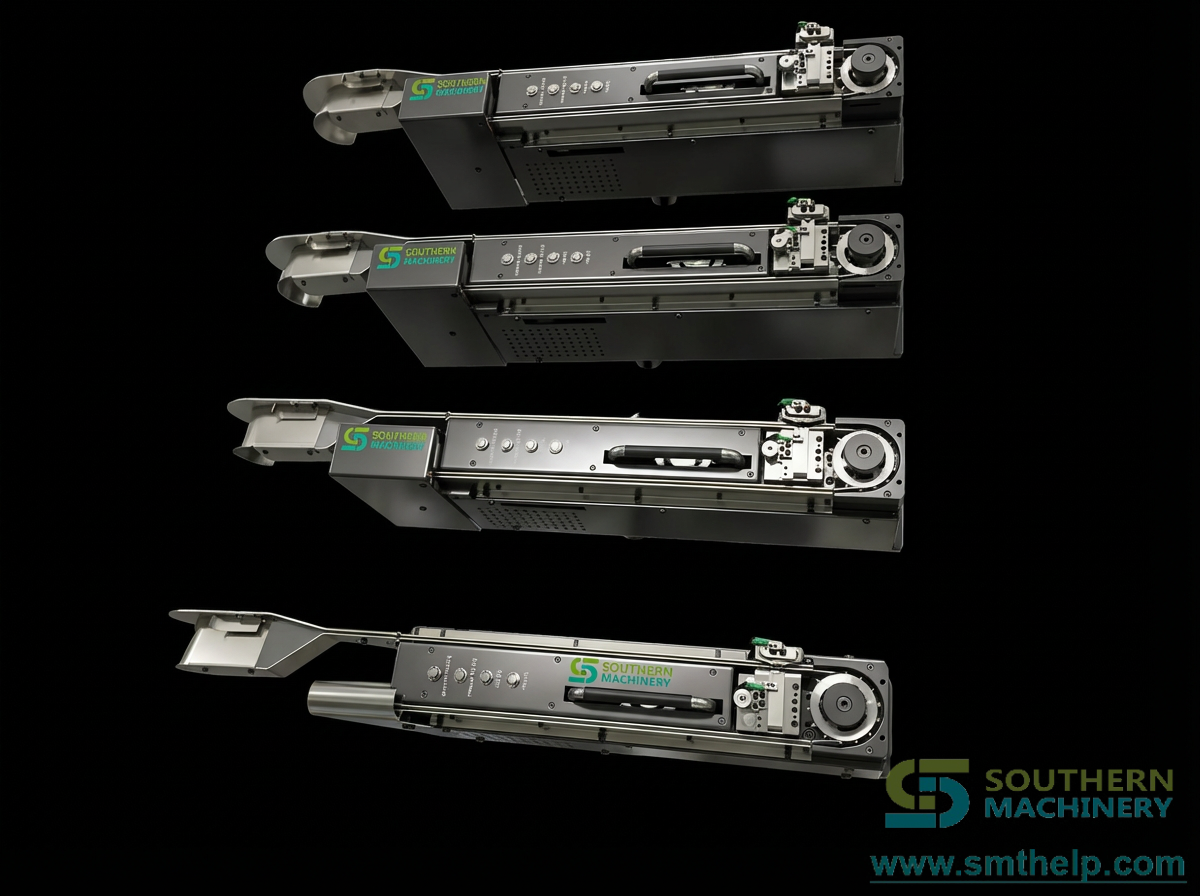
Custom Radial Tape Feeder for SMT and THT Automation by Southern Machinery
Radial components are still common in power supplies, LED lighting, industrial control boards, automotive electronics, and many mixed-technology PCB assemblies. The problem isn't the component itself—it's how to feed, cut, form, and present that component consistently when the rest of the SMT or THT line is already moving toward automation.
A custom radial tape feeder helps close that gap. It turns taped radial components into a repeatable pick-up source for a placement machine, radial insertion process, or robotic automation cell. For EMS factories, the value is simple: less manual handling, fewer setup errors, more stable component preparation, and a cleaner path toward automated through-hole assembly.
Southern Machinery, founded in Shenzhen in 2011, supports global EMS and electronics manufacturers with cost-effective SMT and THT PCB assembly automation equipment. For radial taped components, we can match or customize a feeder solution around your component body size, lead diameter, tape pitch, mounter interface, and full-line automation plan.
What is this machine used for?
A radial tape feeder feeds radial taped components—such as capacitors, varistors, LEDs, and connectors—into an automated assembly process.
In practical terms, the feeder handles the component tape, advances each part one by one, prepares the leads through cutting or forming when needed, and presents the component at a stable pick-up position. From there, a placement head, insertion head, or robotic arm can take the component, depending on the line design.
This is especially useful when a factory wants to reduce manual THT insertion without redesigning every product around surface-mount components. Many boards still need radial parts for electrical, thermal, mechanical, or cost reasons. A feeder-based approach lets the factory automate repetitive handling work while keeping the approved component package.
Why radial taped components become a bottleneck
In many EMS factories, the SMT line is already controlled and repeatable, but the THT side still depends heavily on operators. Radial parts are a common reason:
- The leads must be cut to the right length.
- Some parts need bending or forming before insertion.
- Tape pitch must match the feeder setup.
- Component orientation must stay consistent.
- Manual feeding creates variation between shifts and operators.
A modern radial tape feeder is not just a simple carrier. The source document describes it as a component preparation system with tape loading, tape advance, lead preparation, positioning, and pick-up. That process is what makes automation practical.
Typical applications
Custom radial tape feeders are usually considered for mixed SMT/THT products where radial through-hole parts appear in meaningful volume. Typical examples include:
- LED drivers and lighting control boards using radial capacitors or LEDs.
- Power supplies with varistors, capacitors, and other leaded protection parts.
- Industrial control boards that still require robust through-hole components.
- Automotive electronics where repeatable lead forming and insertion quality matter.
- High-mix EMS work where manual radial insertion is slowing down changeover and output.
If the same radial component appears across several products, the feeder can also support standardization across the factory. Instead of every line handling the component manually, the part can be prepared in a controlled way for the mounter, inserter, or robotic station.
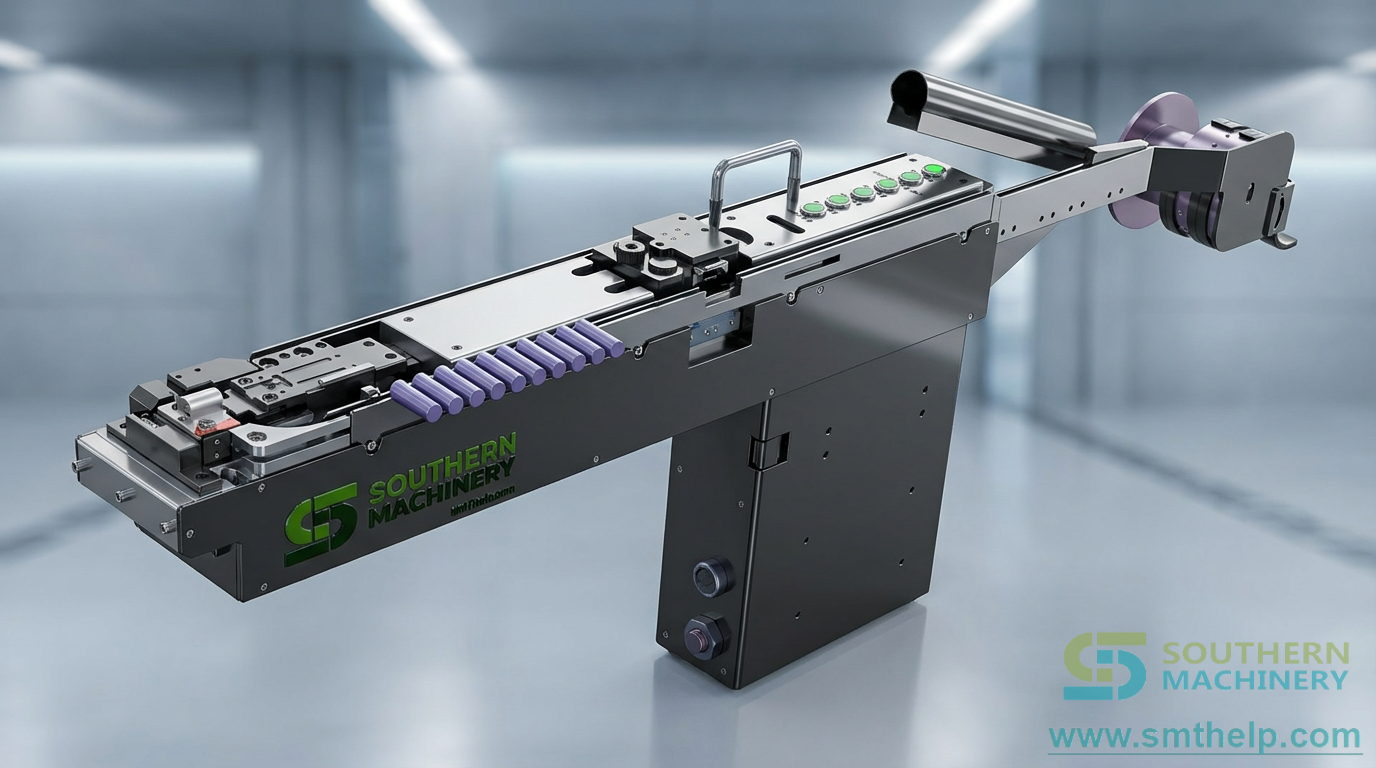
Key feeder functions
1. Tape loading
The radial component tape, sometimes called bandoleer tape, is loaded into the feeder. The feeder must guide the tape smoothly so that the component pitch and position remain stable.
2. Tape advance
The drive mechanism advances the tape step by step. This is important because the downstream machine expects each component to arrive at a predictable position.
3. Lead preparation
The source file highlights lead cutting, bending, and forming as key functions. This matters because the insertion process is only as stable as the lead geometry. If the lead length or bend is inconsistent, insertion quality drops.
4. Stable positioning
After preparation, the component must be held at a precise, repeatable pick-up coordinate. This is where a customized feeder can make a real difference, especially for non-standard body shapes or fragile components.
5. Pick-up by machine or robot
The final station presents the component for a placement nozzle, insertion head, or robotic arm. The mechanical interface, electrical signal, and working height need to match the target equipment.
Key selection parameters
Before recommending a final feeder configuration, Southern Machinery would normally confirm these points:
| Parameter | Why it matters |
|---|---|
| Component type | Capacitor, varistor, LED, connector, or other radial part affects tooling design. |
| Body size | The source range references body sizes from 2 x 2 x 2 mm to 15 x 15 x 30 mm. Final compatibility needs technical confirmation. |
| Lead diameter | The source range references 0.3 mm to 1.0 mm. Lead stiffness affects cutting, forming, and pick-up stability. |
| Tape pitch | The source notes 12.7 mm or 15 mm tape pitch, and these are not interchangeable. |
| Lead forming requirement | Straight cut, bent lead, formed lead, and insertion angle all change the mechanism. |
| Target machine | The feeder must match the SMT mounter, THT insertion machine, or robotic cell interface. |
| Required cycle time | The source notes less than 1 second per component as an example. Actual speed depends on component and configuration. |
| Feeding accuracy | The source references +/-0.2 mm feeding accuracy. Final value should be confirmed against the component and feeder build. |
| Air and power | The source references 24V DC and 0.4-0.6 MPa compressed air as typical requirements. |
These figures should be treated as source-document examples and are subject to final technical confirmation. For a real quotation, we would check your component drawing, tape specification, PCB insertion requirement, and target equipment interface.
How it connects into a complete PCB assembly line
A radial feeder should not be selected as an isolated accessory. It needs to fit the full PCB assembly process.
In an SMT-led mixed assembly line
The feeder may support an SMT mounter or special placement station when the component can be picked and placed before soldering. In that case, the line may include:
- PCB loader and conveyor.
- Automatic stencil printer.
- Pick-and-place machine.
- Custom radial tape feeder for selected leaded parts.
- Reflow or downstream soldering process depending on the component and PCB design.
- AOI or visual inspection.
- Board handling and unloading.
In a THT automation line
For boards with more through-hole content, the feeder can support a radial insertion process or robotic cell. A typical flow may include:
- PCB loader or manual loading station.
- Radial tape feeder with lead preparation.
- Radial insertion or robotic placement station.
- Clinching or fixture support if required by the process.
- Wave soldering or selective soldering.
- THT AOI, visual inspection, ICT, or FCT.
- Unloader, buffer, or NG/OK sorting.
In a smart EMS factory
When traceability is required, the feeder can be part of a wider material management and MES plan. The source document points to smart feeder and Industry 4.0 trends such as part-number recognition, quantity tracking, setup error prevention, and maintenance data. The exact integration scope depends on the feeder model and factory system.

ROI, quality, and capacity value
The strongest business case usually doesn't come from one single number—it comes from several smaller improvements working together.
First, labor dependency is reduced. Operators no longer need to manually pick, cut, form, and feed the same radial parts all shift. That reduces fatigue-driven variation.
Second, quality becomes more repeatable. Consistent lead length, forming, and pick-up position reduce the chance of insertion errors or rework.
Third, capacity becomes easier to plan. When radial feeding is stable, the THT side is less likely to become the hidden bottleneck after SMT output increases.
Fourth, setup discipline improves. For factories handling many products, matching tape pitch, feeder settings, and part data helps prevent avoidable changeover mistakes.
The source file includes an ROI calculator concept using investment cost, annual financial gain, and operating cost. That is the right way to think about this equipment: calculate payback from labor saved, defect reduction, throughput gain, and maintenance cost. The exact payback period should be calculated from your real labor rate, production hours, component count, and defect data.
Maintenance points to control
The source document highlights three common maintenance areas:
- Tape transport and feeding issues, often linked to tape loading, debris, or pitch mismatch.
- Component processing errors, often linked to worn cutting blades, forming die alignment, or unstable air pressure.
- Electrical and pneumatic faults, including worn seals, loose connectors, or jams causing motor overload.
For production use, we recommend preventive cleaning, scheduled replacement of wear parts, stable filtered air, and regular checks of tape path alignment. This is not complicated, but it must be treated as part of the process, not as an afterthought.
Why work with Southern Machinery
Southern Machinery is a Shenzhen-based manufacturer founded in 2011. We focus on high-efficiency, cost-effective SMT and THT automation equipment for PCB assembly factories.
For a radial tape feeder project, our value is not only the feeder itself. We can help review how the feeder connects with your mounter, insertion machine, board handling, wave soldering, selective soldering, inspection, and future traceability plan. Southern Machinery has served 237+ global customers with equipment, spare parts support, professional training, and practical engineering guidance for smart EMS factories.
FAQ
Can one radial tape feeder handle every component?
No. Tape pitch, body size, lead diameter, lead forming, and pick-up method all matter. Some components can share a feeder platform, but the tooling and settings must be confirmed.
What components are suitable for this type of feeder?
The source document lists capacitors, varistors, LEDs, and connectors as typical component types. Final suitability depends on the exact package, lead geometry, and tape format.
Can it be customized to any SMT mounter?
The source topic is customization to different mounters, but “any” should be confirmed case by case. We need the target machine brand/model, working height, signal interface, pick-up clearance, and component drawing before confirming.
Does the feeder replace a radial insertion machine?
Not always. The feeder prepares and presents the component. A radial insertion machine, placement head, or robot still performs the placement or insertion. In some projects the feeder is part of a complete insertion solution.
Is the ROI guaranteed?
No. ROI depends on your production volume, labor cost, defect rate, shift pattern, and maintenance discipline. We can help calculate an example after reviewing your component count and current manual process.
What should I send for a technical recommendation?
Send the component drawing or samples, tape specification, PCB drawing, current process flow, target output, and the target mounter or insertion machine model. With that, Southern Machinery can match the closest feeder configuration and identify any custom tooling needs.
CTA: confirm your radial feeder configuration
If radial taped components are slowing your SMT or THT line, share your component list, tape pitch, lead diameter, body size, and target machine model. Southern Machinery can review whether a custom radial tape feeder is the right solution and how it should connect into your complete PCB assembly line.
Comments
Southern Machinery Admin
Jul 4, 2026As an operator on the THT line, prepping radial components by hand is honestly one of the most tedious parts of the shift. When you have to manually cut the leads and bend them for hundreds of capacitors or varistors a day, your fingers get exhausted, and it’s way too easy for the cut length to be slightly off. If a lead is too long, the board sits unevenly; if it's too short, it doesn't catch the solder wave properly.Seeing that the Custom Radial Tape Feeder handles the tape advance, cutting, and lead forming automatically in less than a second is awesome. It means we can just focus on monitoring the line rather than fighting with component prep bottlenecks or dealing with bent pins that jam up the process. I hope our team looks into adding this to our next line upgrade—it would save us a lot of hand strain and rework hassle!