
Crawler-Type Shoe Bottom Cleaner: Cleanroom Entry Contamination Control for SMT and EMS Plants
Foot-borne dust and metal particles at the factory entrance reach the printing area. A crawler-type shoe bottom cleaner removes them at the source.
Sep 26, 2026 · Updated Sep 26, 2026 · Southern Machinery
Crawler-Type Shoe Bottom Cleaner: Cleanroom Entry Contamination Control for SMT and EMS Plants
Most yield investigations in an SMT/THT PCB assembly plant start at the solder paste, the reflow profile or the component reel. Some of them should start at the front door. Every operator, technician and visitor who walks into a dust-free workshop carries dust, sediment, fibres and fine metal particles in on their shoe soles — and that material is deposited exactly where printing, placement and insertion take place.
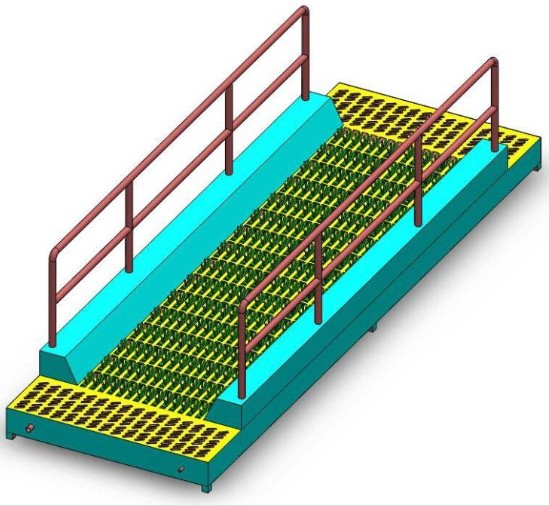
A crawler-type shoe bottom cleaner (often called a walkelator) is a walk-through cleaning platform installed at the entrance of a dust-free workshop, purification studio or air shower room. It removes that contamination at the source, before it ever reaches the production area. Southern Machinery supplies this unit as part of its SMT peripheral and process-support equipment range.
What is this machine used for?
It is used to clean the shoe soles of everyone entering a controlled production area. The operator walks across the platform; rotating brushes and a water-based cleaning section scrub the sole of each shoe, and the loosened dust, sediment and debris are captured in the machine's tank rather than tracked into the SMT cleanroom.
Southern Machinery's published specification for the unit describes a walk-through design that processes one worker in about three seconds, so a shift change does not queue up at the entrance. It is a facility-level contamination control, and it sits upstream of every process step in the plant — stencil printing, pick and place, reflow, THT insertion, wave soldering, inspection and cleaning.
Why foot-borne contamination matters in PCB assembly
Contamination control in electronics manufacturing usually focuses on the board, the stencil and the paste. Airborne and foot-borne particulate deserves the same attention:
- Fine particulate on the board surface interferes with solder paste release, wetting and fillet formation, and is a recognised contributor to solder defects and rework.
- Metallic particles and debris carried into the placement area create short-circuit and bridging risk and complicate inspection.
- Fibres and dust on stencils and tooling increase cleaning frequency, because apertures and fixtures foul faster.
- Inspection noise — contamination on pads and joints is one of the everyday drivers of false calls at AOI and SPI, which costs engineering time even when the product is good.
- Cleanroom discipline — 5S and ISO 9001/ISO 14001 programmes ask for evidence that entrance contamination is managed, not just assumed.
A sticky mat or a disposable adhesive pad handles the first few steps. A walk-through cleaner handles the whole entrance, continuously, with a water tank and a mesh plate you open to remove the collected sediment and sundries.
How the crawler-type walkelator works
The unit is built as a walk-over platform rather than a machine an operator stops at:
| Element | Published description |
|---|---|
| Body / supporting structure | high-quality 304 stainless steel plates |
| Cleaning action | crawler-type brush system that cleans shoe bottoms as the operator walks through |
| Water section | large-capacity water tank; open the mesh plate to clean out the collected particles and sundries |
| Safety / usability | water-shortage alarm; handrails and a defined walkway |
| Sizing | can be customised to the customer's target size |
| Throughput | one worker in approximately three seconds |
| Optional | disinfectant can be sprayed in the cleaning section |
The walk-through concept is what makes it usable in practice. A cleaning step that takes ten seconds per person and requires a stop works for a visitor entrance but fails at a shift change of several hundred operators; a platform that is simply part of the walkway does not.
Where it fits in an SMT / THT PCB assembly facility
A controlled electronics plant has a natural sequence of environmental barriers. The shoe bottom cleaner belongs to the first one:
- Factory entrance / locker room — the crawler-type cleaner is placed at the entrance of the dust-free workshop, purification studio or air shower room.
- Air shower — high-velocity air removes loose particulate from garments.
- Production area — stencil printing, SMT placement, reflow, THT auto insertion, wave and selective soldering, AOI/SPI and cleaning.
- Material and tooling stores — stencil, pallet and fixture cleaning, reel storage and material management.
Because the cleaner is a facility-level control, it complements — rather than replaces — in-process cleaning. Boards still need stencil cleaning, pallet and fixture cleaning, and PCBA cleaning after wave soldering; the difference is how much contamination load reaches those steps in the first place.
Typical application scenarios
- EMS / contract manufacturers running mixed SMT and THT lines for several customers, where a single shift change can move hundreds of people through the entrance.
- Automotive electronics, where particle and metal contamination control is part of the customer audit checklist.
- Medical and industrial-control electronics, where low-volume, high-reliability builds cannot absorb avoidable rework.
- LED and lighting manufacturing, where dust on the board shows up directly in appearance and optical inspection.
- Power supply and appliance PCBA plants, where high-volume lines need the entrance to stay non-blocking.
- Any plant preparing for a cleanliness upgrade — ISO 9001/ISO 14001 evidence, 5S audits or a customer cleanroom requirement.
Key selection parameters checklist
The published figures for the exact configuration are confirmed at quotation. The categories below are the ones worth specifying with your supplier, because they decide whether the unit fits your entrance and your headcount:
- Effective walkway width and length — must suit the doorway and the flow of people.
- Number of lanes (single / double) and the resulting throughput in persons per minute.
- Brush / belt type and bristle material, and whether it handles wet or dry soles.
- Water tank capacity, filling method, drainage arrangement and whether a plumbed supply is available.
- Body material and finish — the published unit uses 304 stainless steel plates.
- Water-shortage alarm and any optional disinfectant spray function.
- Customisation to the target size — the published unit is offered as a size-customised platform.
- Handrail configuration and anti-slip treatment of the surrounding floor.
- Electrical supply and the protection rating of the drive compartment.
- Consumable and spare-part availability — brushes, belts and absorbent pads.
- Surface treatment of the walkway for ESD-safe footwear compatibility.
Maintenance: what a realistic schedule looks like
The published maintenance guidance for the unit is short and practical, which matters for a piece of equipment that lives at a busy entrance:
- Daily — remove garbage and sediment from the sewage tank and the water pump tank; using a vacuum cleaner to extract the sediment gives the best result.
- Every other day (shoe-changing areas) — clean the platform thoroughly.
- At intervals — clean the belt brush; hand-held pouring of water into the brush is sufficient.
- Every three months — add lubricating oil to the chain gear.
- Irregularly — clean the equipment surface, and clean or replace the absorbent pad according to use.
The return: contamination, throughput and rework
The business case for entrance contamination control is not a single number. It is the sum of several ordinary costs:
- Non-blocking throughput — roughly three seconds per worker keeps the entrance from becoming the bottleneck at shift start.
- Fewer contamination-driven rejects — less particulate and debris reaching printing, placement and inspection means fewer solder defects and fewer false calls to chase.
- Lower consumable spend elsewhere — cleaner incoming conditions extend the working life between stencil cleaning and pallet cleaning cycles.
- Audit evidence — a documented entrance control is a straightforward answer in 5S, ISO 9001/ISO 14001 and customer cleanliness audits.
- Durability — a 304 stainless steel body and a simple brush-and-tank mechanism keep the cost of ownership in the consumable parts, which is where it should be.
How it connects to a complete SMT / THT line
Southern Machinery, established in Shenzhen in March 2011, supplies SMT and THT PCB assembly automation equipment and services to 237+ customers worldwide, backed by CE, ISO 9001 and ISO 14001 certifications. The portfolio covers the full line — stencil printing, SMT placement, reflow, THT auto insertion (radial, axial, odd-form and tube-feeding), wave and selective soldering, board handling, dispensing, depaneling, reflow/wave consumables, AOI/SPI, and cleaning equipment for stencils, pallets, PCBA and reels — plus spare parts, sub-assemblies, retrofit kits, operator training and machine overhaul.
That breadth is the point: the entrance cleaner, the stencil cleaner, the pallet cleaner and the PCBA cleaning machine all belong to the same contamination-control strategy, and specifying them together is cheaper and more coherent than buying them one at a time.
FAQ
What is a crawler-type shoe bottom cleaner used for?
It cleans the shoe soles of people entering a dust-free workshop, purification studio or air shower room, removing dust, sediment and debris before it reaches the production area. It is a facility-level contamination control installed at the entrance.
Where exactly should it be installed?
At the entrance of the dust-free workshop or purification studio, or inside the air shower room, positioned as part of the normal walk-in path so that no one has to stop or detour.
How long does it take each person to pass through?
Southern Machinery's published figure is approximately three seconds per worker, which is what allows the unit to work at shift change rather than only at a visitor entrance.
Can it be customised to our doorway?
Yes. The published unit is described as customisable based on the customer's target size, and configuration is confirmed at quotation.
What maintenance does it need?
Daily removal of sediment from the sewage and water pump tanks (a vacuum cleaner is the practical method), periodic cleaning of the belt brush, lubricating oil on the chain gear every three months, and cleaning or replacement of the absorbent pad as required.
Does it replace stencil, pallet or PCBA cleaning?
No. It reduces the contamination load entering the plant. In-process cleaning of stencils, pallets, fixtures and assembled boards is still required, and Southern Machinery supplies those machines as part of the same line.
Can it help with ESD control?
It is part of the same entrance discipline as ESD flooring, ESD footwear and grounded workstations. Your footwear and flooring specification should be confirmed together with the supplier so the walkway surface and the footwear programme are compatible.
Talk to Southern Machinery about your entrance configuration
If you are planning a cleanliness upgrade, a customer audit or a new SMT/THT line, Southern Machinery can advise on entrance contamination control and on the in-process cleaning equipment that goes with it.
- Configuration advice and quotation: jasonwu@smthelp.com — send your doorway dimensions, number of operators per shift change and cleanroom class.
- Equipment catalogue and technical files: https://file.autoinsertion.com
- Machine photos and installation references: https://ph.smthelp.com
- Website: https://www.smthelp.com
Specifications quoted above are the published figures from the Southern Machinery product page for this unit; final configuration, dimensions and options are confirmed at quotation.
Comments