
Capacitor Lead Cut & Forming Machine: From Bulk EPCOS Parts to PCB-Ready in One Pass by Southern Machinery
The S-EPCOS capacitor lead cut and forming machine turns loose, bulk EPCOS-style film capacitors into PCB-ready parts - leads trimmed, bent 90 degrees in X and Y, K-leg formed - at roughly 1,000 pcs/h with one operator.
Sep 2, 2026 · Updated Sep 2, 2026 · Southern Machinery
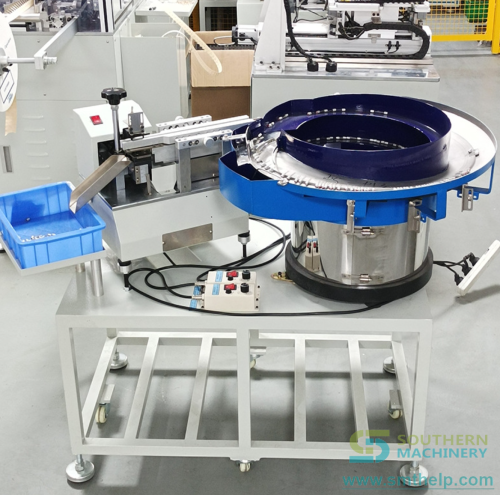
Capacitor Lead Cut & Forming Machine by Southern Machinery
What is a capacitor lead cut and forming machine used for? It turns loose, bulk EPCOS-style film capacitors into PCB-ready parts — leads trimmed to length, bent 90° in X and Y, K-leg formed and spring-back corrected — in one continuous 8-station cycle at roughly 1,000 pcs/h, with one operator loading the vibration bowl. Southern Machinery builds the S-EPCOS to print: dies are cut from your capacitor drawing, so every part in the batch matches the customer's "as-assembled to PCB" form.
One Operator, 1,000 Shaped Capacitors Per Hour
Most factories still treat capacitor lead forming as a hand-skill problem. It isn't. It's a fixturing problem. The S-EPCOS feeds loose, bulk capacitors straight from a vibration bowl, and roughly 1,000 pieces per hour leave the machine cut, bent and K-legged — while one operator loads parts and the machine does the positioning. The 10th part matches the 1,000th because a fixed indexer disc, not a tired wrist, controls every bend.

Why Hand-Forming Fails Your Through-Hole Line
If your bench still shapes capacitor leads by hand, every one of these costs is already in your inspection and audit reports.
Cut length and bend angles drift
Operators snip leads one capacitor at a time; cut length drifts across a shift and between operators. The 90° X/Y bend and K-leg shape shift by hand — the same part rarely matches the drawing twice in a row. Customers specify forms like "as-assembled to PCB, 2 mm R1.3, R0.8 max, 18.5 mm max"; hand work makes compliance a lottery.
Throughput becomes a staffing problem
Thousands of bulk capacitors a day become a headcount problem — hand work paces the whole line. A mis-cut or over-bent leg is a rejected part at inspection: rework at best, waste at worst. And loose parts, lead offcuts and hand tools across the bench are a 5S and ESD liability.
The 8-Station Cycle to Judge Any Forming Machine
Use this station map as a checklist when you evaluate any capacitor lead cut and forming machine — if a station is missing, the form will be inconsistent somewhere.
- Bowl loading — one operator feeds loose capacitors into the vibration bowl.
- Vibration alignment — parts align into a single row; a sensor confirms position.
- Pick & place — the gripper takes each capacitor into the indexer with fixed positioning.
- Lead cutting — upper/lower die trims both leads; scrap falls to the waste chute.
- X 90° forming — leads bent 90° in the X direction.
- Y 90° forming — 90° in Y, plus front/back bending.
- K-leg & reshape — dedicated K-leg station; secondary reshaping corrects spring-back.
- Discharge — finished parts exit via conveyor into the collection box.
Selection parameters that actually matter
Before you specify a machine, pin down these inputs from your own drawing and volumes: body length, body diameter, lead length, required lead form (bend radius and max dimensions), input format (bulk vs. taped), capacity target, and site utilities (power, air, floor space). If a vendor cannot map each of these to a station or a tooling decision, keep shopping.
The S-EPCOS Capacitor Lead Cut & Forming Machine
The S-EPCOS is Southern Machinery's custom bulk-capacitor lead cut and forming machine — a non-standard, indexer-disc design built around one customer drawing at a time.
Tooled from your drawing, not guessed
In the reference project (drawing UE001UTT1A-01, Hanon/Magna), body length, body diameter and lead length are checked against the drawing before tooling is cut, and samples are re-checked after forming. The required form — as-assembled to PCB, 2 mm R1.3, R0.8 max, 18.5 mm max — is held by fixed dies and indexer positioning, batch after batch. Cut trimmings drop into a dedicated waste chute and never mix back into product flow.
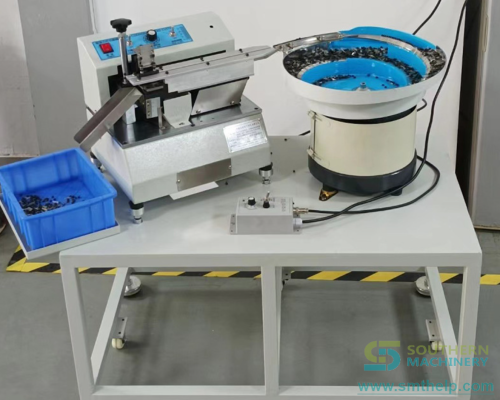
S-EPCOS key specifications (from the technical agreement)
| Parameter | Value |
|---|---|
| Model | S-EPCOS (custom bulk capacitor forming machine) |
| Machine type | Non-standard lead cutting & forming machine, indexer disc design |
| Working stations | 8: cut → X 90° → Y 90° → K-leg → secondary reshape → discharge |
| Capacity | ≥ 1,000 pcs/h |
| Power supply | AC 220 V ±10%, 50 Hz |
| Air supply | 5–7 MPa per technical agreement — flagged for verification (likely 0.5–0.7 MPa); confirm with Southern Machinery engineers |
| Dimensions (L×W×H) | ≥ 1,800 × 1,200 × 1,900 mm |
| Weight | ≥ 190 kg |
| Feeding | Manual bowl loading + vibration track + position sensor |
| Control | Integrated control panel, vibration-speed regulator, sensor-confirmed cycles |
| Output | Collection conveyor + receiving box |
Where it sits in your PCB assembly line
The S-EPCOS is the pre-insertion step: shaped capacitors feed manual or automatic THT insertion, then wave or selective soldering. It fits the through-hole stage of Southern Machinery's complete PCB assembly solutions, alongside the THT machine range — auto insertion, lead cutting and odd-form solutions from a Shenzhen manufacturer founded in 2011, serving 237+ global customers with installation guidance, training, spare parts and remote support (global services).
The ROI math (example — depends on configuration)
Daily shaped parts needed = boards/day × capacitors/board
Machine hours needed      = parts ÷ machine rate (≥1,000 pcs/h per source)
Hand-forming hours today  = parts ÷ your measured manual rate
Operator-shifts freed     = (hand hours − machine hours) ÷ 8
Example (illustrative only — substitute your own numbers; subject to final technical confirmation): 4,000 capacitors/day ÷ 1,000 pcs/h = 4 machine-hours. If your bench forms 250 pcs/h per operator (example assumption — not specified in source, measure your own), the same volume takes 16 hand-hours — two operator-shifts — versus one bowl-loading operator. Machine price is not specified in source — contact Southern Machinery to confirm; final tooling, lead form and air-supply settings are confirmed against your drawing before production.
From Drawing to Running Line in Five Steps
The repeatable path from problem to running line has five steps: (1) send your capacitor drawing, a sample and annual volume; (2) engineers review tooling against body size, lead length and the exact form; (3) the machine is configured, built and test-run; (4) on-site installation guidance and operator training with a trial on your parts; (5) after-sales support — spare parts, remote help, follow-up. Keep this series bookmarked: next up is how automatic terminal and fuse-assembly machines fit the same THT front-end — and how to decide between forming in-house versus ordering pre-formed parts.
FAQ: What Buyers Ask Before Ordering
Which capacitors can the S-EPCOS process?
Bulk EPCOS-style film capacitors — loose parts, no tape. Body length, body diameter and lead length are tooled to your drawing; send it for a fit check.
Does it really hold the K-leg shape?
Yes. K-leg forming is a dedicated station after the X and Y 90° stations, followed by secondary reshaping — so forms like 2 mm R1.3 with 18.5 mm max hold across the batch.
How is the machine fed?
One operator loads loose capacitors into the vibration bowl; the track aligns them into a single row and a material sensor confirms position before each cycle. No taping or pre-arranging.
What does it need on site?
AC 220 V ±10% 50 Hz power, a pneumatic supply, and about 1.8 × 1.2 m of floor space (machine ≥1,900 mm high, ≥190 kg). Air pressure must be confirmed with our engineers before installation.
Can forming change for a different capacitor?
Cutting dies and forming tooling are drawing-specific — a different capacitor means re-tooling. Send the new drawing and engineers will confirm what changes.
How do I get a quote?
Email info@smthelp.com or WhatsApp +86 136 0256 2576 with your drawing, required lead form and annual volume. You get a tooling review and quote — typically within one working day.
Send Your Drawing for a Tooling Review
Next step: email [info@smthelp.com](mailto:info@smthelp.com) or WhatsApp +86 136 0256 2576 with your capacitor drawing, required lead form (bend radius, max dimensions) and annual volume — or use the quote request page. Southern Machinery's engineers confirm tooling, configuration and delivery before you commit. Browse the full machine catalog at file.autoinsertion.com and machine photos at ph.smthelp.com, or learn more about Southern Machinery — your Shenzhen-based SMT & THT equipment partner since 2011.
Comments