
Burr-Free PCB Router Separator S300AS by Southern Machinery
Burr-free PCB router separator for SMT and THT panels: S300AS dual-table milling depaneling, ±0.02 mm edge accuracy, dust extraction, about 120 boards/hr.
Oct 7, 2026 · Updated Oct 7, 2026 · Southern Machinery
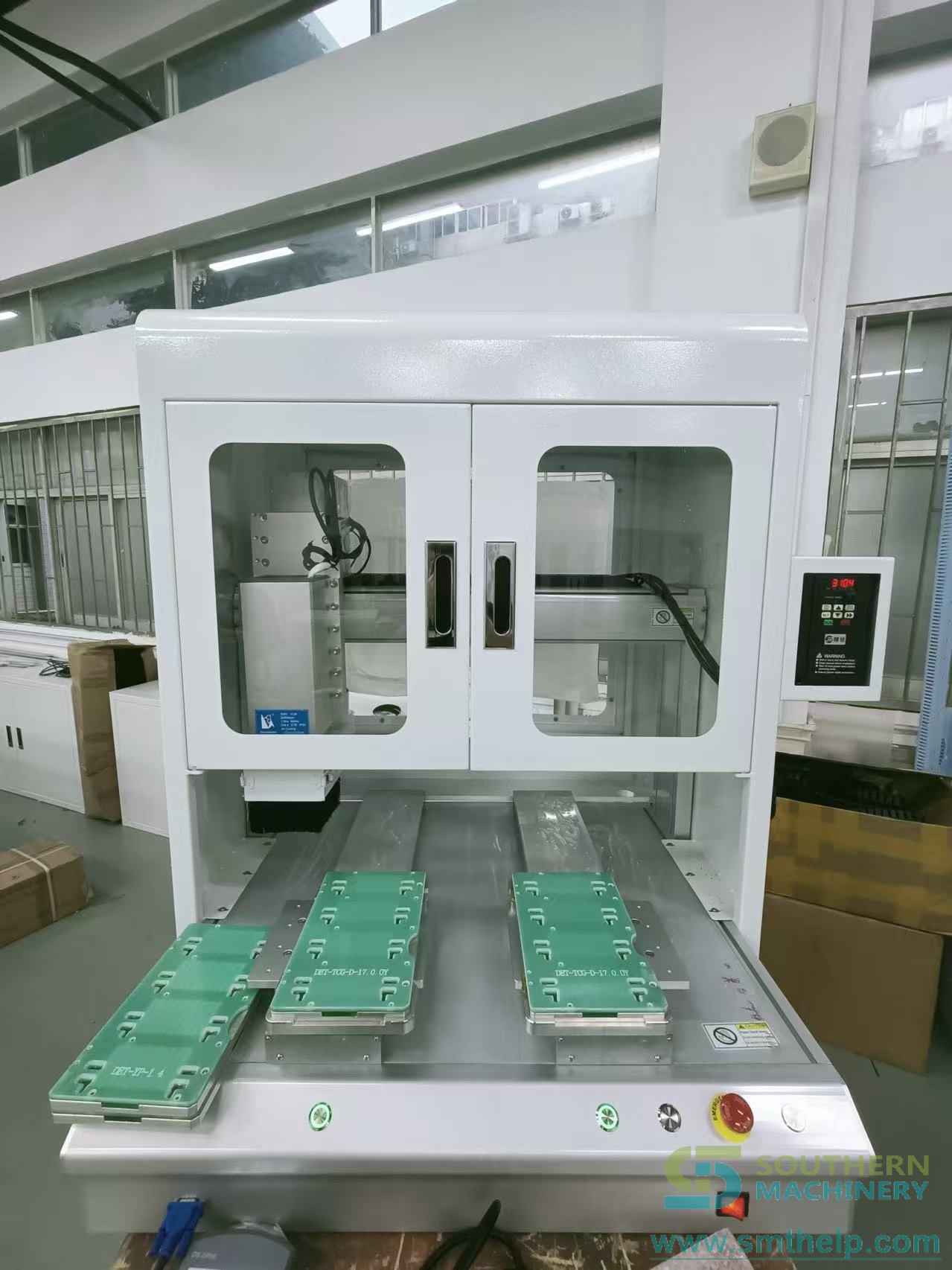
A PCB router separator turns a multi-up panel into single boards by milling the route with a rotary cutter instead of snapping the panel on a blade. The Southern Machinery S300AS desktop PCB router runs a 600 × 400 mm X/Y cutting range, an 800 W precision milling spindle, ±0.02 mm repeatability and two fixtures with independent dust trays in an alternating cycle. We document about 120 boards per hour on that dual-table cycle, roughly double the typical manual rate of about 60 boards per hour — and, more importantly, boards exit clean and burr-free.
What is a PCB router separator used for?
A PCB router separator removes the material that still holds a panel to its individual boards: the tabs of a V-cut, the webs between stamp-hole arrays, and the odd-form contours of a mixed-technology panel. It sits after soldering and before functional test, and it is the last operation that can still scrap a fully assembled board.
Unlike a V-cut separator, which depends on a straight grooved line, a milling router follows a contour. On the S300AS the path is taught point by point from the handheld LCD teaching box or imported as a DXF / PLT file with automatic path optimization. That covers both a straight V-cut panel and a curved LED board from the same machine.
Milling a contour instead of snapping a groove
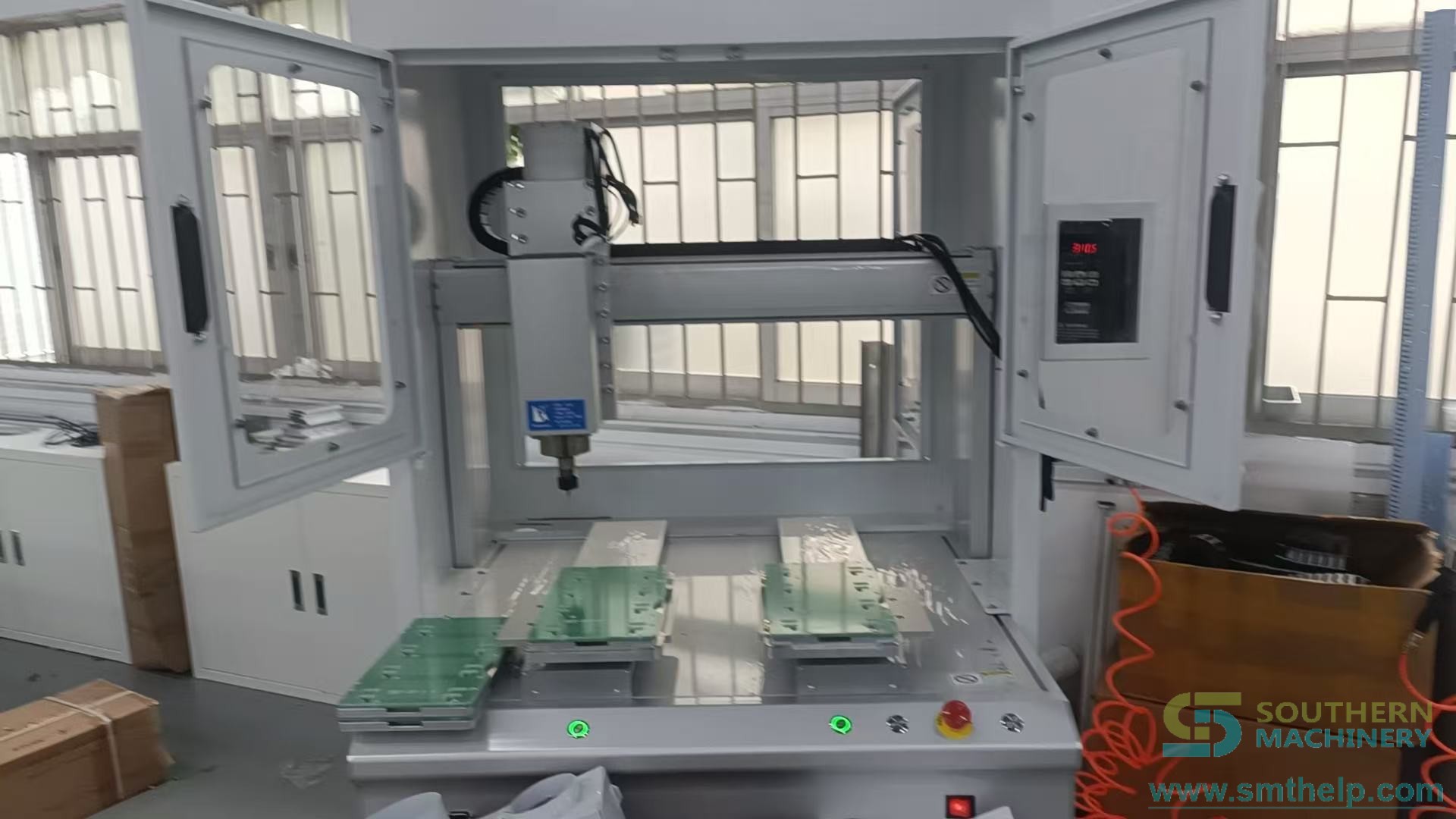
A blade separator concentrates force along a groove — fast and cheap, but limited to straight lines and predictable materials. A router spends spindle time instead of blade force: the 800 W spindle machines the tabs away, the tool never loads the assembly, and the edge follows the CAD path rather than the operator's wrist. Accuracy and repeatability are specified at ±0.02 mm.
Which panels the S300AS covers
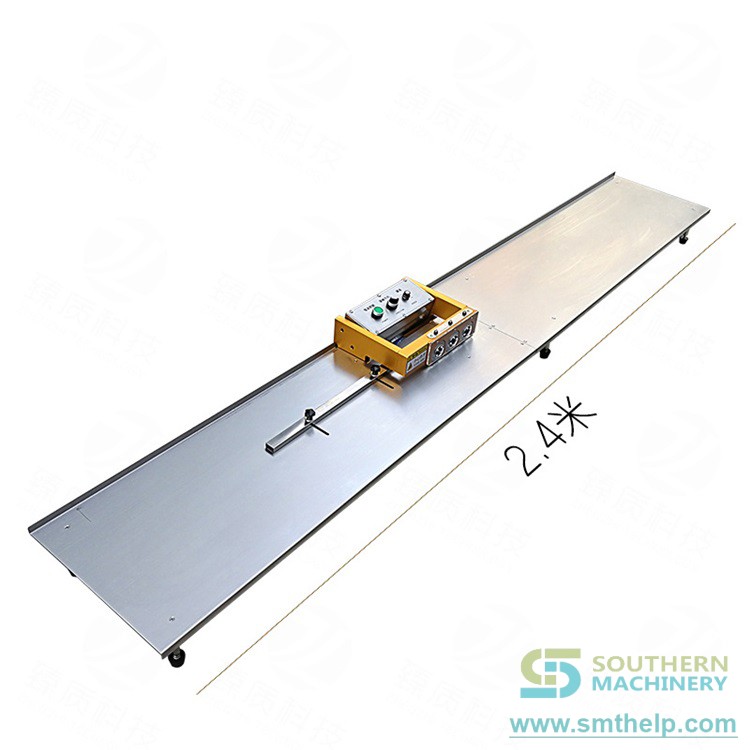
The S300AS is documented for V-cut depaneling, stamp-hole separation and curve milling on FR4, aluminum and LED panels, held in purpose-made bakelite fixtures with a maximum fixture load of 10 kg. Confirm your panel dimensions, material, component clearance and routing path before quotation.
Why does hand depaneling leave burrs, dust and scrapped panels?
Hand depaneling is not inaccurate because operators are careless. It is inaccurate because the process has no machine reference: cut speed, cut depth and cut position all vary with the person holding the tool.
Burrs and rough edges that fail your quality standard
Hand tools leave burrs, fibers and uneven edges. On a high-reliability assembly those edges become a soldering, coating and inspection problem downstream, and rework on a finished board costs far more than the seconds a cleaner cut would have cost. A milling cutter is specified for clean, burr-free edges: the spindle removes material on a controlled path instead of fracturing it.
Dust and debris clinging to a finished assembly
Cutting FR4 by hand generates dust that settles on the assembly, turning depaneling into a cleaning and ESD problem. The S300AS collects it in two independent trays under the two fixtures, capturing material at the point of cutting.
Over-cut, missed cuts and operator dependency
Hand tools overshoot or skip, and one wrong cut destroys a whole panel of finished boards. The S300AS stores 1000 program records (8000 instructions per file) and recalls them instantly per product, so the cut is identical on the first board of a batch and on the thousandth.
How does the S300AS milling cycle work?
Four documented steps carry the panel to clean single boards, with the dust extracted while the spindle cuts — no blades to sharpen and no force applied to the board.
1. Load the panel into one of the two product fixtures.
2. Teach points, or import a DXF / PLT path with automatic path optimization.
3. The 800 W spindle mills straight lines, arcs and curves along the trajectory.
4. Dust is collected; boards exit clean and burr-free.
Why the alternating dual table doubles throughput
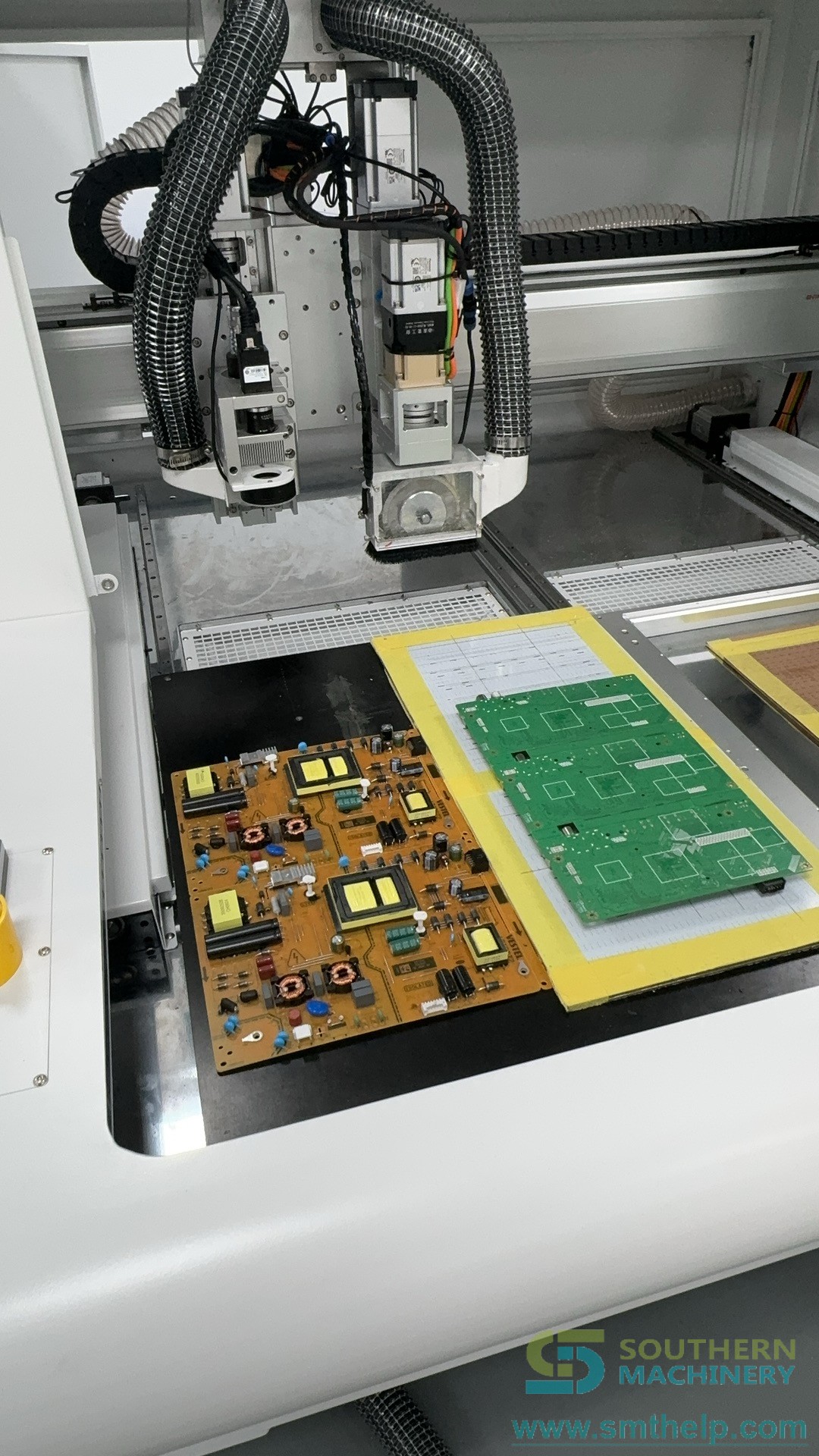
The two fixture stations run in an alternating cycle: while the spindle cuts the panel in one fixture, the operator unloads finished boards and loads the next into the other. Loading overlaps cutting, so the spindle stays busy instead of waiting for a human — the mechanism behind the documented comparison of about 120 boards per hour against about 60 for typical manual depaneling.
Which specifications should a buyer confirm before ordering?
Every value below comes from the Southern Machinery S300AS product sheet; final configuration is confirmed against your panel layout.
Equipment dimensions (L × W × H) — 1350 × 800 × 1900 mm
Cutting range X / Y — 600 / 400 mm
Z clearance and Z travel — 400 mm / 100 mm
Tool head — precision milling cutter
Spindle power — 800 W
Repeatability / cutting accuracy — ±0.02 mm
Movable trajectory — points, straight lines, arcs, full circles, curves, polylines, helices, ellipses
Programming method — teach programming, or graphic import (DXF / PLT with automatic path optimization)
Control method — microcontroller with handheld LCD teaching box
Program record capacity — 1000 sets; 8000 instructions per file
Movement speed — 0–500 mm/s
Maximum fixture load — 10 kg
Fixture material — bakelite, purpose-made
Motor system — Shinano Electric, Japan
Driver and linear guide — YAKO driver, HIWIN Taiwan linear guide
Power input — full voltage AC 110–220 V
External control interface — RS232
Two things are intentionally absent: a price and a delivery date. Both depend on fixture design, panel mix and routing program, so they are quoted per project. Anything a source document does not state is not specified in source — contact Southern Machinery to confirm.
What does burr-free depaneling cost compared with hand depaneling?
Payback on a depaneling router is driven by throughput and by the boards it saves, not only by the operators it replaces. Use this shape:
annual labour removed   = (boards per year / manual rate) - (boards per year / router rate)
annual saving           = labour removed x loaded operator cost per hour + panels saved x board value
simple payback (months) = investment / (annual saving / 12)
Illustrative example only. Take 200,000 boards a year. At the documented manual rate of about 60 boards per hour that is roughly 3,333 operating hours; at the documented dual-table rate of about 120 boards per hour it is roughly 1,667. The difference of about 1,666 operator-hours a year, at an illustrative loaded cost of USD 12 per hour, is about USD 20,000 of labour capacity released before any credit for panels no longer lost to burrs or over-cut.
Every non-machine figure above — shift pattern, operator cost, board volume, board value and the investment itself — is an illustrative placeholder, depends on configuration, and is subject to final technical confirmation against your own cost model. Southern Machinery does not publish or guarantee an ROI figure; the arithmetic is here so your engineering and finance teams can run it on your numbers.
How does the S300AS fit a complete PCB assembly line?
Depaneling is a line-end operation, and a router separator only pays back when the operations around it are stable. Typically the panel is printed and placed on the SMT side, soldered by reflow for SMT content and by wave soldering for THT and odd-form content, and only then routed into single boards.
- Upstream: SMT line equipment for printing, placement and reflow.
- Through-hole joining: wave soldering systems for the THT content a router cannot replace.
- Line-end handling: board handling and conveyor systems between stations.
- Depaneling: the PCB separator and depaneling router category.
The RS232 external control interface is the detail worth flagging in a line-integration review: it lets the depaneling station be tied to a host or cell controller instead of running as a stand-alone bench. Browse the machine catalog at file.autoinsertion.com.
Technical evaluation FAQ
What panel sizes can the S300AS route? Cutting range is 600 mm × 400 mm with 400 mm Z clearance and 100 mm Z travel. Confirm your panel dimensions and component height — if the board is larger, Southern Machinery can recommend the next model in the series.
How is the cutting path programmed? Teach programming from the handheld LCD controller, or DXF / PLT import with automatic path optimization, covering points, lines, arcs, circles, curves, polylines, helices and ellipses.
What accuracy and edge quality should we expect? Repeatability and cutting accuracy are specified at ±0.02 mm, and the 800 W precision milling spindle is documented to produce neat, stable edges without burrs.
How fast is it compared with manual depaneling? Manual depaneling is typically about 60 boards per hour; the S300AS dual-table alternating cycle is documented at about 120 boards per hour, and the operator only loads panels and presses start.
Does it handle V-cut, stamp holes and odd-form boards? Yes — the milling cutter routes V-cut panels, stamp-hole arrays and odd-form contours, held in purpose-made bakelite fixtures. Send a panel for a free cutting test to confirm your geometry.
What about warranty and support? A 1-year free warranty with free prototype testing before purchase, spare cutters and remote guidance afterwards. Power input is full voltage AC 110–220 V, external control interface RS232.
Next step: send a panel for a free cutting test
Tell Southern Machinery your panel dimensions, material and board quantity, or ship a sample. You get a cutting evaluation on your own boards plus a quotation with the right fixture and routing program, before you commit to the machine. Founded in Shenzhen in 2011 and serving 237+ customers worldwide, Southern Machinery builds SMT and THT PCB assembly automation equipment with full-line integration, spare parts and operator training.
Comments