
Bare Board Destacker Loader (SLC460) by Southern Machinery: How to Feed Bare PCBs into an SMT or THT Line
A bare board destacker loader is the machine that starts an SMT or THT line: it lifts a stack of unpopulated PCBs and releases them one at a time onto the conveyor, so printing, Pick and Place, insertion and soldering begin without an operator handling every board by hand. This guide from Southern Machinery covers the documented SLC460 bare board destacker loader - a 200-board stack at 0.4 mm board thickness, 460 mm maximum PCB width, PLC control and a SMEMA signal - where it fits in a complete PCB assembly line, how to pair it with a stacker or magazine unloader at line exit, the parameters to confirm before you buy, and the quality, ESD and throughput arguments for automating bare board feeding.
Sep 25, 2026 · Updated Sep 25, 2026 · Southern Machinery
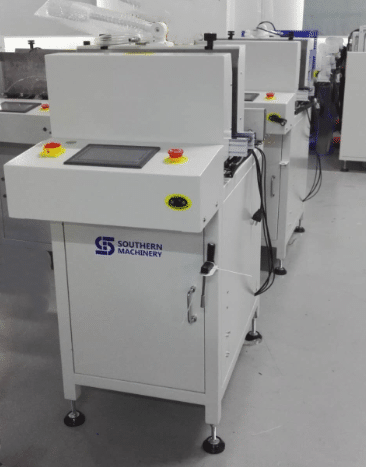
Bare Board Destacker Loader (SLC460) by Southern Machinery: How to Feed Bare PCBs into an SMT or THT Line
Every PCB assembly line begins with a stack of unpopulated boards and ends with a stack of finished ones. In between, printing, Pick and Place, Reflow Oven, Wave Soldering, insertion and inspection all depend on one thing: boards arriving at the right place, the right way up, at a steady rate. The bare board destacker loader is the machine that makes that happen. It lifts a stack of bare PCBs, separates the bottom board, and delivers it onto the line conveyor one piece at a time — without an operator picking up every panel by hand.
Southern Machinery has designed and manufactured SMT/THT PCB assembly automation equipment in Shenzhen since 2011, and serves 237+ customers worldwide. This guide covers the documented SLC460 bare board destacker loader, where it belongs in a complete line, how to pair it with a stacker or magazine unloader at the exit, the parameters you should confirm before ordering, and the quality and throughput case for automating bare board feeding.
What is a bare board destacker loader used for?
A bare board destacker loader — also written as destacker loader, unstacker or bare board loader — is a board handling machine installed at the input of an SMT or THT line. It holds a vertical stack of bare PCBs on a lift platform, uses a pusher/lift mechanism to release the bottom board from the stack, and transfers that single board onto the conveyor so the first process station (stencil printer, mounter, gluer or insertion machine) receives one board at a time.
Its job is not to add process capability — a destacker does not print, place or solder anything. Its job is to remove a manual, repetitive, damage-prone step from the line entry and to pace the line: board after board, at a consistent interval, at the correct transfer height, with the correct orientation, until the stack is empty. Then the operator reloads the stack and does something with higher value than unstacking PCB panels.
At the other end of the line, a stacker PCB unloader performs the mirror-image function: it collects finished boards from the outfeed conveyor and stacks them neatly, ready for depaneling, inspection rework, kitting or packaging. Destacker loader at the front, stacker unloader at the back is one of the most common automation pairs in an EMS factory, because it converts both ends of the line from manual workstations into self-feeding buffers.
Where the destacker loader sits in the line architecture
A useful way to think about line entry is to ask three questions: Are my boards already in a magazine? Are they bare or populated? Do I need to change board type frequently? The answers determine which loader class fits.
- Bare boards, supplied loose or in deep stacks, high-volume, one board type at a time → a bare board destacker loader such as the SLC460.
- Boards already loaded in an ESD magazine / rack → a magazine loader (Southern Machinery's SLD series), which indexes the magazine and pushes boards out one by one.
- Bare boards needing vacuum pick-up for very thin or large panels → a bare board vacuum loader such as the S-V500.
- Boards that must enter along a second lane or bridge between lines → buffer and bridge modules such as the S-350C buffer conveyor, SPD330 shuttle conveyor, S-460 90-degree turning conveyor or SBN250 NG buffer.
Southern Machinery supplies all of these entry classes, plus magazine unloaders, NG/OK unloaders after AOI, temporary storage machines and PCB turnover machines, so the destacker does not have to be specified in isolation. It has to be specified as one node in a SMEMA-compatible board handling chain.
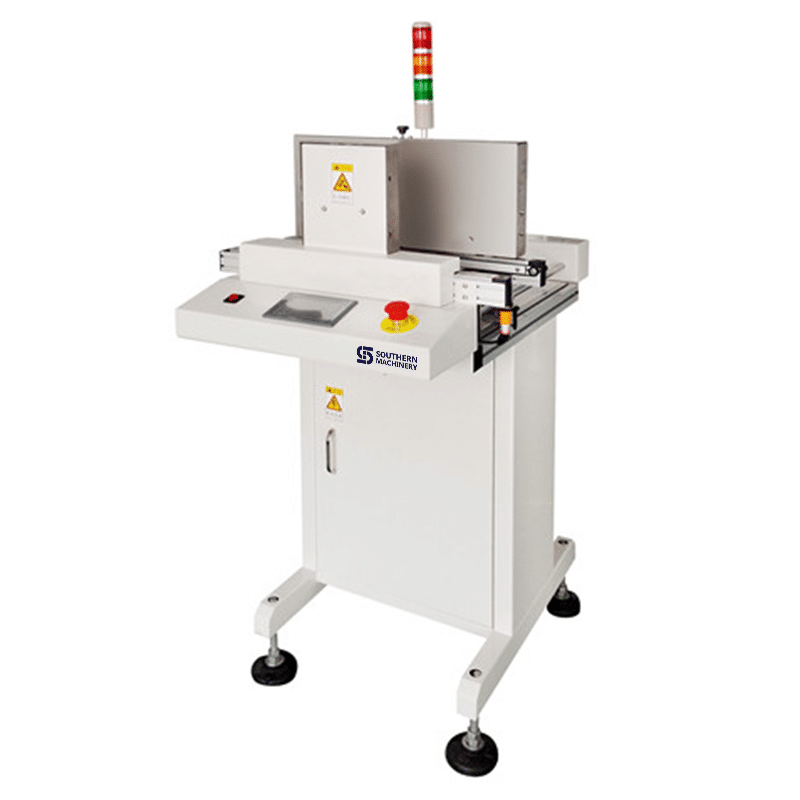
Documented SLC460 bare board destacker loader specifications
The parameters below are the ones Southern Machinery publishes for the SLC460 bare board destacker loader. They are listed here exactly as documented so that engineering and procurement teams can check compatibility against their own board and line requirements.
| # | Parameter | Documented value |
|---|---|---|
| 1 | Model | SLC460 |
| 2 | Function | Bare board destacker (PCB loader) |
| 3 | Stack capacity | 200 boards, at 0.4 mm board thickness |
| 4 | PCB width | Max 460 mm |
| 5 | PCB transport direction | Left to right (L → R) |
| 6 | Conveyor height | 900 ± 20 mm |
| 7 | Conveyor speed | 0 – 10000 mm/min |
| 8 | Control system | PLC |
| 9 | Number of drives | 1 belt |
| 10 | Communication plug | SMEMA signal |
| 11 | Power supply | Single phase 220 V, 50/60 Hz, 80 W |
| 12 | Dimensions (L × W × H) | 889 × 589 × 1200 mm |
| 13 | Net weight | 180 kg |
Documented construction features for the destacker / stacker series:
- Steel frame structure
- Transmission adopts stepper motor
- Laminated action parts made of aluminum alloy
Two machinery generations are documented for this design — a newest design and an old design — which matters in practice: if you are adding a destacker to an existing line that already contains an older unit, ask Southern Machinery to confirm which generation is currently shipping and whether mechanical and control interfaces are interchangeable.
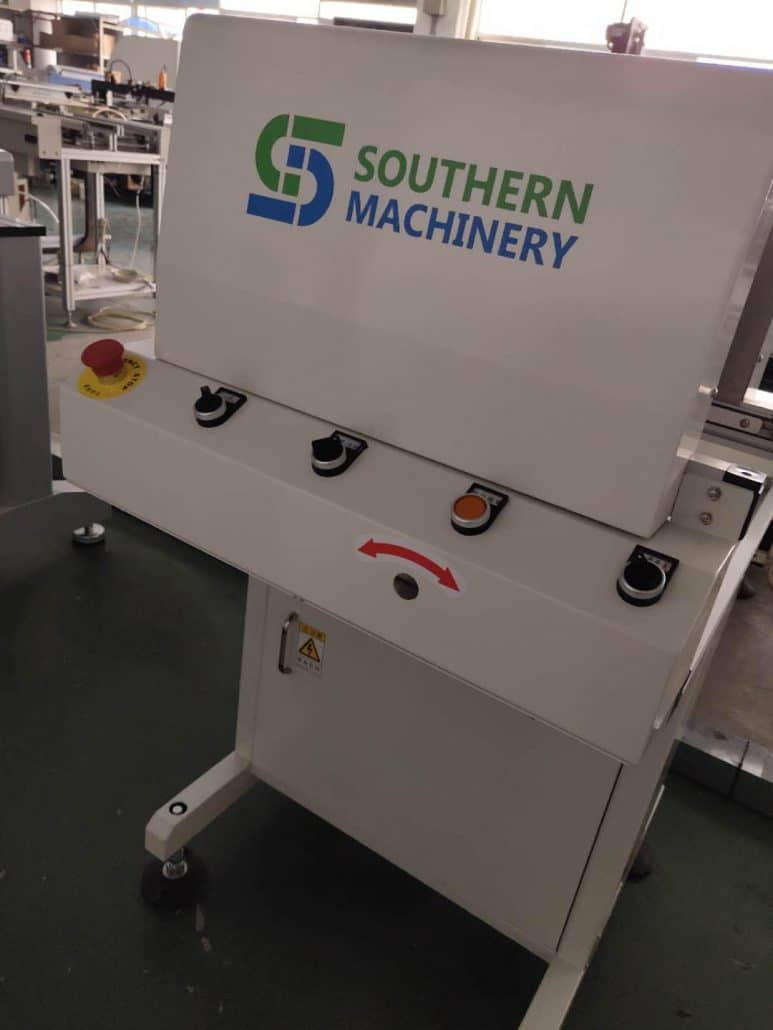
What the 200-board stack capacity really means
Stack capacity is a function of board thickness, not a fixed number of panels. The SLC460 is documented as holding a 200-board stack at 0.4 mm board thickness. If your boards are thicker, the physical stack height fills up sooner, so fewer boards fit; if your boards are thinner and more flexible, the lift and separation behaviour changes and the stack may need to be kept shorter to avoid board flex and mis-picks.
This is why the productive question at quotation stage is not "how many boards does it hold?" but:
- What is the actual board thickness and stack height you want to load?
- What is the board size range (the SLC460 document covers up to 460 mm width)?
- How long can the line run between stack reloads, and does that match your operator walk-around interval?
- Do the boards have break-away tabs, large cut-outs, or unsupported areas that need a different separation approach?
Southern Machinery reviews Gerber data, panel construction and board thickness before recommending a loader configuration, precisely because stack capacity, separation reliability and board support are interdependent.
Typical application scenarios
EMS and contract manufacturing, high-mix to high-volume
A shared SMT line that runs many different assemblies benefits from a destacker because board changeover is a magazine-free operation: restack the new board type and run. Where the same product runs for days, the destacker keeps the first station fed continuously without an operator standing at the infeed.
Power supply, ballast and energy-saving lighting
These products often use large, thick, FR4 panels with heavy copper. A destacker loader feeding a printer or insertion line removes the manual panel-lifting step that causes edge damage and operator fatigue, and it presents each panel to the line squarely.
LED lighting and LED display boards
Long, thin LED boards are awkward to handle by hand and prone to bowing. Loading from a properly supported stack rather than from a hand-carry between machines reduces the flex events that crack solder joints and damage components.
Appliance, automotive and industrial control electronics
Where traceability and consistent takt matter, an automated entry point standardises the interval between boards, which makes downstream cycle-time analysis meaningful instead of being masked by manual feeding variation.
THT and mixed SMT/THT lines
A destacker is not only an SMT device. Lines that run a printer, an axial or radial insertion machine, an odd-form inserter and a Wave Soldering machine also benefit from automated bare board entry, especially where panels are heavy.
Destacker loader vs. magazine loader: how to choose the line entry method
| Consideration | Bare board destacker loader (SLC460 class) | Magazine loader (SLD class) |
|---|---|---|
| Board input format | Loose / stacked bare boards | Boards pre-loaded in ESD magazine |
| Magazine handling | Not required | Magazine load, index and return |
| Changeover between board types | Restack the boards | Swap or reload magazine |
| Best fit | High-volume single board type, or magazine-free feeding | Lines already running magazine logistics and rack storage |
| Documented SLC460 figures | 200-board stack at 0.4 mm, 460 mm max width, PLC, SMEMA | See SLD series documentation |
Some production environments want both: Southern Machinery also documents a PCB magazine and destacker combo loader, which can switch between stacking-plate feeding mode and frame (magazine) feeding mode according to the situation, and is documented with a precision lead screw motor control system, touch screen plus PLC control, strip transmission surface, L → R transport direction, AC 220 V 50/60 Hz 150 W power supply and an adjustable conveying height of 880–920 mm. If your board mix changes between magazine-fed and stack-fed products, the combo loader can remove the need for two separate entry machines — but confirm your board thickness range with Southern Machinery, because the combo unit is documented differently from the stack-fed SLC460.
How to integrate the destacker into a complete PCB assembly line
1. Match conveyor height and direction
The SLC460 is documented at a conveyor height of 900 ± 20 mm with L → R transport. Confirm the transfer height of the first machine in your line and its own direction before ordering; direction and height mismatches are the most common cause of a "works on the bench, not in the line" installation.
2. Close the SMEMA handshake
The SLC460 documents a SMEMA signal communication plug. In practice this means the destacker's board-available / board-requested signals must be wired and understood by the neighbouring machine. During commissioning, verify the handshake in both directions — the destacker should not release a second board until the downstream machine is ready to accept it, and the downstream machine should not fault when the stack runs empty.
3. Define the entry station and its process
The destacker feeds whatever comes first. On an SMT line that is normally a stencil printer or a glue dispenser; on a THT line it may be an axial or radial insertion machine. Confirm that the entry machine's own board-clamping and centring behaviour tolerates a board delivered by belt transfer, and that the conveyor speed range (documented 0 – 10000 mm/min) can be tuned to the slowest machine in the chain.
4. Plan the exit, not just the entry
Pair the destacker with the right exit device: a stacker unloader for bare-board return, a magazine unloader (SULD series) for rack-based logistics, an NG/OK unloader after AOI for sorting, or a wave unloader after Wave Soldering. A destacker that feeds the line faster than the exit can clear it simply moves the bottleneck.
5. Add buffering where the line is unbalanced
If the printing station or the insertion cell has a longer cycle than the entry, a buffer module between the loader and the first process machine absorbs the mismatch. Southern Machinery documents a buffer conveyor, a shuttle/translational conveyor and a temporary storage machine for exactly this purpose.
6. Handle bare boards with ESD discipline
Bare boards entering the line are unprotected. Ground the machine, work on a properly grounded ESD floor or mat, and keep the boards in ESD-safe transport racks before and after loading. The destacker removes manual contact, but it does not replace an ESD control programme.
Key selection parameters to confirm before you buy
Use this as the checklist to send to Southern Machinery with your enquiry. Everything here is either a documented SLC460 parameter or a question your own process data must answer.
Machine-side, documented: - Model and function: SLC460 bare board destacker loader - Maximum PCB width: 460 mm - Conveyor height: 900 ± 20 mm - Transport direction: L → R - Conveyor speed range: 0 – 10000 mm/min - Control: PLC - Drives: 1 belt - Communication: SMEMA signal - Power: single phase 220 V, 50/60 Hz, 80 W - Footprint and mass: 889 × 589 × 1200 mm, 180 kg
Buyer-side, to confirm with your own data: - Actual PCB thickness range and required stack height / reload interval - Whether your boards are stack-fed, magazine-fed, or a mix of both - Board construction: break-away tabs, cut-outs, edge clearance, panel bow - Required transfer height and direction of the first process machine - SMEMA or non-SMEMA interface on the neighbouring equipment - ESD environment, floor loading and available floor space - Whether the line needs an exit-side counterpart (stacker, magazine unloader, NG/OK unloader)
ROI, quality and throughput perspective
Automating bare board feeding pays back through three mechanisms, and it is worth separating them when you build the business case.
1. Removing a manual work element. Picking up and presenting every bare panel is a low-value, high-repetition task. When one person is released from unstacking, the value of that labour, multiplied by shifts and by the lines involved, is the simplest part of the ROI calculation. Use your own loaded labour rate — do not accept a vendor's generic percentage.
2. Reducing board damage and scrap at the very first step. A damaged board that enters the line consumes the full cost of everything downstream before it is scrapped: paste, components, insertion time, reflow energy and inspection. Handling panels from a supported stack instead of a manual transfer reduces the drop, edge-knock, flex and ESD events that cause early-line defects and latent failures.
3. Stabilising takt. When the entry interval varies because a human is loading, downstream cycle-time data is noisy and bottleneck analysis is unreliable. A PLC-controlled loader with a documented 0 – 10000 mm/min conveyor range delivers boards on a repeatable cadence, which makes it possible to balance the line on real data. For EMS factories running MES and traceability, a consistent entry point also makes board-in timestamps meaningful.
None of these three depends on an inflated throughput claim. They depend on your labour rate, your board value and your line balance — which is exactly why the sizing conversation should start with your board stack, not with a specification sheet alone.
FAQ
What is a bare board destacker loader?
It is a board handling machine at the input of an SMT or THT line that separates bare PCBs from a stack and feeds them onto the conveyor one at a time. In Southern Machinery's documentation the SLC460 is a bare board destacker (PCB loader) rated for a 200-board stack at 0.4 mm board thickness and a maximum PCB width of 460 mm.
Does a destacker loader replace a magazine loader?
Not always — they solve different logistics. A destacker loader feeds loose, stacked bare boards and needs no magazine. A magazine loader feeds boards already loaded in an ESD magazine or rack. If your line mixes both formats, Southern Machinery also documents a magazine-and-destacker combo loader that can switch between stacking-plate and frame feeding modes. Confirm your board thickness range before choosing.
Is the SLC460 SMEMA compatible?
The SLC460 is documented with a SMEMA signal communication plug, which is the standard board-handling handshake between adjacent equipment. During commissioning, verify the handshake in both directions with whichever machine sits immediately upstream and downstream of the loader.
What conveyor height and direction should I specify?
The documented SLC460 transfer height is 900 ± 20 mm, and the documented transport direction is L → R. Measure the transfer height and direction of your first process machine and confirm they match before ordering; height and direction are the two most common causes of installation rework.
Can the destacker feed a THT insertion line, not just an SMT line?
Yes. Bare board entry is useful on any line where panels are heavy or board handling is repetitive, including radial and axial insertion, odd-form insertion and dip or Wave Soldering lines. The loader's job is to present a board, not to define the process that follows it.
What should I send Southern Machinery for a configuration recommendation?
Send your board size range and thickness, panel construction (tabs, cut-outs, bow), required stack height or reload interval, the transfer height and direction of the neighbouring machine, your board input format (stack, magazine or both), and whether you need an exit-side counterpart such as a stacker or NG/OK unloader. Southern Machinery reviews Gerber files and component packaging before recommending equipment.
Contact Southern Machinery for configuration advice
Tell us your board type, panel size, thickness, target output and automation level, and Southern Machinery will match the right loader class — destacker, magazine loader, vacuum loader or combo — plus the buffer, conveyor, unloader and inspection modules needed to complete the line.
- Email: jasonwu@smthelp.com
- Phone / WhatsApp: +86 13602562576
- Website: https://www.smthelp.com
- Browse the full product catalogs and documents: https://file.autoinsertion.com
- See machine photos by model: https://ph.smthelp.com
Southern Machinery Sales And Service Co., Ltd — established 2011 in Shenzhen, China. Designers and manufacturers of SMT/THT PCB assembly automation equipment, delivering complete line solutions across SMT, THT, Wave Soldering, board handling and inspection, with spare parts, retrofit, training and global service support.
Comments