
Bulk Axial to Radial Taping Machine for THT Auto Insertion | Southern Machinery
Loose axial-lead resistors, diodes and capacitors are the cheapest way to buy through-hole components — and the hardest to feed into an automatic insertion line. Southern Machinery's axial-to-radial taping machine forms each component's leads, controls orientation and polarity, and tapes the parts into standard radial carrier tape, so a part that arrived in a bulk bag leaves as a feeder-ready reel. Building in Shenzhen since 2011 for 237+ global customers, Southern Machinery supplies this taping stage alongside its radial and odd-form insertion, wave soldering and SMT platforms. This guide explains what the machine does, where it pays back, how it fits a complete PCB assembly line, and what to evaluate before you buy.
Sep 12, 2026 · Updated Sep 12, 2026 · Southern Machinery
Bulk Axial to Radial Taping Machine for THT Auto Insertion | Southern Machinery
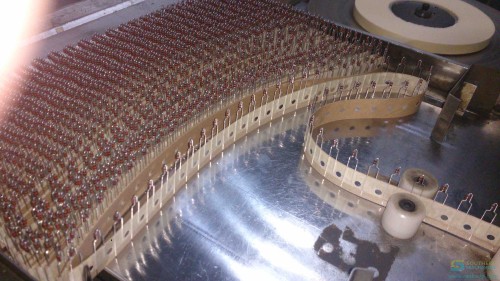
Axial-lead resistors, diodes and capacitors cost less in bulk bags than on finished tape and reel — but a bulk bag cannot feed an automatic insertion machine. Southern Machinery's axial-to-radial taping machine closes that gap. It takes loose axial components, forms each lead set, checks orientation, and tapes the parts into standard radial carrier tape, so a part bought by the kilogram leaves the machine as a feeder-ready reel. The short demo above shows the conversion running on a Southern Machinery taping platform.
<iframe width="100%" height="480" src="https://www.youtube-nocookie.com/embed/_ixWTgu1ejM?rel=0" title="Bulk Axial electronic components to Radial taping machine for Smart EMS factory PCB assembly" frameborder="0" allow="accelerometer; autoplay; clipboard-write; encrypted-media; gyroscope; picture-in-picture; web-share" referrerpolicy="strict-origin-when-cross-origin" allowfullscreen></iframe>
Direct link: watch the axial-to-radial taping demo on YouTube
What is this machine used for?
An axial-to-radial taping machine is a material-preparation machine for the THT (through-hole technology) side of PCB assembly. It exists to solve one specific mismatch: the component your purchasing department buys cheapest and the component your insertion machine can actually accept are usually packaged differently.
- Axial components have their two leads emerging from opposite ends of the body (classic carbon-film resistors, diodes, axial capacitors). They are cheap, widely available loose in bags, boxes, or ammo-pack, and they are not ready to feed a radial insertion machine.
- Radial tape is what auto-insertion machines and radial tape feeders expect: the component leads point the same way, the bodies sit in a line on a standard carrier-tape pitch, and the reel indexes one part after another into a fixed pick position.
The axial-to-radial taping machine is the bridge between the two. Bulk axial parts are fed in, each lead set is straightened and formed to a consistent pitch, component orientation and polarity are controlled, and the finished parts are sealed into radial carrier tape — box or reel — ready for the insertion line.
In Southern Machinery's portfolio this is the S-250ART automatic axial component lead forming and vertical taping machine, part of a wider automatic forming-and-taping family that also covers SMD forming and taping (S-120FCSMD), radial component taping (S-300BSTD), spring-contact welding and taping (S-300RT), flat-terminal taping (S-350) and gas-discharge-tube forming and taping (S-60TP). For factories that also need to repack tray, tube and bulk parts into tape and reel for SMT mounters, the semi-automatic SJL80A reel taping machine handles that side of the material-prep room.
The practical point for a buyer: this machine is not a placement machine. It is the upstream machine that decides whether you can buy the cheaper component format and still run it automatically — or whether you keep a manual forming-and-taping bench feeding the line by hand.
Typical applications
Axial-to-radial taping pays back wherever axial-lead components appear in volume and the purchased package format does not match the insertion line:
1. Cost-driven EMS and ODM factories. When purchasing buys bulk or ammo-pack axial resistors and diodes to cut component cost, the taping machine recovers the feeder-ready format without reintroducing manual labor. The saving on the component is kept; the labor is removed.
2. High-mix SMT/THT lines. On a line that changes product every few days, a new build often needs an axial part that the supplier ships only loose or in ammo-pack. An automatic taping machine converts a small quantity on demand instead of forcing an expensive special-order reel or a manual bench job.
3. Lighting and display electronics. LED drivers, lighting control boards and display boards carry axial and radial resistors, diodes and capacitors in high volumes — exactly the part mix that benefits from automated forming and taping before insertion.
4. Power supply, ballast and adapter PCBA. Switch-mode and linear supplies use axial diodes, resistors and small capacitors alongside radial parts; consistent taped format keeps the insertion station fed without operator intervention.
5. Component distributors and kitting services. Operations that prepare feeder-ready reels for downstream assembly customers use automatic forming-and-taping to deliver reels that match the customer's carrier-tape standard.
6. Prototype and NPI departments. Small quantities of reeled axial components can be produced quickly on-site instead of waiting for supplier re-taping lead times.
How it fits into a complete PCB assembly line
The taping machine lives in the material-preparation stage, one step in front of the insertion line — and it only pays off when the whole flow around it is understood.
- SMT side first. Solder paste printing, SPI, pick-and-place and reflow build the SMD side of the board. Southern Machinery's SMT range — including the S-530L semi-automatic pick and place for LED and lens mounting — covers the surface-mount portion.
- Material preparation. Here the taping equipment sits, alongside SMT smart reel storage and the SMD X-Ray chip counter. The SJL80A semi-automatic reel taping machine repacks tray, tube and bulk components into embossed carrier tape with heat or pressure (PSA) sealing, empty-pocket detection and adjustable 8–72 mm / 8–200 mm tape tracks, at packing speeds up to 400 metres per hour. The automatic forming-and-taping family — with the S-250ART handling axial component lead forming and vertical taping — prepares formed, taped parts for the insertion stations.
- THT insertion block. Radial insertion machines such as the S-3010B and S-3000 take taped radial components (capacitors, transistors, LEDs), while an odd-form inserter such as the S-70LD handles non-standard parts — transformers, relays, connectors and terminal blocks. All of them depend on steady, correctly taped component supply; a taping machine upstream is what keeps that supply from becoming the constraint.
- Downstream. Inserted boards pass through lead-free wave soldering (the S-WS450 or the PC-controlled S-WS350B dual-wave machine), then cleaning, AOI and functional test.
- Supporting ecosystem. Board handling systems, PCB separators, stencil and nozzle cleaning machines, custom nozzles and Southern Machinery's spare-parts, training and retrofit services complete the line around the taping and insertion stations.
Because the taping stage sets the feed quality for every insertion machine downstream, the tape pitch, orientation and seal quality should be specified together with the line architect — not decided in isolation by the repacking bench.
Key selection parameters
If you are evaluating an axial-to-radial taping machine, confirm the following against your actual components. Only parameters documented by the equipment builder for your machine configuration should be treated as fixed; everything else is an item to validate with sample parts:
- Component envelope. Body diameter and length, lead diameter, and the axial lead span of the parts you intend to tape. The machine must be specified for your real component family, not a generic "small axial parts" description.
- Package format in and out. What arrives (bulk bag, box, ammo-pack, tube, tray) and what must leave (radial/vertical carrier tape, box or reel). Also confirm collating/feeding method for the loose input.
- Lead forming specification. Target lead pitch, bend geometry and cut length — these must match what the downstream insertion machine and its feeder expect. Forming accuracy is the parameter that determines insertion yield.
- Orientation and polarity handling. How the machine controls component orientation and, for polarised parts such as diodes and electrolytic capacitors, whether polarity is checked during the pass so reversed parts never enter the reel.
- Throughput class. Parts per minute or metres of tape per hour, expressed against your insertion line's demand — the taping machine must outpace the machine it feeds, with margin for changeovers. (For reference, Southern Machinery's S-300B molding-and-taping platform is documented at 180 ± 20 parts per minute; the SJL80A semi-auto reel taper is rated up to 400 metres per hour. Your required figure depends on your part mix and line speed.)
- Tape standard and seal method. Carrier-tape width and pitch compatibility, cover-tape sealing by heat or pressure (PSA), and whether empty-pocket detection and low-cover-tape sensing are included.
- Output packing and traceability. Box or reel output, label format, and whether the machine records which component lot went into which reel.
- Integration and automation level. Inline (SMEMA) versus standalone operation, program storage for your part family, and how quickly the machine changes over between component types.
- Utilities, footprint and support. Power, air, floor space, and the supplier's installation, training, spare-parts and retrofit coverage.
ROI and quality perspective
From a buyer's perspective, the business case for axial-to-radial taping is a chain of four effects, each of which can be measured on your own floor:
- Component cost. Bulk axial parts are almost always cheaper per piece than finished reels. Automatic taping is what lets you capture that saving without giving it back in labor.
- Labor and bottleneck removal. Manual forming and taping is a bench job that scales only with headcount and becomes the schedule when the insertion line is faster than the bench. Automating the taping stage removes that dependency and the training and turnover risk that comes with it.
- Insertion yield. Lead pitch and bend accuracy set directly translate into insertion success at the radial machine. Inconsistent formed leads cause misinsertions and bent pins that are only caught at AOI or functional test — and every late-caught defect carries desoldering, hole-cleaning and re-soldering rework. Consistent forming upstream attacks that cost before the board is ever built.
- Orientation defects. A reversed polarised component that reaches the reel becomes a field-failure risk. Polarity checking during the taping pass stops the defect at the source rather than relying on downstream inspection.
The calculation is not "what does the machine cost" but "how many parts per week am I forming and taping, what does the bench cost me in hours and rework, and what does the cheaper bulk package save me." Run it with your own volumes and part mix rather than a generic assumption.
FAQ
What does an axial-to-radial taping machine do?
It converts loose or bulk axial-lead components — resistors, diodes, axial capacitors — into radially oriented carrier tape. Each part's leads are straightened and formed to a consistent pitch, orientation and polarity are controlled, and the parts are sealed into tape in box or reel format so an auto-insertion machine or radial tape feeder can pick them from a fixed position.
Why convert axial components to radial tape?
Because radial tape is the input format radial insertion machines and radial tape feeders accept. Axial components are typically cheaper and more widely available in bulk; converting them to radial tape lets you buy the cheaper package format and still run it automatically, without a manual forming-and-taping bench.
Is this the same as an SMD taping machine?
No. An SMD taping machine (such as the semi-automatic SJL80A) repacks surface-mount components from trays, tubes and bulk into embossed carrier tape for pick-and-place mounters. An axial-to-radial taping machine handles through-hole axial-lead components, forms their leads, and produces radially oriented tape for the THT insertion line. Southern Machinery builds both, along with radial, terminal, spring-contact and gas-discharge-tube forming-and-taping platforms.
Can the machine check component polarity while taping?
Polarised components such as diodes and electrolytic capacitors need correct orientation in the reel. Polarity and orientation control is a selection parameter to confirm against your exact component list and the machine configuration quoted — ask your supplier to demonstrate it with samples of your polarised parts before purchase.
Does taped-format quality affect insertion yield?
Yes. Lead pitch and bend accuracy from the taping machine are what the insertion machine sees on every cycle. Inconsistent forming produces misinsertions and bent leads that are usually only detected at AOI or functional test, where the rework cost is far higher than at the taping stage.
Can an axial-to-radial taping machine be added to an existing line?
Yes. The taping stage sits in material preparation, ahead of insertion, so it does not require changes to existing insertion, wave-soldering or handling equipment. Standalone (offline) configurations suit lower volumes or space-constrained plants, while inline material handling can be integrated where the plant layout calls for it.
How do I know if it will pay back in my factory?
Count the axial-lead components per board, multiply by daily volume, and measure the real manual forming-and-taping time plus the rework caused by inconsistent leads. Compare those hours and costs against the automated taping cycle and the lower purchase price of bulk components. If axial parts are a repeating part of your BOM, model it in detail with your own numbers.
Contact Southern Machinery
Southern Machinery (Shenzhen, China) has designed and manufactured SMT, THT and PCB assembly automation for 237+ global customers since 2011. For an axial-to-radial taping solution matched to your component list, package format and insertion line, contact the team:
- Email: [jasonwu@smthelp.com](mailto:jasonwu@smthelp.com)
- Website: www.smthelp.com
- Catalogs & documents: file.autoinsertion.com
- Product images: ph.smthelp.com
Comments