
Axial Insertion Machine FAT and Installation: S4000 Handover by Southern Machinery
Axial insertion machine FAT and installation, using published S4000 figures: 2.0 kVA power, 0.6-0.8 MPa air, commissioning, training and wear-part stocking.
Oct 8, 2026 · Updated Oct 8, 2026 · Southern Machinery
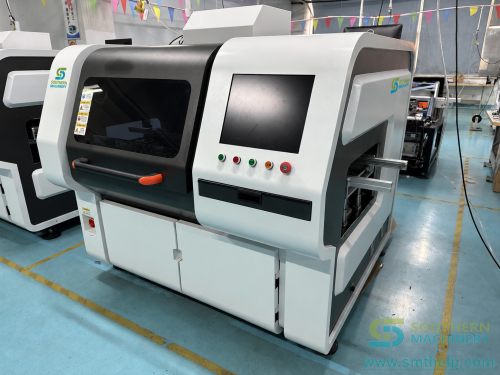
An axial insertion machine is handed over at three checkpoints: a factory acceptance test on your own component list before the crate is closed, site preparation that brings 220 V single-phase power and 0.6-0.8 MPa dry air to the floor, and a commissioning run that returns the THT cell with operators trained and wear parts stocked. The Southern Machinery S4000 series is published at 24,000 insertions an hour with a non-performing rate under 300 PPM.
What is an axial insertion machine used for?
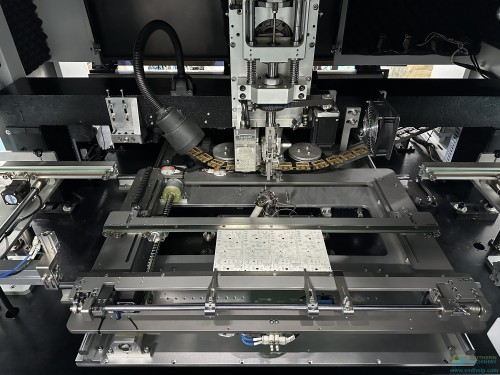
An axial insertion machine takes axial tape-packed components - resistors, diodes, transistors, capacitors, blown fuses - plus cylindrical jumper wire, and inserts them into through-holes automatically: centred, bent into a splayed U, pushed through the hole, clinched from below and trimmed, in one cycle. The S4000 does this in four insertion directions (0, 90, 180, 270 degrees) without re-fixturing the board, with the clinch angle adjustable 0-35 degrees and clinch length 1.2-2.2 mm.
The published envelope is a 5.0-20 mm dual lead span, boards from 50 x 50 mm to 450 x 450 mm, and thickness 0.79-2.36 mm. Tinned copper jumper wire of 0.5-0.6 mm is inserted straight from its own feeder, which the manual says keeps one third of every jumper reel.
Why the handover decides the payback
A rated speed is a ceiling. The manual's own arithmetic: at 24,000 pieces an hour, a 10-component board is 2,400 boards an hour at 100 per cent utilisation, 1,920 at 80, 1,440 at 60 and 960 at 40 for a mixed load.
Utilisation is not a machine property. It is changeover, clip replenishment, board load and unload, and how fast a technician finds a spare at 2 a.m. All four are settled during the handover.
Factory acceptance: what to witness before the crate closes
Southern Machinery runs a factory acceptance test before shipping: your component list loaded on the clips, your boards inserted, the non-performing rate counted before the crate is closed - so you approve output on your own product, not a demonstration panel.
Load your own part list, not a demo program
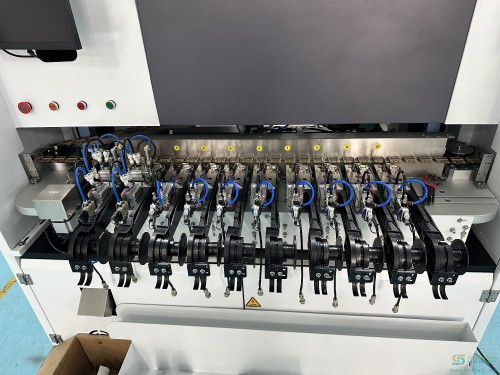
Station count is a part-list decision before it is a machine decision: 60 stations recommended, configurable 10-100, each 10-station rack 510 x 1000 x 1410 mm. Confirm every unique taped axial and jumper type has a station, a wedge slot and a pool of carrier clips.
Count the non-performing rate on your product
The manual publishes under 300 PPM with missing-insert detection on the display. Witness it on your boards, at the direction mix your layout actually uses.
Check the geometry and the part bank
Confirm the clinch angle and length applied to your parts (0-35 degrees, 1.2-2.2 mm) and a part-parameter bank already carrying your types, diameters and lead spans, so a new product is a list rather than a re-teach.
Installation: what your floor needs before the crate opens
The demands are modest - single-phase power and a small air line - but the cell layout decides how well the cell runs.
Power: 220 V single-phase at 2.0 kVA
220 V AC single-phase, 50/60 Hz, on a 2.0 kVA supply with a 1.6 kW working draw; the S-4000H variant document gives a steady draw near 1.5 kW. No three-phase drop is needed.
Air: 0.6-0.8 MPa dry air at 0.3 m3/min
Supplied on a 12 x 8.5 mm line. The manual is explicit that dry air protects the clincher and shear cylinders - the two whose wear appears first as insertion defects.
Floor, footprint and leveling
The main unit is 1700 x 1300 x 1600 mm at 1500 kg, with feeder racks added at 750 kg per 40-station rack, so the footprint grows with the part list. A solid, level floor matters: the frame holds accuracy only if the floor does not move under it.
Line interface: conveyor height, SMEMA, magazines
In-line builds need conveyor height matched upstream and downstream, SMEMA signal cabling, and a magazine loader and unloader on the board-flow side. Noise is published at 65 dB, so no enclosure is needed; keep tape stations out of sunlight and dust.
Commissioning and training
Documented scope: installation supervision and commissioning, remote or on-site, through leveling, power, air and line interface, then a full-load commissioning run with your operators present. Training covers program building, clip and wedge handling, station setup, the alarm list and the daily checks.
Rehearse the software early. S4000 software version 2.6.0.0 keeps a part-parameter bank and logs yield, standby time, insertion time and error records on the machine. Decide who reads those statistics before go-live, not after.
Spares and wear parts
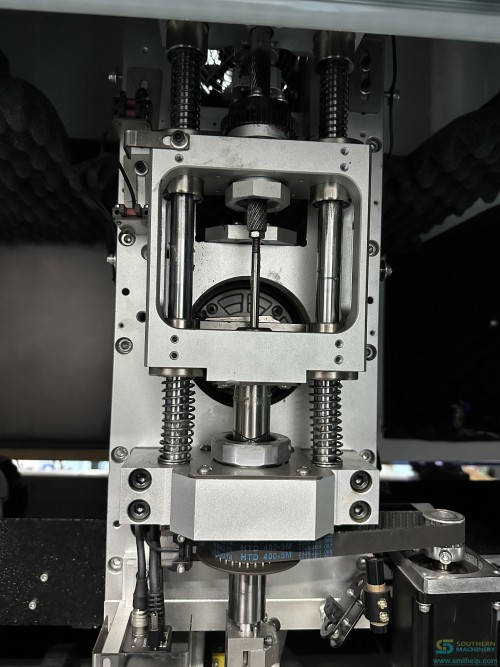
Each of the five motions has a wear part: centring uses the carrier clip and guides, forming the former, pushing the needle and tape cut, clinching the anvil, trimming the shear blade. Carrier clips are the consumable that lets one machine run taped axials and bulk jumpers; they circulate station to head and back hundreds of times a shift.
Documented stock: carrier clips, needles, shear blades, cutter and clinch parts, plus station upgrades and loader retrofits when the mix changes. Warranty terms and lead times are not specified in the source document - contact Southern Machinery to confirm them against your quotation.
Payback: the arithmetic to run before you sign
The manual's comparison is that one S4000 operator equals the output of 40 manual inserters. The simplified payback is:
Simple payback = machine price / annual freed bench labour
where annual freed labour is operators freed, multiplied by a loaded wage, multiplied by the hours those benches ran.
Worked example - example only, depends on configuration, subject to final technical confirmation: freeing 6 operators at a loaded USD 5 per hour across 3,000 insertion hours a year addresses about USD 90,000 of bench labour; against a USD 180,000 machine price the simple payback is about 2 years. The manual notes the formula ignores the one-third jumper saving, rework avoided and supervision, so treat it as a floor. Machine prices are not published - use your own quotation.
How the S4000 fits a complete PCB assembly line
Standalone use is documented, and so is the in-line configuration: an in-line conveyor track with SMEMA lets the inserter handshake with the machines before and after it, while loader and unloader options remove board handling from the operator. In a THT cell the inserter typically follows SMT and sits ahead of wave soldering, leaving leads clinched and trimmed for the wave to solder.
Useful starting points: PCB assembly equipment, board handling systems and feeders. The axial feeder catalogue and the full machine catalogue of 585 product documents are published at file.autoinsertion.com.
FAQ
What is a factory acceptance test on an axial insertion machine?
Your own acceptance run before shipping: your component list on the carrier clips, your boards inserted, the non-performing rate counted before the crate closes, so approval is on your product rather than a demo panel. Documented as part of the purchase.
What power and air does an S4000 axial inserter need?
220 V AC single-phase, 50/60 Hz, on a 2.0 kVA supply with a 1.6 kW working draw, plus 0.6-0.8 MPa air at 0.3 m3/min on a 12 x 8.5 mm line, a level solid floor, and 65 dB operating noise.
How many boards per hour should I expect after installation?
Divide the rated 24,000 pieces an hour by the components per board, then apply the utilisation your cell can defend - the manual gives 80, 60 and 40 per cent bands for 5, 10 and 20 component boards. Plan at 60-80 per cent.
What spare parts should I stock for an axial insertion cell?
Carrier clips, needles, shear blades, cutter and clinch parts, which the manufacturer keeps in stock, plus the wear part for each motion: clips and guides, the former, the needle, the anvil and the shear blade. Pricing and lead time are not in the source document - confirm them in your quotation.
What does installation and commissioning include?
Installation supervision and commissioning, remote or on-site, covering leveling, power, air and line interface, then a full-load commissioning run with your operators present, plus training on programming, clip and wedge handling, station setup, alarms and daily checks.
How do I get a quotation or a sample insertion?
Send your component list (types, spans, taped or bulk, jumper lengths), board size and takt to info@smthelp.com or WhatsApp +86 13602562576. The documented turnaround is a station list, cycle estimate and configuration sheet, usually within one working day, with sample insertion before you commit. General questions go through the FAQ or contact page.
Next step: send your part list and get a station plan
A component list and a board photo are enough. Southern Machinery maps stations to clips to spares in one sheet, sizes the feeder racks and returns the cycle arithmetic with the machine data filled in. Request an insertion evaluation and quotation and ask for the factory acceptance protocol for your own boards.
Comments