
Automatic SMT Reel Scrap Tape Cutting: Buyer's Spec Guide for Smart EMS Factories
Every SMT line generates a river of waste carrier tape and cover film, and most factories still cut it by hand with scissors. An automatic SMT reel scrap tape cutter sits at the chip-mounter tape recycling point, shreds tape and film into uniform segments, and drops them into an anti-static bin. This buyer-oriented guide from Southern Machinery (Shenzhen, China; 237+ global customers since 2011) explains what the machine does, where it fits in a complete PCB assembly line, the parameters worth comparing before you buy, and how to calculate payback. Includes the S-680A in live operation.
Sep 22, 2026 · Updated Sep 22, 2026 · Southern Machinery
Automatic SMT Reel Scrap Tape Cutting: Buyer's Spec Guide for Smart EMS Factories
Every reel that feeds a pick-and-place machine leaves behind a stream of waste carrier tape and cover film. On most SMT lines that waste is still handled with a pair of scissors — an operator snips tangled tape into pieces, stuffs it into a bin, and repeats the job all shift. An automatic SMT reel scrap tape cutting machine turns that manual chore into a self-running, ESD-safe, 5S-friendly process.
This guide is written for SMT process engineers, line supervisors and equipment buyers who want to specify the right machine rather than just buy a box with blades. Southern Machinery has supplied SMT, THT and PCB assembly automation from Shenzhen, China to 237+ global customers since 2011 — and tape waste is one of the most overlooked cost centres we see on factory audits.
<iframe width="560" height="315" src="https://www.youtube-nocookie.com/embed/bT-uI3Vptok?rel=0" title="Auto SMT reel scrap tape cutting for Smart EMS factory PCB assembly" frameborder="0" allow="accelerometer; autoplay; clipboard-write; encrypted-media; gyroscope; picture-in-picture" allowfullscreen></iframe>
Auto SMT reel scrap tape cutting in a smart EMS factory — the S-680A in operation.
What is this machine used for?
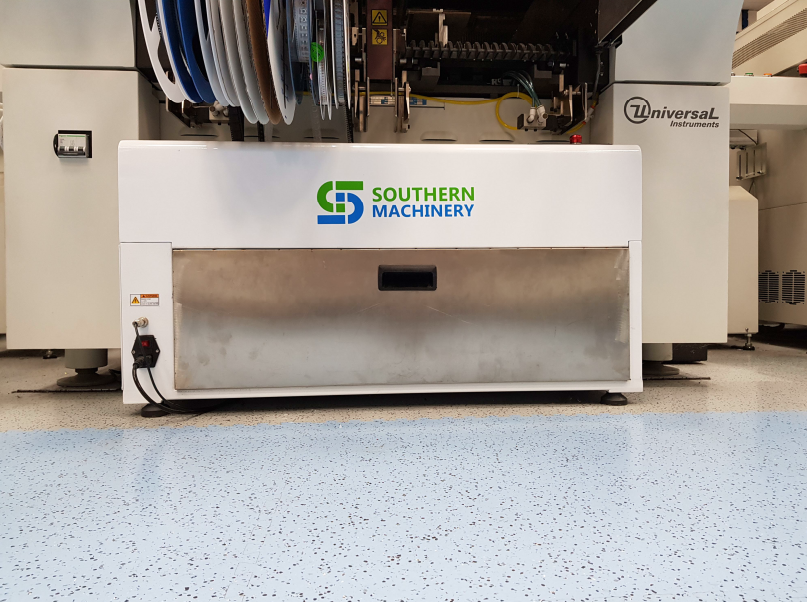
An automatic reel scrap tape cutter is a benchtop waste-processing station for the SMT feeder area. It is installed at the point where the chip mounter (pick-and-place machine) discharges spent carrier tape and cover film. Instead of an operator collecting that loose tape and cutting it by hand, the tape and film are fed into the machine, which cuts them into short, uniform segments and drops them into an extractable anti-static waste bin.
The design intent is simple and worth stating in buying terms:
- It removes a manual task. Manual scissor cutting of sharp, springy tape is slow, ergonomically poor and impossible to standardise.
- It shrinks the waste volume. Cutting long tape into short segments lets the bin pack far denser, so bins are emptied less often and disposal handling is cheaper.
- It protects the process. Long strips of loose tape drifting across a line can reach feeders, nozzles and moving machine parts. Cutting and containing the waste at source removes that risk.
- It makes 5S visible. A floor with tangled tape debris fails a 5S audit. A machine that swallows the waste and leaves a clean cell passes it.
On the S-680A SMT Reel Scrap Tape Cutting Machine, Southern Machinery builds this as a compact benchtop unit with upper and lower cutters made from imported hard high-speed steel working on the scissor principle, a 0–560 mm effective cutting range, and an extractable anti-static bin for centralised collection.
Typical applications
1. High-mix, high-changeover SMT lines. Every product changeover flushes a fresh wave of reel scrap. A tape cutter that lives beside the feeder carts absorbs that spike without adding headcount — particularly valuable in EMS plants running many small batches per shift.
2. Multi-line P&P cells. Where one factory floor runs several pick-and-place lines, a single cutter can serve the feeder-replenishment zone, so tape from every line converges on one controlled waste stream instead of several scattered bins.
3. Wave-soldering and THT support areas. Radial, axial and odd-form feeders on THT insertion machines produce their own carrier-tape scrap. Locating a cutter at the tape-cutter station near the insertion line keeps that waste out of the assembly area.
4. 5S / lean and audit-driven plants. Customers preparing for customer audits, IATF-style quality reviews or internal lean rollouts use the cutter as a visible housekeeping control — the machine is the evidence that waste is managed, not tolerated.
5. ESD and recycling-compliance programmes. The anti-static bin and contained cutting action keep waste tape off ESD-sensitive areas and make tape/film collection cleaner for recycling or contract disposal.
How it fits into a complete PCB assembly line
The reel scrap tape cutter is line-side support equipment, not a process machine — it never sits in the product flow, so it adds zero seconds to takt time. Its natural position is at the feeder-replenishment or tape-recycling station beside the Pick and Place / chip mounter.
Think of it as one node in the material lifecycle that Southern Machinery builds around PCB assembly:
- SMT placement — pick-and-place machines and their Feeders and Nozzles consume the reels; the cutter closes the loop on the waste they generate.
- SMT reel storage — intelligent reel racks manage reels before use; the cutter manages what is left after use.
- THT / insertion — radial and odd-form insertion machines produce carrier-tape scrap that the same station can process.
- Wave soldering — pallets, fingers and conveyor hardware from the wave-solder line also move through the factory's housekeeping cycle.
- Cleaning ecosystem — stencil cleaners, PCBA cleaners and nozzle cleaners keep the process clean; the tape cutter keeps the floor clean.
The point for a buyer is ecosystem consistency: when the waste side of the line is designed with the same discipline as the process side, audits, safety walk-throughs and line audits stop being events you prepare for and become a standing condition.
Key selection parameters
When you evaluate an automatic SMT reel scrap tape cutter, compare these categories. Verify every specific figure against the supplier's datasheet for the exact model — never accept a marketing number without a spec sheet.
- Material compatibility. What tape and film thicknesses can it cut, and does it handle both paper carrier tape and embossed plastic carrier tape plus cover film? (The S-680A's stated range is 0.05 mm film up to 1.5 mm thick tape, with a 0–560 mm effective cutting range.)
- Cutting mechanism and blade life. Scissor-action upper/lower cutter geometry and blade material determine how cleanly the tape is severed and how often blades need replacement — a key consumable cost.
- Cut length control. Is segment length fixed or adjustable? Uniform segments pack better and reduce bin changes.
- Waste containment. Is the bin anti-static? Is it tool-free extractable? How is it emptied and how large is the collection interval?
- Safety. Interlocks, emergency stop, and auto-stop when the bin is removed should be standard, not optional.
- Footprint and integration. Benchtop or floor-standing? Does it fit the feeder-cart position, and can it be used under-cart or in a dedicated recycling station?
- Utilities and noise. Confirm supply voltage, phase, power draw and working noise against your factory standard.
- Service and spares. Blade and cutter availability, spare-part lead time, and access to an operator manual in your language.
ROI and quality perspective
From a buyer's perspective, the business case for an automatic tape cutter is one of the simplest on the SMT floor — because you are comparing it against a manual task with a known labour cost.
Labour. Manual tape cutting consumes operator minutes every shift, on every line, permanently. Anything that removes a repetitive manual task from the shift frees that time for value-added work. Even a conservative estimate — a fraction of an operator per shift, per line — compounds across a multi-line factory.
Waste handling. Cutting tape into uniform short segments lets containers pack significantly denser, which reduces how often bins are emptied and how much volume you pay to store, transport and dispose of.
Quality and risk. Loose tape and film are a genuine contamination source: they can reach feeders and nozzles, they can hide on the floor as a trip hazard, and they scatter static-generating debris across ESD-sensitive areas. Contained cutting removes all three at once.
Audit and ESG posture. Customers and auditors increasingly ask how you manage production waste. A machine that demonstrably collects, cuts and contains tape scrap is a concrete answer, and it is a visible part of a zero-e-waste ambition rather than a poster on the wall.
Payback. Because the machine replaces manual labour and reduces disposal handling without touching takt time, payback is typically short and easy to justify as a housekeeping and labour-efficiency project rather than a capital-intensive process upgrade.
FAQ
What is an SMT reel scrap tape cutting machine?
It is a benchtop station that automatically cuts the waste carrier tape and cover film discharged by SMT feeders. It replaces manual cutting with scissors, cuts the tape into short uniform segments, and collects them in an anti-static waste bin for centralised disposal.
Where is the machine installed on an SMT line?
At the chip mounter's tape-recycling point or the feeder-replenishment / feeder-cart area. It is line-side equipment, so it does not sit in the product flow and adds no time to takt.
What tape thicknesses and types can it handle?
The S-680A is specified to cut from 0.05 mm film up to 1.5 mm thick tape, covering paper carrier tape, embossed plastic carrier tape and cover film, with a 0–560 mm effective cutting range. Always confirm the range against the datasheet for the exact model.
Does it improve 5S and audit results?
Yes. Containing and cutting tape at source removes the long tangled tape debris that fails 5S audits, keeps the floor clear and makes waste collection a controlled, repeatable process.
Is the waste bin anti-static?
On the S-680A the waste bin is anti-static and extractable, so operators can remove and empty it without tools. Waste tape is contained rather than loose on the floor, which is important in ESD-controlled areas.
How do I justify the investment?
Model it as a labour and housekeeping project: manual cutting minutes saved per shift per line, denser waste packing that reduces bin changes and disposal volume, plus removed contamination and trip-hazard risk. Because the machine does not affect takt time, payback is normally fast.
Contact Southern Machinery
Southern Machinery (Shenzhen, China) has supplied SMT, THT and PCB assembly automation to 237+ global customers since 2011. If you are specifying an automatic reel scrap tape cutter for a new line or retrofitting an existing feeder area, send us your tape types, reel sizes and feeder layout and we will confirm the right configuration.
- Email: [jasonwu@smthelp.com](mailto:jasonwu@smthelp.com)
- Website: www.smthelp.com
- Catalogs & documents: file.autoinsertion.com
- Product images: ph.smthelp.com
Tags: SMT Line, Feeders & Material Supply, THT Automation, PCB Assembly Automation, EMS Manufacturing, Factory ROI
Comments