
THT Auto Lead Cutter vs Hand Trimming by Southern Machinery
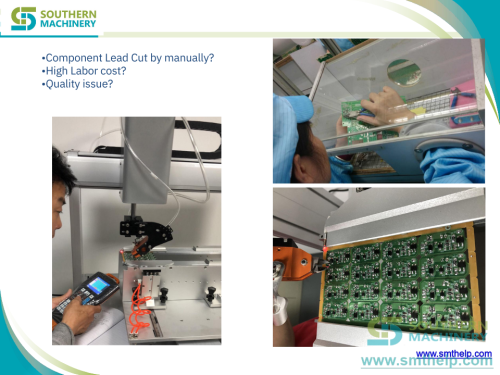
Compare automatic lead cutting with hand trimming after wave soldering: cut quality, repeatability, labour, changeover and payback on a THT PCBA line.
Oct 6, 2026 · Updated Oct 6, 2026 · Southern Machinery
THT Auto Lead Cutter vs Hand Trimming by Southern Machinery
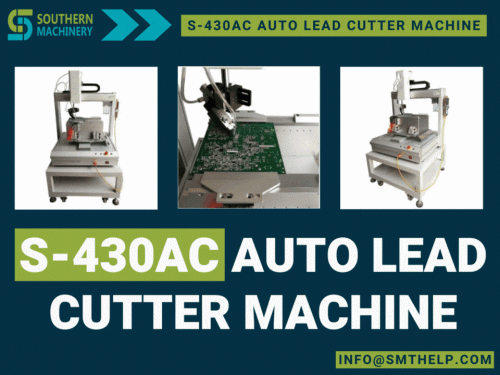
Quick answer. An auto lead cutter trims the through-hole lead tails that stand above a soldered joint after wave soldering, so every lead finishes at the same height instead of at whatever height the operator's hand decided. The S-430AC is a three-axis automatic lead cutter with an R axis on the cutter head: it runs a stored program, shears each lead with a by-pass shear cut and draws the offcuts into a collection cup.
What is an auto lead cutter used for on a THT line?
Wave soldering fills the barrel and forms the fillet, but it never decides how much lead stays above the joint. An auto lead cutter turns that decision into a stored number: every instruction carries its own scissor closing delay, opening delay and back-cutting height. In a THT sequence the station sits after soldering and before test:
- Component preparation — radial and axial parts are taped, formed and fed to the inserter.
- Insertion — leads pass through the plated barrels and are clinched underneath.
- Soldering — the fillet forms and the barrel fills; the leads are still long.
- Lead cutting — the cutter shears each lead to the programmed protrusion and vacuums the offcut away.
- Test and coating — ICT or FCT, then conformal coating, with leads inside the fixture envelope.
Manual trimming vs automatic lead cutting: what actually changes?
A hand trim bench looks free because the cost is already in the payroll: the operator's hours, the second operator added when volume grew, the by-eye protrusion checks, and the supervisor's time when a batch goes out wrong. What a machine changes is the source of the number.
- Repeatability. Two operators with the same flush cutter produce two different protrusion distributions, and one operator drifts across a shift. A stored program does not.
- Changeover. Programs are taught on the pendant or imported from DXF or PLT, then stored: hundreds of files of up to 8,000 instructions each.
- Foreign objects. Offcuts are drawn into a pin collecting cup in real time and the cup rotates out for emptying, instead of landing on the fixture.
Loading, unloading, changeover and inspection stay with the operator; removing the cutting judgement is the realistic outcome.
Why a pinched cut damages the joint and a shear cut does not
If the cutting edges compress the lead before it separates, that force arrives at the solder fillet as a peel load. The joint can still pass a visual inspection and still fail later under thermal cycling. A by-pass shear is a different geometry: two edges pass each other in offset planes and slice the metal in tension-shear, so the lead separates with a small, flat, repeatable face and almost no load reaches the joint. On the S-430AC the R axis sets the shearing angle and the knife-edge centring.
Where does the lead cutter sit in a full PCB assembly line?
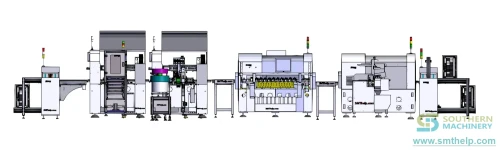
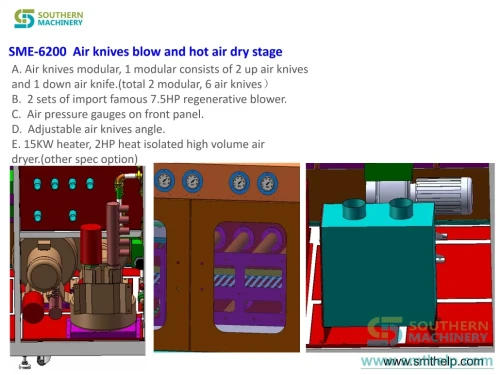
The lead cutter is one station inside a sequence, not a standalone island. It usually follows soldering, sometimes after a cooling conveyor, and can be shared between two lines. Upstream it depends on insertion, so specify it with the radial and axial insertion equipment and the wider THT machine range. Downstream it feeds test and coating, and often a cleaning stage, because a trimmed board still carries flux residue.
- Auto lead cutter machine for through-hole technology PCB assembly and the auto lead cutter machine category
- THT component cutting and bending machines
- PCB DIP assembly line and the machine document library
What should you specify before you buy an auto lead cutter?
Four decisions change what the machine can accept; a fifth changes product-change speed.
- Lead count and pitch — this sets the cycle, not the machine class. A board with 90 well-spaced leads and one with 900 dense leads differ by an order of magnitude in output.
- Fixture and board envelope — the precision fixture clamps different PCBA products and its width is easily adjusted; maximum board size is not published for the S-430AC and must be confirmed on your product.
- Program source — pendant teaching, or DXF or PLT import with automatic path optimisation, plus double mark point alignment.
- Air supply — the machine needs an external air source for the scissors, the pressing cylinder and the vacuum circuit. Pressure and flow are not published; ask for the figure when you plan the air drop.
How do you build the ROI case for automatic lead trimming?
Payback in months = machine price delivered and installed ÷ monthly benefit
Monthly benefit = (operators × fully loaded monthly labour cost × share of trimming hours removed) + rework and scrap avoided
Worked example. These are example values only, dependent on configuration and subject to final technical confirmation — not a quotation. Inputs: 2 operators, 1,400 per operator per month fully loaded, 70 % of trimming hours removed, 300 per month of rework avoided, machine price 24,000.
- Labour released: 2 × 1,400 × 0.70 = 1,960 per month
- Rework and scrap avoided: 300 per month
- Total monthly benefit: 2,260
- Simple payback: 24,000 ÷ 2,260 ≈ 10.6 months
Two caveats decide whether the case is real. The machine must be able to cut your board: if the fixture envelope or lead pattern does not suit, there is no project. And if leads are already cut in a die during insertion, there may be no separate trimming operation to automate. If you cannot source a rework number, run the labour case alone and treat the rework benefit as upside.
What the S-430AC documents do and do not publish
A datasheet with no gaps is a datasheet somebody filled in. These values come from the S-430AC User Instruction Manual, the supplied customer presentation and the key-components list.
- Platform: 3 axes X, Y, Z plus R on the cutter head; R sets shear angle and knife-edge centring
- Cut timing precision: 1 ms, published in the pendant specification
- Control channels: 4 shear, 8 input, 4 universal extended output; external AC 220 V single phase; air required but pressure not published
- Program storage: hundreds of files, 8,000 instructions each, on flash, copyable between same-type machines
- Teach pendant: 3.2-inch colour LCD, 320 × 240, English interface; plug or unplug only with the power off
- Cut lead protrusion: under 1.3 mm as a reference on a 152 mm panel in the customer presentation; no tolerance is published in the manual
- Not published: maximum board size, footprint, weight and noise — confirm on your product
- Key components: HIWIN guides, AirTAC pneumatics, KEYENCE and SICK sensors, Leadshine closed-loop steppers, Mitsubishi or Xinje PLC, MEAN WELL supply, OMRON relays, NSK bearings, and the cutters that decide cut quality
- Consumables: muffler, air hose, cutter body and head, pin collecting cup seal ring
Daily maintenance stays in the operator's scope: clean dust, swarf and oil; check power, air pressure and pneumatic sealing; with the power off, check each axis moves smoothly by hand; confirm screws, buttons and the emergency stop. Electrical debugging is reserved for qualified personnel.
FAQ
How many leads per hour can an automatic lead cutter process?
It is not published for the S-430AC, because your board sets it. Cycle time is the number of leads multiplied by the sum of the cut-to-cut move time and the cut cycle; a 420-lead example with a 0.35 s move and a 0.18 s cut gives about 14 boards per hour gross and 10.7 at 75 % OEE.
Can an automatic lead cutter run a different board without reprogramming?
Yes, if the program already exists. Programs live on flash, hundreds of files of up to 8,000 instructions each, and copy between machines of the same type. A new product needs a new program, taught on the pendant or imported from DXF or PLT.
Does an automatic lead cutter need compressed air?
Yes. The S-430AC needs an external air source for the scissors, the pressing cylinder and the vacuum circuit. Pressure and flow are not published, so request the supply figure when you plan the air drop.
What consumables does a lead cutter use?
Four, all reachable by the operator: the muffler, the air hose, the cutter body and head, and the pin collecting cup seal ring. Cutter geometry decides cut quality, so it is kept in stock.
Is the under 1.3 mm protrusion a guaranteed tolerance?
No. It is a reference figure from a customer presentation on a 152 mm panel, and the manual publishes no protrusion tolerance anywhere. Confirm the number on your own board with your own gauge before it enters a process sheet.
Send a board before you commit to a purchase order
The value of an automatic lead cutter is a repeatable measurement, so start from one. Send Southern Machinery a soldered board: we cut it, photograph the joints, measure the lead protrusion and send the numbers back, including a direct answer if your line does not need the machine. Founded in 2011 in Shenzhen, Southern Machinery supports 237+ customers worldwide with SMT and THT PCB assembly equipment, spare parts and training, and can review the lead cutter inside a complete line solution.
Comments