
4-Head, 4-Bowl Feeder Odd-Form Insertion Machine with Clinching: A Buyer's Guide | Southern Machinery
A 4-head, 4-bowl feeder odd-form insertion machine with clinching inserts transformers, relays, connectors and other non-taped THT parts, verifies polarity with vision, seats every lead to a programmed depth and clinches it before wave soldering. This guide explains what the machine does, the applications it fits, how it drops into an existing SMT/THT line through an SMEMA interface, which selection parameters actually decide the configuration, and how to build an ROI case on rework and field-failure cost rather than operator wages. Includes documented S-70LD / S7900 reference specifications and a buyer FAQ from Southern Machinery, Shenzhen.
Sep 27, 2026 · Updated Sep 27, 2026 · Southern Machinery
4-Head, 4-Bowl Feeder Odd-Form Insertion Machine with Clinching: A Buyer's Guide | Southern Machinery
<iframe width="560" height="315" src="https://www.youtube-nocookie.com/embed/QoRhQDHjL7Y?rel=0" title="4 Heads 4 Bowl Feeders Odd-form Insertion Machine with Clinching" frameborder="0" allow="accelerometer; autoplay; clipboard-write; encrypted-media; gyroscope; picture-in-picture; web-share" allowfullscreen></iframe>
Product demo — 4-head odd-form insertion machine with four bowl feeders and integrated clinching, running on a DIP/THT assembly line. Source: Southern Machinery (@Smthelping).
What is this machine used for?
This machine is a THT odd-form auto-insertion station that picks non-standard through-hole components — the parts that never fit a radial or axial tape — orients them with vision, inserts their leads into the plated through-holes, and then clinches the leads so the part is mechanically locked to the board before wave soldering.
Three things in the title matter to a buyer:
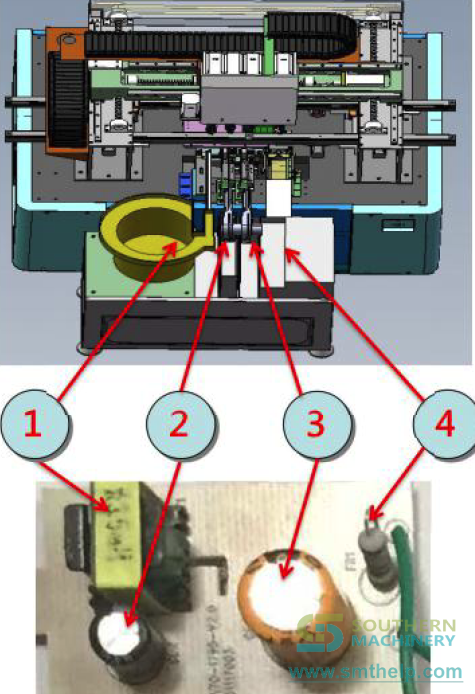
- Odd-form components. Transformers, relays, connectors, fuse holders, terminal blocks, radial electrolytic capacitors, inductors and optoelectronic parts. They arrive in trays, vibration bowls, tubes or loose bags, their lead pitches vary, and their bodies are asymmetric — which is exactly why they are the last 10% of the part list still being inserted by hand on most DIP lines.
- 4 heads + 4 bowl feeders. Four insertion heads work in parallel while four independently adjustable feeds present parts to them. That combination is what turns odd-form insertion from a single-part-per-cycle operation into a balanced, multi-part-family feeder station — the machine can hold four different component families online at once instead of forcing a feeder changeover for every variant.
- Clinching. After insertion, the machine bends the leads outward or inward against the board so the component cannot shift, lift or fall out during board transfer and wave soldering. Clinching is the step that makes an automated odd-form insertion cell trustworthy downstream: a part that is correctly clinched does not "float high" when it crosses the solder wave.
Southern Machinery builds this class of machine as the S-70LD / S7900 odd-form insertion platform: four insertion heads, four adjustable feeders (vibration bowl or tape), industrial-PC control with vision guidance, and an inline SMEMA interface so it sits on the conveyor immediately upstream of wave soldering. Documented reference specifications for that platform are listed in the selection table below.
Typical applications
- Power supplies and adapters — transformers, radial electrolytic capacitors, inductors, fuse holders and terminal blocks on vehicle power supplies, ballasts and energy-saving power supplies.
- Home appliance control boards — relays, connectors and terminal blocks on air conditioner, TV, microwave and induction-cooker PCBs, where an odd-form cell absorbs the mixed component families that come with the product family.
- LED drivers and lighting control — odd-form parts on LED lighting, display and control-system boards, often alongside a radial inserter and a lead cutter.
- Automotive and vehicle electronics — car audio, vehicle power supplies and control units that mix dense SMD areas with rugged through-hole connectors and transformers.
- Industrial instruments, meters and general electronics — watches, instruments and terminal assemblies where the number of odd-form parts per board is small but the rework cost of a bad insertion is high.
In every one of those cases the driving pain is the same: a manual odd-form station produces variable cycle times, and its defects (floating high, misinsertion, reverse insertion) are only discovered after wave soldering, when rework requires desoldering, through-hole cleaning, reinsertion and re-soldering.
How it fits into a complete PCB assembly line
An odd-form inserter is not a standalone machine — it is a station in the DIP/THT half of a mixed-technology line:
- SMT side (upstream): stencil printing → SPI → pick-and-place → reflow → AOI.
- Board handling into the THT section: magazine loader / destacker and conveyor modules, with SMEMA handshakes between every station.
- THT insertion: axial and radial insertion machines for standard taped parts → this odd-form insertion machine for trays, bowls and tubes → terminal / pin-eyelet insertion for FASTON, PIN and eyelet parts.
- Soldering: wave soldering. For lead-free work, a dual-wave machine with turbulent + laminar waves and controlled conveyor speed and angle.
- Cleaning and inspection: aqueous or ultrasonic cleaning of boards, pallets and fixtures → AOI / SPI / X-ray verification → depanelising → magazine unloader.
Because the odd-form machine is designed as an inline SMEMA station, it accepts boards from the existing conveyor, hands them back downstream and does not require any change to the wave-soldering, cleaning or conveyor infrastructure already installed. In practice that is the deciding factor for factories retrofitting odd-form automation onto a line that is already producing: the cell is inserted into the DIP flow, not bolted on as an island.
Related Southern Machinery equipment that pairs with this station:
| Line role | Equipment |
|---|---|
| Standard radial insertion | S-3010B / S3000 radial insertion machines |
| Terminal / pin / eyelet insertion | S7020 series, S-7000E, S-7000T |
| Wave soldering | S-WS450; S-WS350B lead-free dual-wave |
| Feeding components to the cell | BF-2002D dual bowl feeder, VTF-1007 vibratory tube feeder, STF-1002 stacked tube feeder, RTF-1001 radial tape feeder |
| Board handling | Magazine loaders / unloaders, destackers, conveyor modules |
| Cleaning | S1688 / SME800 stencil cleaning, SME-5200 pallet cleaning, S-100A ultrasonic |
| Tape waste handling | S-680A reel scrap tape cutting machine |
| Inspection | 3D SPI, AOI, X-ray |
Key selection parameters
Do not buy an odd-form inserter on head count alone. These are the categories that decide whether the machine can actually run your part list. The values in the "documented reference" column are Southern Machinery's published figures for the S-70LD / S7900 odd-form insertion platform — treat them as a benchmark for the class, and confirm exact numbers for your configuration in a formal quotation.
| Parameter to evaluate | What to ask | Documented reference (S-70LD / S7900 class) |
|---|---|---|
| Component envelope | Body size and height range, lead count, lead pitch, radial vs. axial lead form | 3 × 3 mm to 30 × 30 mm bodies, up to 50 mm height |
| Insertion heads | Number of heads, what each head can carry | 4 heads |
| Feeder architecture | Bowl / tape / tube mix, number of independently adjustable feeds, capacity and refill interval | 4 feeders — tape or vibration plate, adjustable |
| Throughput class | Insertions per hour per component family, and how throughput changes with lead count and clinching | ~4,000 CPH (≈3,800 CPH for radial resistor insertion) |
| Insertion accuracy | Placement and lead-seating accuracy class | ±0.05 mm |
| Clinch capability | Inward / outward / "N" clinch forms, clinch height and board-thickness compatibility | Clinching integrated (clinch form names documented across the terminal-insertion platforms) |
| Vision and polarity control | Lead-geometry recognition, polarity check before placement, handling of tray/bowl presentation variation | Industrial-PC vision guidance, polarity verification before placement |
| Insertion force control | Force monitoring / anomaly detection, seating depth repeatability per pin | Force-controlled seating to programmed depth |
| PCB handling | PCB size and thickness range, conveyor direction, SMEMA inline interface | 50 × 50 to 300 × 300 mm, 0.8–5.0 mm thick, SMEMA inline |
| Program and data layer | Program naming/revision control, offline programming, PCB/mark-point data, brand-library reuse, backup policy | Industrial-PC control platform with program file management |
| Traceability / MES | Data export, RS-232C or network link to MES, insertion verification method | Data export supported on the S7000 terminal platform (RS-232C → MES) |
| Utilities and footprint | Supply, air pressure, consumption, noise, floor space | 220 V AC, 0.8 kVA; air 0.4–0.6 MPa; ≤75 dB |
| Service and tooling | Nozzle/gripper supply, custom tooling lead time, spares, training, remote support | In-house nozzle and gripper design and manufacture; spares and training programmes |
Two practical rules from the field: first, send sample components with the RFQ — feeder and tooling design follows the real parts, not the part list. Second, agree the first-article acceptance criteria (lead penetration depth, clinch form, polarity, seating) before the machine ships, because that is the checklist the acceptance run will be measured against.
ROI and quality perspective
The case for automating odd-form insertion is rarely about the operator's wage. It is about what variability costs downstream.
- Throughput variability. A hand-inserted odd-form part takes roughly 4 to 10 seconds depending on operator familiarity, part orientation and presentation. Spread that variance over a run of thousands of boards with several odd-form parts each and the lost hours are unplanned and invisible in the standard cost model.
- Defect economics. Manual insertion produces higher rates of floating high, misinsertion and reverse insertion. A transformer with 6–10 pins that has one pin not fully seated can become a field failure whose repair cost multiplies far beyond the board's assembly value, and odd-form defects are typically only caught at AOI or functional test — after wave soldering and cleaning. Rework then means desoldering, cleaning through-holes, reinserting and re-soldering, several minutes per board and real risk to neighbouring components.
- What automation changes. Vision guidance locates and orients each part regardless of how it was presented, checks polarity before placement and rejects a rotated part instead of soldering it in backwards. Force-controlled seating pushes every lead to programmed depth, so "floating high" is a process escape rather than a normal outcome. Clinching locks the part mechanically before the wave. And cycle time becomes predictable, which is what makes line balancing and throughput forecasting work at all.
- Where the fit is strongest. Medium-to-high volume per SKU — roughly 500+ boards per run with repeat orders — and component families that recur across several PCB variants. Changeover cost per SKU falls as more variants share the same odd-form component families and the same tooling and feeder setup.
If you are comparing an odd-form cell against a permanent manual station, cost it on four lines: labour hours including overtime, rework and scrap hours, field-failure exposure, and the throughput ceiling you cannot raise without more people.
FAQ
What is odd-form insertion?
Odd-form insertion is the automated placement of through-hole components that are not supplied on radial or axial tape and do not have a standard body shape — transformers, relays, connectors, fuse holders, terminal blocks, radial electrolytics and similar parts. They are presented in trays, vibration bowls, tubes or bulk, and are inserted with vision-guided pick, orient, insert and clinch.
What does "clinching" mean, and why does it matter?
Clinching is the bending of the component leads against the board after insertion, in an inward, outward or "N" form, so the part is mechanically retained. It matters because a clinched part cannot shift or lift during board transfer and wave soldering, which is where a poorly seated component becomes a floating-high defect.
What is the difference between a bowl feeder and a tape or tube feeder for odd-form parts?
Bowl feeders are used when parts arrive loose or in bulk and need to be sifted, oriented and singled out — typically connectors, switches, transformers and plastic-bodied parts. Tape and tube feeders are used when the part is supplied in a defined orientation and a regular pitch, and they give higher, more repeatable feed rates. A 4-feeder platform lets you mix both to match the part list rather than redesigning the feed for every variant.
How many components per hour can a 4-head odd-form insertion machine insert?
Published figures for Southern Machinery's odd-form platform are in the region of 4,000 insertions per hour, with lower rates for parts such as radial resistors. Real output depends on the component family, lead count, presentation, insertion depth and clinch requirements — so ask for a throughput estimate based on your actual part list and board, not a headline number.
Can an odd-form insertion machine be added to an existing DIP line?
Yes. The machine is designed as an inline SMEMA station that accepts boards from the existing conveyor and returns them downstream, positioned immediately before wave soldering. Existing wave soldering, cleaning and conveyor infrastructure does not have to be changed.
What should a buyer include in the RFQ?
Send sample components (the real parts, including the worst-case lead condition), the board with the odd-form part positions, PCB size and thickness, target volume per SKU and per run, the existing line layout and conveyor direction, and the clinch requirement. That lets Southern Machinery specify head count, feeder architecture and tooling against your process instead of a generic configuration.
Talk to Southern Machinery about your odd-form part list
Southern Machinery (Shenzhen Southern Machinery Sales And Service Co., Ltd) has supplied SMT and THT automation equipment from Shenzhen, China since 2011, serving 237+ customers worldwide across power supply, appliance, LED, automotive and industrial electronics manufacturing.
- Send your odd-form part list, board data and target volume: jasonwu@smthelp.com
- Browse the full machine catalogue and 3D models: https://file.autoinsertion.com
- Machine photos, feeder and tooling close-ups: https://ph.smthelp.com
- Product and specification pages: https://www.smthelp.com
Specifications quoted above are Southern Machinery's published figures for the S-70LD / S7900 odd-form insertion platform and associated feeder families. Confirm the exact configuration, throughput and tooling for your part list in a formal quotation.
Comments