
Transformer Packaging for Auto Insertion Machines: Advantages and Disadvantages | Southern Machinery
How transformers are packaged - radial tape, trays, tubes or bulk - decides which auto transformer inserter and feeder you need, and how many insertion defects you can expect. Southern Machinery, the Shenzhen THT automation builder serving 237+ global customers, compares the advantages and disadvantages of each packaging method so DIP line buyers can choose feeders, plan changeovers and calculate ROI on real volumes.
Sep 9, 2026 · Updated Sep 9, 2026 · Southern Machinery
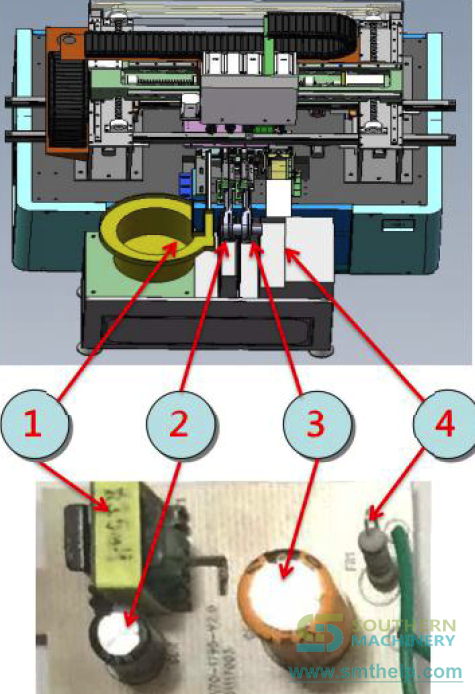
Transformer Packaging for Auto Insertion Machines: Advantages and Disadvantages
Every PCB assembly engineer who has automated a THT line eventually hits the same question: how is the transformer going to reach the insertion machine? Unlike resistors or capacitors, which almost always arrive in standard radial or axial tape, transformers are delivered in a wider variety of packaging — radial tape, anti-static trays, tubes, or loose bulk. The packaging method you choose determines which feeder the machine needs, how fast it can cycle, how much operator handling remains, and how many insertion defects you can expect.
This short technical guide, based on Southern Machinery's transformer insertion demo video, walks through the practical advantages and disadvantages of each packaging method so you can make an informed decision before you quote a new DIP line or upgrade an existing one.
Southern Machinery (Shenzhen, China; established 2011; 237+ global customers) designs and manufactures THT auto insertion machines, SMT machines and complete PCB assembly automation. The demo below shows how packaging choices play out on a real auto transformer inserter:
<iframe width="560" height="315" src="https://www.youtube-nocookie.com/embed/ulRp3kF8q4E?rel=0" title="Advantages and disadvantages of packaging methods for auto transformer inserter" frameborder="0" allow="accelerometer; autoplay; clipboard-write; encrypted-media; gyroscope; picture-in-picture" allowfullscreen></iframe>
Direct link: watch the auto transformer inserter packaging demo on YouTube
What is this machine used for?
An auto transformer inserter is a THT (through-hole technology) insertion machine that automatically places transformers into a PCB before wave soldering. Transformers are among the most demanding components on a DIP line: they are heavy relative to their lead size, they have 4 to 10 or more pins that must all align with plated through-holes, and their polarity and pin-1 orientation must be correct every cycle. Done by hand, that combination produces exactly the defects line managers know best: floating high, bent pins, missing insertion and reversed polarity — most of which are only discovered at functional test.
The machine exists to take that variability out. Southern Machinery's transformer insertion platforms are vision-guided THT inserters that pick each transformer from its packaging, verify its lead geometry and orientation, and seat it to a programmed depth with consistent insertion force. Whether the transformer arrives in tape, tray or tube format depends on how it was sourced — and that is where packaging method becomes a machine-selection issue, not just a purchasing issue.
The practical question for a buyer is not "can the machine insert transformers?" but "which packaging methods can the machine and its feeders accept, and what does each one cost me in feeder hardware, changeover time and component price?"
Typical applications
Transformer auto insertion pays off in any factory where transformers are a repeating, medium-to-high-volume part of the BOM:
1. Power supply and charger PCBA. Switch-mode power supplies, adapters and chargers carry one or two transformers per board in very high volumes. Packaging consistency directly drives line speed, because a taped or tray-presented transformer is picked the same way every cycle.
2. Home appliance control boards. Rice cookers, induction cookers, microwave ovens, air conditioners and electric kettles all use through-hole transformers on their control and power boards. These products are the classic Southern Machinery customer profile — appliance EMS plants running multiple SKUs over the same DIP line.
3. LED lighting drivers and ballasts. Transformer insertion on LED driver boards is frequently paired with radial LED and capacitor insertion, so the transformer inserter must coexist with radial inserters and odd-form inserters on one line.
4. Industrial and energy-saving lighting electronics. Street lamps, floodlights and outdoor drivers run longer batches with fewer changeovers, which suits automated transformer insertion with stable feeder setups.
5. EMS lines with shared odd-form component families. When several PCB variants use the same transformer family, a vision-guided inserter holds programs for all variants and pays back through reduced changeover — Southern Machinery's fit analysis puts this sweet spot at roughly 500+ boards per run with repeat orders.
How it fits into a complete PCB assembly line
A transformer inserter never works alone. It sits in the THT portion of the line, normally positioned to feed boards into wave soldering:
- SMT side first. Solder paste printing, SPI, pick-and-place and reflow build the SMD side of the board. Southern Machinery's SMT range — including the S-530L semi-automatic pick and place for LED and lens mounting — covers the surface-mount portion.
- THT insertion block. Radial inserters such as the S-3010B handle standard taped radial components (capacitors, transistors, LEDs), while an odd-form inserter such as the S-70LD takes the non-standard parts: transformers, relays, connectors, fuse holders and terminal blocks. Depending on packaging, the transformer inserter may be the odd-form station itself or a dedicated transformer platform with a matching feeder.
- Inline or offline. Southern Machinery's S-70LD odd-form inserter is documented as an inline station: it accepts boards via SMEMA handshake upstream of wave soldering and returns them to the same conveyor, so existing wave solder, cleaning and handling infrastructure stays unchanged.
- Downstream. Inserted boards pass through lead-free wave soldering (the S-WS450 or the PC-controlled S-WS350B dual-wave machines), then cleaning, AOI and functional test. A transformer with one unseated pin can cause a field failure that costs far more than the board's assembly value to repair — which is why consistent seating at insertion is a quality investment, not just a labor-saving one.
- Supporting ecosystem. Board handling systems, PCB separators, stencil/nozzle cleaning machines, and spare-parts and nozzle design services from Southern Machinery complete the line around the inserter.
Because packaging affects feeding, and feeding affects everything downstream, packaging decisions should be made together with the line architect — not left to the purchasing department alone.
Key selection parameters
If you are evaluating a transformer inserter and its packaging strategy, confirm the following points against your actual transformers. Only the parameters documented by the equipment builder should be treated as fixed values — treat everything else as items to validate with samples of your components:
- Packaging compatibility and feeder configuration. Which packaging formats can the machine accept: radial/axial tape, anti-static trays, tubes, or loose parts via vibratory bowl feeder? How many feeder positions are available? Southern Machinery's S-70LD is documented with 4 feeders that can be tape or vibration-plate type; bowl-feeder and tray-feeder solutions also exist across the odd-form feeder range. Your supplier should confirm feeder type per transformer model before quoting.
- Component envelope. Check the transformer body dimensions, lead pitch/span, pin count and pin diameter against the machine's documented part range. Transformers with unusually long leads or large bodies may need an odd-form platform rather than a standard radial inserter.
- Orientation handling. Ask how the machine detects polarity and pin-1 orientation from each packaging type — vision systems that read lead geometry can reject or correct a part rotated 180°, which eliminates the classic reverse-insertion defect.
- Insertion and clinch capability. Confirm the machine can seat heavy components to a programmed depth (no floating high) and whether lead clinching is available or required for your vibration/shock specifications.
- PCB size and thickness range. Transformer boards are often larger power boards; verify the board envelope against your panel sizes.
- Inline vs. offline configuration. SMEMA-compatible inline insertion keeps the line continuous; offline (standalone) insertion suits lower volume or space-constrained plants.
- Changeover and program management. How quickly can the machine switch between transformer models, and how many product programs can it store for your SKU mix?
- Facility requirements and support. Power, air pressure, floor space, and the supplier's training, spare parts and retrofit support — Southern Machinery provides full training, spare parts and upgrade services across its installed base.
ROI and quality perspective
From a buyer's perspective, the business case for automating transformer insertion — and for choosing the right packaging — comes down to four measurable effects:
- Defect cost. Southern Machinery's own analysis of hand-inserted odd-form lines highlights that a single non-seated pin on a 6–10 pin transformer can cause a field failure costing many times the board's assembly value to repair. Automated insertion with consistent seating attacks that risk at the source. Because insertion defects are largely invisible until AOI or functional test, every defect caught late carries desoldering, hole-cleaning, reinsertion and re-soldering rework.
- Throughput consistency. A hand-placed transformer takes anywhere from a few seconds to much longer depending on operator familiarity, part presentation and shift conditions. A vision-guided inserter delivers a repeatable cycle whether it is Monday morning or Friday night, which makes line balancing and delivery commitments reliable.
- Labor and training. Transformer insertion stations are typically the last manual stations on a DIP line — and the hardest to staff. Automation removes the dependency on skilled operators and reduces training cost and turnover risk.
- Packaging economics. Taped components cost more per part but feed fastest and with the least operator intervention; tray, tube and bulk formats are cheaper per part but may need more feeder hardware, more program logic or more presentation care. The right choice balances component price against feeder investment, changeover time and defect risk — a calculation your supplier should run with your real volumes, not with generic assumptions.
FAQ
What packaging methods can transformers use for auto insertion?
Transformers for THT insertion typically arrive in one of four formats: radial or axial tape, anti-static trays, tubes, or loose/bulk supply. Each maps to a different feeder type on the insertion machine — tape feeders, tray feeders, tube feeders or vibratory bowl feeders — with different trade-offs in component cost, feed speed and operator handling.
What is the difference between a radial inserter and an odd-form inserter for transformers?
A radial insertion machine is designed for standard taped radial components with fixed lead spans. An odd-form insertion machine uses vision guidance and programmable tooling to handle non-standard parts such as transformers, relays and connectors presented in trays, tubes or bowls. Transformers with non-standard bodies, multiple lead pitches or high pin counts normally require an odd-form platform.
Does transformer packaging affect insertion quality?
Yes. Packaging determines how consistently the machine can grip, orient and present the part. Poorly controlled packaging — bent leads in bulk supply, damaged tray pockets, or tube jams — causes pickup failures and misinsertions. Vision-guided machines compensate for some presentation variation by reading each part's lead geometry before placement, but well-controlled packaging still yields the highest first-pass rates.
Can one insertion machine handle several transformer models?
Yes, within its documented component envelope. Vision-guided odd-form inserters store multiple product programs, and the same feeder or bowl can often be re-set for a transformer family. Southern Machinery's fit guidance recommends automation when transformer families are shared across multiple PCB variants and runs are large enough to justify setup.
How do I know if automated transformer insertion will pay back in my plant?
Run the calculation on your own floor: count transformers per board, multiply by daily volume, measure the real manual insertion time and the real odd-form defect rate from AOI or functional test data, and compare the total hours and rework cost against an automated cycle. If transformers are a repeating part of your BOM at 500+ boards per run, automation is usually worth modeling in detail.
Can a transformer inserter be added to an existing wave soldering line?
Typically yes. Inline odd-form insertion machines connect to the existing conveyor upstream of wave soldering via SMEMA handshake, leaving the wave solder machine, cleaning equipment and board handling infrastructure in place. Offline versions are available when floor space or layout requires a standalone station.
Contact Southern Machinery
Southern Machinery (Shenzhen, China) has designed and manufactured SMT, THT and PCB assembly automation for 237+ global customers since 2011. For a transformer insertion layout matched to your component packaging, board mix and line layout, contact the team:
- Email: [jasonwu@smthelp.com](mailto:jasonwu@smthelp.com)
- Website: www.smthelp.com
- Catalogs & documents: file.autoinsertion.com
- Product images: ph.smthelp.com
Comments