
Southern Machinery THT Odd Form Insertion Machine: 10x Labor Savings for the DIP Line
Odd-form THT components—transformers, relays, connectors, and terminal blocks—are still inserted by hand on many EMS DIP lines, driving up labor costs, rework, and quality variability. Southern Machinery's vision-guided
Sep 1, 2026 · Updated Sep 1, 2026 · Southern Machinery
Southern Machinery THT Odd Form Insertion Machine: 10x Labor Savings for the DIP Line
Odd-form through-hole components—transformers, relays, connectors, terminal blocks, fuse holders, and large electrolytic capacitors—are the reason most EMS factories still keep a manual DIP insertion bench running. These parts don't fit standard radial or axial tape formats, so they're handed to operators, and output depends on who's on the shift. Southern Machinery (founded 2011, Shenzhen, China; 237+ global customers) builds the vision-guided odd-form insertion platform that takes this work off the bench and puts it on the line—the S-70LD Odd Form Insertion Machine. This post explains what the machine does, where it pays back fastest, and how it slots into a complete SMT/THT PCB assembly line.
<iframe width="100%" height="420" src="https://www.youtube-nocookie.com/embed/zZuwzq0ah5E?rel=0" title="10x labor cost saving THT Odd Form Insertion machine for Smart EMS factory PCB assembly" frameborder="0" allow="accelerometer; autoplay; clipboard-write; encrypted-media; gyroscope; picture-in-picture; web-share" referrerpolicy="strict-origin-when-cross-origin" allowfullscreen></iframe>
What Is This Machine Used For?
An odd-form insertion machine is a through-hole (THT) automation station built for components that standard radial and axial inserters can't handle. Radial machines process taped radial resistors and capacitors at very high speed; odd-form machines handle the irregular remainder—parts with non-standard bodies, varying lead pitches, and presentation in trays, tubes, or vibration bowls.
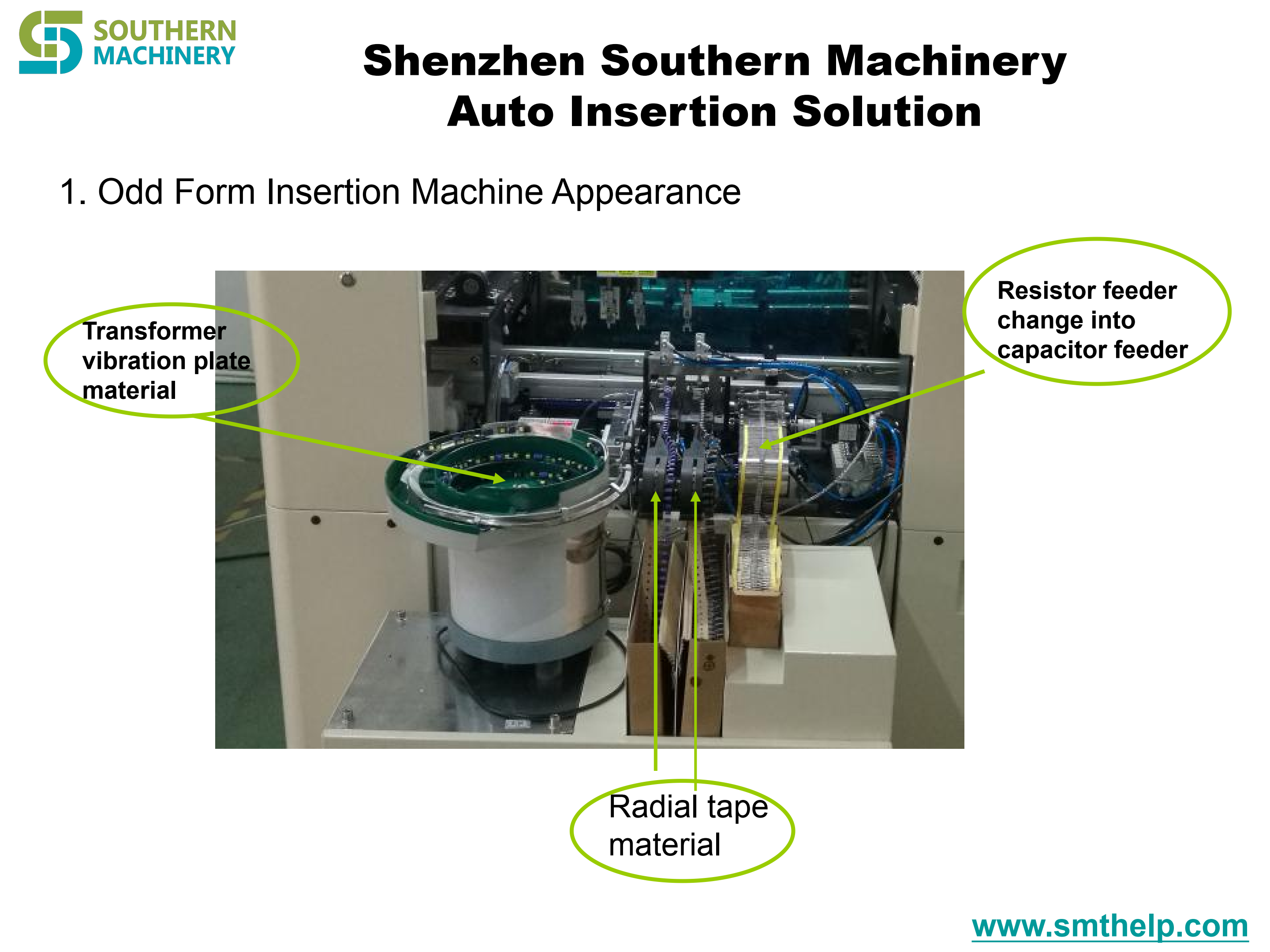
The Southern Machinery S-70LD automates this work with four insertion heads, four adjustable feeders (tape or vibration plate), and an industrial computer with vision guidance. The vision system locates each part, recognizes its lead geometry regardless of how it's presented, checks polarity before placement—rejecting 180°-rotated parts—and seats every lead to a programmed depth with consistent insertion force. That directly attacks the three defect families that manual DIP lines live with: floating high, misinsertion (leakage), and reverse insertion (anti-interpolation).
In buyer terms: the machine takes the components that are hardest to hire for, hardest to train, and hardest to inspect, and moves them into a repeatable automated process on the DIP line.
Typical Applications
The S-70LD's component envelope—3×3 mm to 30×30 mm bodies, up to 50 mm component height—covers the standard odd-form families shared across multiple PCB variants, which is exactly the profile EMS factories want to automate:
- Power supply and adapter boards — transformers, common-mode chokes, bridge rectifiers, and large electrolytic capacitors that are too heavy for standard placement heads and too bulky for tape feeders.
- Home appliance control boards — relays, buzzer elements, terminal blocks, and fuse holders on air-conditioner, microwave, induction-cooker, and electric-kettle PCBs, where mixed SMT/THT boards dominate.
- TV and display boards — flyback and power transformers with multiple pins, where a single non-seated pin can cause a field failure; plus connectors and radial E-CAPs fed by tape or vibration bowl.
- Automotive and vehicle electronics — connectors, relay sockets, and fuse holders on car-audio and vehicle power boards, where consistent insertion orientation and seating directly affect reliability under vibration.
- LED lighting and control boards — radial E-CAP, axial resistor, and inductance solutions for lamps, luminous-character displays, street lamps, and floodlight drivers.
The machine handles PCBs from 50×50 mm up to 300×300 mm with board thicknesses from 0.8–5.0 mm, which covers the standard panel sizes on most DIP lines.
How It Fits Into a Complete PCB Assembly Line
The S-70LD is designed as an inline station, not a standalone island. It accepts boards via SMEMA handshake and returns them to the same conveyor, which means it drops into an existing DIP line upstream of wave soldering without changing your soldering, cleaning, or material-handling infrastructure.
A typical mixed-technology line looks like this:
- SMT section — solder paste printing, SPI, pick-and-place, reflow, and AOI populate the surface-mount side at high speed.
- THT insertion section — a radial auto insertion machine (such as Southern's S-3010B) handles standard taped radial parts at high speed, while the S-70LD odd-form insertion machine places the non-standard remainder: transformers, relays, connectors, terminal blocks.
- Wave soldering — boards pass through a lead-free wave soldering machine (e.g., the S-WS450) that solders all through-hole joints in one pass. This is why consistent lead seating and orientation from the inserter matter so much for solder quality.
- Post-solder — cleaning, depaneling, and inspection close the loop. Tape-fed odd-form insertion also produces carrier-tape waste, which an automatic reel scrap tape cutting machine like the S-680A can handle.
Because the S-70LD is conveyor-compatible and SMEMA-negotiated, EMS companies can automate the odd-form station of an existing line step by step—no need to rebuild the floor.
Key Selection Parameters
When evaluating an odd-form insertion machine, compare these parameters against your actual board and component mix. Verified S-70LD product data is shown where available; request the current data sheet from Southern Machinery to confirm against your specific PCB set.
| Selection parameter | What to evaluate | S-70LD (verified product data) |
|---|---|---|
| Component envelope | Body size, height, lead pitch flexibility | 3×3 to 30×30 mm, height up to 50 mm |
| PCB size range | Board dimensions your line runs | 50×50 to 300×300 mm; thickness 0.8–5.0 mm |
| Feeders | Tape, tube, or vibration-bowl flexibility | 4 feeders, tape or vibration adjustable |
| Insertion heads | Head count vs. your cycle-time target | 4 heads |
| Vision capability | Polarity check, lead-geometry recognition | Industrial PC with vision guidance; 180°-rotated parts detected and rejected |
| Seating consistency | Insertion force control to avoid floating high | Consistent programmed insertion depth per part |
| Speed | Throughput balanced against line rate | 4,000 CPH (3,800 CPH for radial resistor insertion) |
| Placement accuracy | Repeatability | ±0.05 mm |
| Utilities and footprint | Power, air, noise, floor space | 220V AC, 0.8 kVA; 0.4–0.6 MPa air; ≤75 dB; ~1,000 kg |
Beyond the spec sheet, ask the supplier how feeders are configured for your specific part families, how programs are managed for new products, and what the changeover time looks like between SKUs—for EMS factories running 500+ boards per run with repeat orders, those operational details drive the real payback.
ROI and Quality Perspective
From the buyer's perspective, the ROI case for odd-form automation isn't about replacing one wage—it's about removing hidden cost. Manual odd-form insertion is the slowest, most variable step on the DIP line. Output depends on operator proficiency or overtime, and defects such as floating high, misinsertion, and reverse insertion are typically caught only at AOI or functional test—after wave soldering and cleaning—when rework means desoldering, clearing through-holes, reinserting, and re-soldering.
Automation changes the calculation in three concrete ways:
- Consistent insertion force — every component is seated to the same depth, cycle after cycle, eliminating floating-high defects at the source.
- Vision-based polarity verification — reverse insertion is detected and rejected before the board moves downstream, instead of failing at test.
- Predictable cycle time — insertion timing no longer depends on the shift, the operator, or the day of the week, so line balancing and capacity forecasting become accurate.
Southern Machinery's product demo is titled around a 10x labor cost saving for this machine class—the exact multiple depends on your component mix, volumes, and local labor costs, so the company works with each customer to calculate the case against their actual BOM and production plan before equipment is committed. The structural point holds across factories: automated odd-form insertion removes recurring headcount, training, and turnover cost while making throughput predictable enough to take on more volume without adding a shift.
FAQ
What is an odd-form insertion machine?
An odd-form insertion machine is a THT automation station that places non-standard through-hole components—parts that don't fit radial or axial tape formats, such as transformers, relays, connectors, and terminal blocks. It uses vision guidance and programmable tooling to locate, orient, and insert these parts into the PCB automatically.
Which components can the S-70LD insert?
The S-70LD handles component sizes from 3×3 mm to 30×30 mm with heights up to 50 mm, covering transformers, relays, connectors, terminal blocks, fuse holders, radial electrolytic capacitors, inductors, and radial/axial resistors—the standard odd-form families found on power, appliance, TV, automotive, and LED boards.
Does an odd-form insertion machine replace wave soldering?
No. Odd-form insertion only places components into the plated through-holes. The boards still pass through wave soldering afterward, which solders all through-hole joints in one pass. The machine is designed to sit inline upstream of the wave solder machine.
What is the difference between radial insertion and odd-form insertion?
Radial insertion machines handle standard radial components on tape (resistors, small capacitors) at very high speed. Odd-form insertion machines handle non-standard components presented in trays, tubes, or vibration bowls—larger bodies, irregular shapes, and varying lead pitches that radial machines can't process. Many DIP lines use both: radial for standard parts, odd form for the rest.
How does the machine prevent reverse (polarity) insertion errors?
The vision system recognizes each part's lead geometry and checks polarity before placement. Parts presented 180° rotated are detected and rejected or corrected, so polarity-sensitive components such as electrolytic capacitors and transformers are inserted in the correct orientation.
Can the S-70LD be added to an existing DIP line?
Yes. The machine is designed as an inline station that accepts boards via SMEMA handshake and returns them to the same conveyor, upstream of wave soldering. Existing wave soldering, cleaning, and conveyor infrastructure remain unchanged, which makes it practical to retrofit into a running line.
Contact Southern Machinery
Southern Machinery (founded 2011, Shenzhen, China) is an SMT/THT/PCB assembly automation specialist with 237+ global customers in the EMS industry. We design and manufacture odd-form insertion machines, radial and axial auto inserters, wave soldering equipment, board handling systems, custom feeders, and SMT nozzles—and we support them with spare parts, training, and global service.
- Email: jasonwu@smthelp.com
- Product catalog and technical files: https://file.autoinsertion.com
- Product photos and albums: https://ph.smthelp.com
- Website: https://www.smthelp.com
Send us your component list and board files—we'll help you decide whether an odd-form insertion machine is the right automation step for your DIP line, and how to configure it for your part families.
Comments