
Southern Machinery Odd Form Insertion Machine: Automate THT Assembly and Cut Manual Labor Cost by 10x
Manual DIP insertion of transformers, relays, and connectors is often the last labor-heavy step in PCB assembly. Southern Machinery's odd form insertion machines automate special-shaped THT component placement with visio
Aug 26, 2026 · Updated Aug 26, 2026 · Southern Machinery
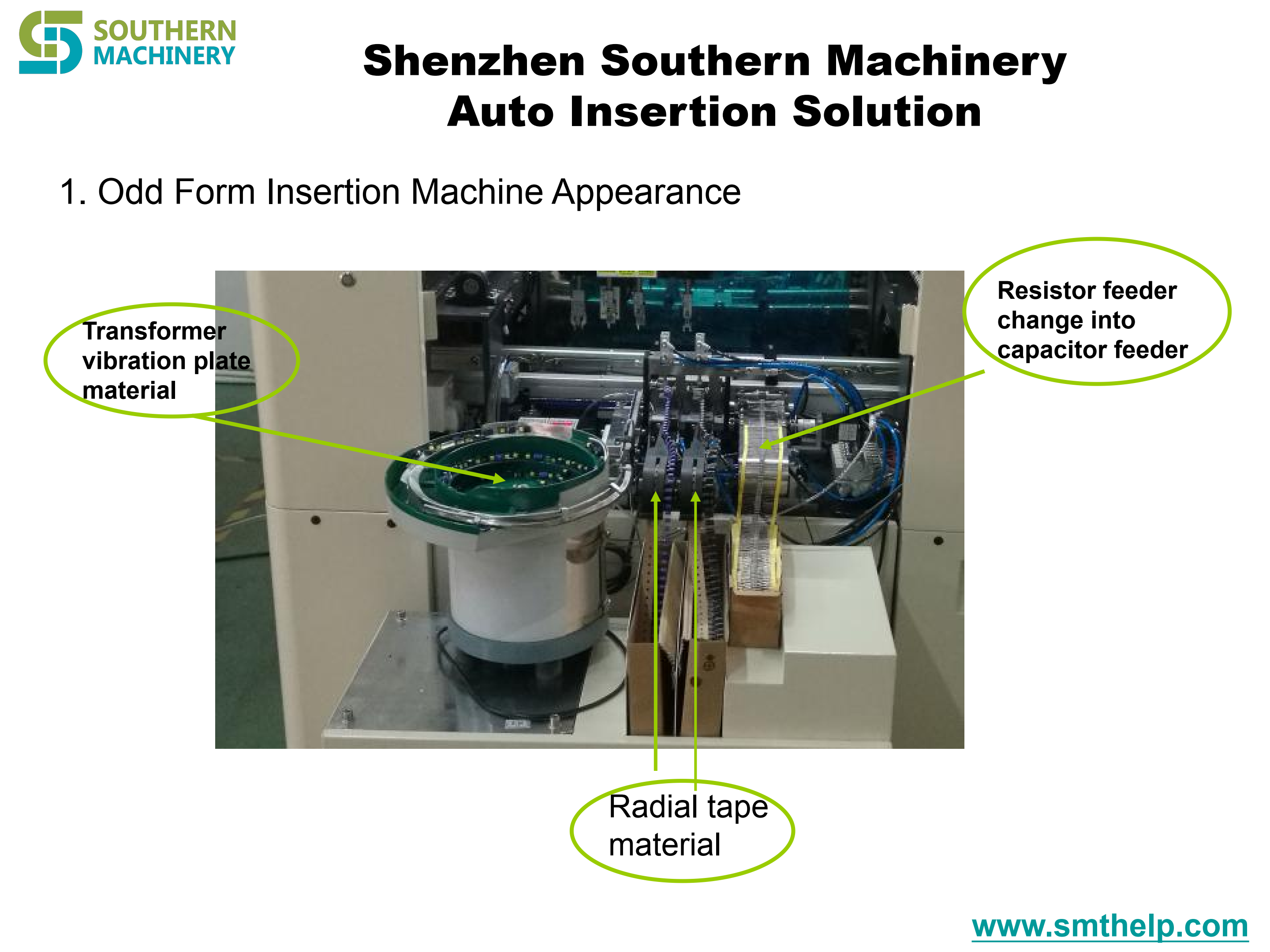
Southern Machinery Odd Form Insertion Machine: Automate THT Assembly and Cut Manual Labor Cost by 10x
Manual DIP (through-hole) insertion is often the last pocket of hand labor on an otherwise automated PCB assembly floor. Transformers, relays, connectors, coils, and large electrolytic capacitors do not run on standard radial or axial inserters, so EMS factories still staff entire benches to place them by hand. Southern Machinery — a Shenzhen, China based SMT/THT/PCB assembly automation specialist founded in 2011, trusted by 237+ customers worldwide — builds odd form insertion machines that take that work off the bench and put it on the line. This article explains what an odd form insertion machine is used for, where it pays back fastest, and what to evaluate before you buy.
<div style="text-align:center; margin:24px 0;">
<iframe width="100%" max-width="640" height="360" src="https://www.youtube-nocookie.com/embed/pXuilb8TrMs?rel=0" title="10x labor cost saving Odd Form Insertion machine for Smart EMS factory PCB assembly" frameborder="0" allow="accelerometer; autoplay; clipboard-write; encrypted-media; gyroscope; picture-in-picture; web-share" allowfullscreen></iframe>
</div>
What is this machine used for?
An odd form insertion machine automates the placement of odd form (special-shaped) through-hole components — parts that cannot be handled by standard automatic inserters because of their height, shape, weight, or packaging. Typical odd form parts include transformers, relays, connectors, terminal blocks, solenoids, buzzers, switches, fuses, and large electrolytic capacitors.
Instead of an operator picking each part and inserting it by hand, the machine uses industrial computer control with vision guidance to locate, orient, and insert components onto the PCB. It handles the same DIP assembly work a manual line does — but with machine repeatability.
Southern Machinery's odd form inserters (including the S-70LD and S-7000 families) are built around the problems that make manual DIP lines painful in practice:
- Labor cost and turnover — insertion operators are increasingly hard to hire, train, and retain; every new operator means a new learning curve.
- Quality variability — manual insertion produces defects such as floating components, missing insertions, misinsertions, and reverse (anti-polarity) insertion.
- Output limits — throughput is capped by operator skill and working hours, which limits how far production can scale.
That is exactly why the industry is moving from manual plug-in to special-shaped (odd form) insertion machines as part of Industry 4.0 and smart factory programs. One machine replaces a multi-person manual insertion station: Southern Machinery's demonstration video for this machine is titled "10x labor cost saving" — the saving comes from collapsing several manual stations into a single automated process supervised by one operator.
Typical applications
Odd form insertion machines earn their keep wherever boards carry a mix of large through-hole components. Realistic scenarios:
- Power supply and ballast boards — transformers, large electrolytic capacitors, and relays on switch-mode power supplies, adapters, and ballasts.
- Home appliance control boards — air conditioner, microwave, induction cooker, and electric kettle PCBs with connectors, relays, and transformers.
- LED lighting and display driver boards — LED driver power sections and display control boards where coils, capacitors, and terminal blocks dominate the THT content.
- Automotive electronics — car audio, vehicle power supplies, and other in-vehicle PCBs with vibration-rated connectors and relays.
- Energy-saving and industrial lighting — street lamp, floodlight, and industrial luminaire drivers where high-voltage through-hole components require reliable, repeatable solder joints.
If your DIP line spends more than a few operators on parts that do not fit radial or axial tape feeders, an odd form inserter is likely a candidate.
How it fits into a complete PCB assembly line
An odd form insertion machine is one station in a full SMT + THT automation ecosystem, and it is designed to drop into that flow cleanly:
- Front end: SMT assembly — solder paste printing, pick-and-place, reflow — handled by Southern Machinery's SMT machines and line peripherals.
- THT section: axial insertion (S4000 series), radial insertion (S-3010B / S3000), pin-eyelet-terminal insertion (S7020 series), and odd form insertion machines run together to cover the complete through-hole component mix.
- Soldering: after insertion, boards flow to wave soldering (e.g., the S-WS450 wave soldering machine) or selective soldering to form reliable solder joints on all leads at once.
- Board handling: magazine loaders, conveyors, buffers, and unloaders keep boards moving between the SMT, insertion, and wave soldering stages — no manual lifting, no bottlenecks.
- Quality: AOI/SPI and X-ray inspection catch defects before they ship, and vision-guided insertion already prevents many of them from being created.
Southern Machinery positions itself as a smart EMS factory partner — the same company supplies the insertion machines, the wave soldering equipment, the board handling system, the feeders, and the custom nozzles, so the whole line can be quoted, commissioned, and supported from one Shenzhen-based team.
Key selection parameters
No two odd form applications are identical, so evaluate the machine against your actual component and board portfolio. The parameters below are the ones buyers should verify — specific values should come from a datasheet or a technical discussion, not from general marketing claims:
- Component envelope — maximum component height, width, weight, and lead pitch the machine can handle. This decides whether your transformers and relays fit.
- Feeder strategy — how parts are presented: trays, tubes, vibration/bowl feeders, or tape. Odd form parts often need custom feeders, and feeder flexibility determines changeover effort.
- Vision and guidance — mark/board recognition, component lead inspection, and the ability to confirm polarity before insertion. This is what eliminates reverse and misinsertion defects.
- Insertion head and tooling — number of heads, nozzle/gripper options, and how quickly tooling can be changed between product variants.
- PCB size and board handling — board dimensions supported, inline vs. offline operation, and compatibility with your conveyor height and board handling equipment.
- Programming and data — offline programming, component database, and recipe management for fast changeovers across multiple products.
- Clinching and force control — whether leads are clinched or insertion force is monitored, which matters for high-vibration applications.
- Throughput vs. tact time — match machine capability to your required line rate; the right answer depends on your board mix, not on a headline CPH number.
Ask for the machine to be evaluated against your own top five boards — a good supplier will quote realistic cycle times only after seeing your components.
ROI and quality perspective
From a buyer's perspective, the ROI case for odd form insertion is usually built on three levers:
- Labor reduction. Replacing a multi-operator manual insertion station with one machine (supervised by a single operator who can often run several machines) directly cuts direct labor per board. Labor savings are the headline in Southern Machinery's own video title — up to 10x when several manual stations are consolidated.
- Defect reduction. Vision-guided insertion prevents floating, leakage, misinsertion, and reverse insertion before wave soldering. Fewer defects mean less rework, fewer field failures, and lower warranty exposure — not just lower labor cost.
- Stability and scalability. Output no longer depends on operator skill, attendance, or overtime. Production can scale to meet demand, quality stays consistent across shifts, and the process becomes data-ready for MES and traceability.
Quality-wise, automated insertion removes the human-variability layer from the DIP process: every board is inserted the same way, every lead is placed the same way, and the machine reports its own performance. For EMS companies competing on quality audits and delivery reliability, that consistency is the quieter half of the business case.
FAQ
What is an odd form insertion machine?
An odd form insertion machine is a THT automation machine that automatically places special-shaped through-hole components — such as transformers, relays, connectors, and large capacitors — onto PCBs using programmable motion and vision guidance.
Which components can an odd form insertion machine place?
Odd form inserters handle components that standard radial and axial inserters cannot: tall, heavy, or irregularly packaged parts like transformers, relays, terminal blocks, solenoids, switches, fuses, and large electrolytic capacitors, typically presented in trays, tubes, or vibration feeders.
Can an odd form insertion machine integrate with an existing wave soldering line?
Yes. Odd form inserters are designed as inline or offline stations in a THT line: boards flow from insertion through wave soldering (such as Southern Machinery's S-WS450) and into inspection, with board handling conveyors linking the stages.
How many operators does an odd form insertion machine need?
One operator can supervise several machines — the machine loads, inserts, and unloads automatically. This is the main source of the labor cost reduction versus manual insertion stations.
Does the machine inspect components before insertion?
Vision guidance is a core feature of odd form insertion: the machine recognizes board marks and inspects components before insertion, which prevents polarity errors, misinsertions, and missing parts.
How can I get a catalog or quotation from Southern Machinery?
Contact Jason Wu at jasonwu@smthelp.com, request the machine catalog via file.autoinsertion.com, and browse product photos at ph.smthelp.com. Southern Machinery is based in Shenzhen, China, and supports global EMS and PCB assembly customers.
Contact Southern Machinery
Southern Machinery (Shenzhen Southern Machinery Sales And Service Co., Ltd) is a Shenzhen-based designer and manufacturer of SMT, THT, and PCB assembly automation equipment, founded in 2011 and serving 237+ customers worldwide. To discuss your odd form insertion requirements:
- Email: jasonwu@smthelp.com
- Product catalog: file.autoinsertion.com
- Machine images: ph.smthelp.com
- Website: www.smthelp.com
Tell us your board mix and current DIP headcount — we will help you size the machine, the feeders, and the line integration for your smart EMS factory.
Comments