
Southern Machinery Odd Form Insertion Machine: Automate THT Assembly and Cut Labor Cost
Odd-form THT components—connectors, relays, transformers, fuse holders, and terminal blocks—are still inserted by hand in many EMS factories, and they are the biggest source of quality and cost variability on the DIP lin
Aug 20, 2026 · Updated Aug 20, 2026 · Southern Machinery
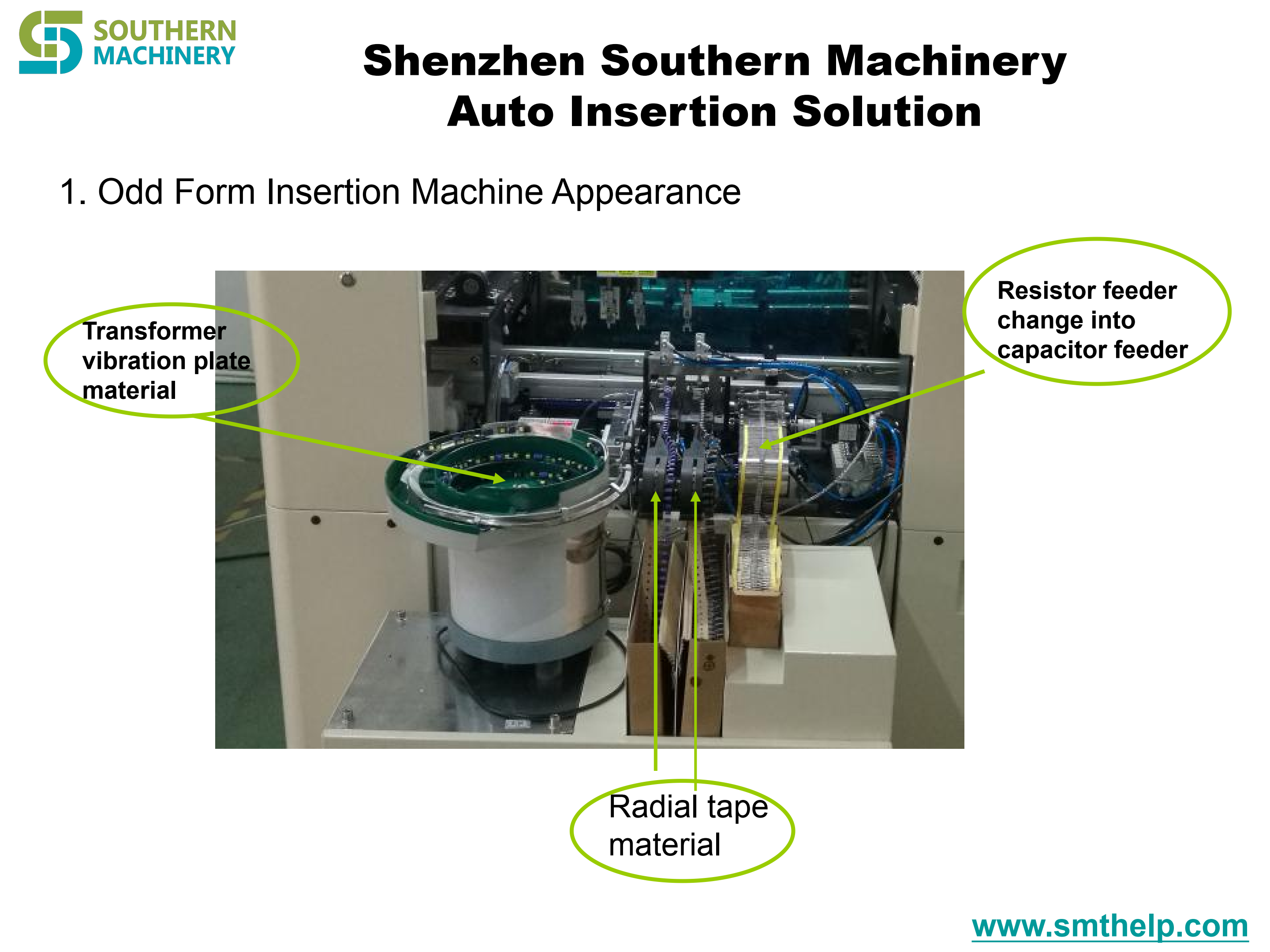
Southern Machinery Odd Form Insertion Machine: Automate THT Assembly and Cut Labor Cost
In many EMS factories, odd-form THT components—connectors, relays, transformers, fuse holders, and terminal blocks—are still inserted by hand, making them the biggest source of quality and cost variability on the DIP line. Southern Machinery's odd form insertion machines take these non-standard parts off the manual bench and place them using a vision-guided automatic insertion platform, eliminating floating-high, misinsertion, and reverse-insertion defects while removing dependence on operator skill and overtime. This deep-dive article explains what the machine does, where it pays back, and how it fits into a complete SMT/THT PCB assembly line.
<iframe width="100%" height="480" src="https://www.youtube-nocookie.com/embed/P0rfpkHpPxg?rel=0" title="10x labor cost saving Odd Form Insertion Machine for Smart EMS factory PCB assembly" frameborder="0" allow="accelerometer; autoplay; clipboard-write; encrypted-media; gyroscope; picture-in-picture; web-share" referrerpolicy="strict-origin-when-cross-origin" allowfullscreen></iframe>
What is this machine used for?
An odd form insertion machine (also called a special-shaped or odd-form DIP inserter) is a THT auto insertion machine built for components that do not fit standard radial tape, axial tape, or SMD formats. These are the asymmetric, non-standard parts that arrive in trays, tubes, or loose bags: transformers, relays, connectors, terminal blocks, fuse holders, radial electrolytic capacitors, inductors, lamps, and optoelectronic components.
In a typical DIP line, these parts are still hand-inserted because their lead pitches vary and their bodies are irregular. That manual step is exactly where the line loses money:
- Labor and training cost — Operators are younger, less stable, and more mobile; every new hire means training cost and a learning curve before quality stabilizes.
- Quality defects — Manual insertion commonly produces floating high (leads not seated), leakage (missed components), misinsertion, and anti-interpolation (reverse polarity or wrong orientation).
- Output variability — Throughput depends entirely on operator proficiency and working hours; production cannot scale, and competitiveness suffers.
For a buyer, the practical answer is: if operators are still hand-plugging odd-form parts, and your wave soldering line is waiting on them, this machine replaces the manual bench with a programmable, vision-guided insertion station that seats every lead to a set depth and checks orientation before placement.
Typical applications
Southern Machinery's odd form insertion platforms are applied wherever THT boards mix SMD and through-hole content. Real application scenarios include:
- TV and display boards — Transformers, tuner shields, connectors, large electrolytic capacitors, and standoffs dominate TV mainboards.
- Power supply and LED driver boards — Transformers, bridge rectifiers, varistors, thermistors, and terminal blocks in switch-mode power supplies, vehicle power supplies, energy-saving power supplies, and ballasts.
- Home appliance control boards — Relays, connectors, buzzers, potentiometers, and fuse holders in air conditioners, microwave ovens, induction cookers, electric kettles, and washing machine panels.
- Automotive and industrial electronics — Heavy connectors, relays, and terminal blocks on vehicle power and car audio boards, plus industrial control and instrumentation PCBs.
- Lighting and LED modules — Odd-form components in LED lighting, display, luminous-character, and control-system boards.
How it fits into a complete PCB assembly line
An odd form insertion machine is not a standalone gadget—it is one station in the THT half of a mixed SMT/THT line, and it should be planned as part of the whole material flow:
- Upstream: After SMT reflow and AOI inspection, boards enter the THT area on a board handling system (loaders, conveyors, buffers, and unloaders keep the line flowing without manual lifting).
- The THT insertion block: Radial components go to a radial auto insertion machine (such as the S-3000/S-3010B class), axial components to an axial inserter (S-4000 class), pins/eyelets/terminals to a pin and eyelet machine (S-7020 series), and the non-standard parts—the odd-form family—to the odd form insertion machine. Feeders, trays, and tube feeders supply components in the presentation the machine can handle.
- Downstream: Assembled boards pass through wave soldering (lead-free dual wave machines such as the S-WS350B/S-WS450 platform) to solder all through-hole joints in one pass, then through post-soldering inspection and depaneling.
Because Southern Machinery designs and manufactures the insertion machines, the board handling, and the wave soldering equipment, one supplier can engineer the whole THT cell—including feeder and nozzle selection, line balancing, and training—instead of the buyer integrating machines from several vendors.
Key selection parameters
There is no single specification that fits every board. When evaluating an odd form insertion machine for your line, buyers should compare these parameters—and ask the supplier for data matched to their own component list:
- Component range: The sizes, lead pitches, lead lengths, and packaging types (tray, tube, tape, loose) the machine can handle, and how feeders are configured for each.
- Insertion head and tooling: Number of heads, nozzle and gripper options, and how quickly tooling can be changed between component types.
- Vision and verification: How the vision system reads lead geometry, checks polarity, and rejects defective parts before placement—this is what eliminates reverse insertion and floating high.
- Programmability: How PCB data, mark points, and component teaching are handled, and whether programs can be built offline or learned on the machine.
- Board size and throughput: Maximum PCB dimensions and realistic cycle time for the specific components on your bill of materials. (Do not buy on headline CPH alone—odd-form machines are judged on the mix, not the best case.)
- Integration: Conveyor height, line interface, MES connectivity, and whether the machine can be linked to upstream and downstream equipment.
- Support and spares: Availability of nozzles, feeders, spare parts, and training from the manufacturer.
ROI and quality perspective
From a buyer's perspective, the return on an odd form insertion machine is calculated on three lines:
- Direct labor reduction. Every hand-insertion position removed from the DIP line reduces headcount, training cost, and the cost of turnover. One machine replacing several operators changes the line's fixed cost structure—the "10x labor cost saving" framing in the video is exactly this: the same output with a fraction of the manual labor, or far more output with the same team.
- Quality cost. Floating-high, misinsertion, and reverse-insertion defects do not just fail at test—they create rework, solder defects after wave soldering, and field returns. A vision-checked, programmable insertion step removes the human variance that produces these defects, and the improvement is visible in first-pass yield.
- Scalability. With a machine, throughput is predictable and repeatable; the line can run additional shifts without recruiting and training new operators. Production scale stops being limited by "personnel plug-in proficiency" and becomes a matter of machine capacity.
For an EMS factory competing on cost and delivery, this is the difference between a DIP line that is a cost center and one that is a reliable, repeatable process.
Frequently asked questions
What is an odd form insertion machine?
An odd form insertion machine is a THT auto insertion machine that automatically inserts non-standard (odd-form) through-hole components—such as transformers, relays, connectors, and terminal blocks—into PCBs, replacing manual insertion on the DIP line.
Which components can an odd form insertion machine handle?
Odd form machines handle components that do not fit standard radial or axial tape formats, typically delivered in trays, tubes, tape, or loose packaging: transformers, relays, connectors, terminal blocks, fuse holders, radial electrolytic capacitors, inductors, and optoelectronic components.
How does an odd form insertion machine improve quality?
The vision system reads each part's lead geometry, verifies orientation and polarity before placement, and seats leads to a programmed depth. This eliminates the classic manual defects of floating high, leakage, misinsertion, and reverse insertion.
Where does an odd form insertion machine sit in a PCB assembly line?
It sits in the THT insertion block of a mixed SMT/THT line, between board loading and wave soldering—typically after radial and axial insertion, with the assembled boards then passing through wave soldering for joint formation.
How do I know if my factory needs an odd form insertion machine?
If operators are hand-inserting transformers, relays, connectors, or terminal blocks, and you see floating-high, misinsertion, or reverse-insertion defects, or output that depends on operator skill and overtime, your line is a candidate for odd form insertion automation. Send Southern Machinery your component list and board data for a configuration review.
Does Southern Machinery provide the whole THT line?
Yes—Southern Machinery designs and manufactures radial insertion, axial insertion, pin/eyelet insertion, odd form insertion, board handling, and wave soldering equipment, plus custom nozzles, feeders, and spare parts, so one supplier can engineer the complete THT automation cell.
Get a quote
Southern Machinery—Smart EMS factory partner—designs and manufactures SMT and THT automation in Shenzhen, China. Since 2011, we have served more than 237 customers worldwide with insertion machines, pick and place equipment, wave soldering, board handling systems, custom nozzles, and global after-sales support.
- Email: jasonwu@smthelp.com
- Product catalog: browse machine catalogs and datasheets at file.autoinsertion.com
- Machine photos: find product images at ph.smthelp.com
- Website: www.smthelp.com
Send us your PCB data and component list—we will recommend the odd form insertion configuration that fits your line.
Comments