
Southern Machinery Radial Feeder Odd Form Insertion: 10x Cost Saving for EMS PCB Assembly
Manual odd-form insertion — transformers, relays, connectors, terminal blocks — is the most labor-intensive, quality-critical step left on most THT lines. Southern Machinery's radial feeder odd form insertion automation replaces hand insertion with vision-guided, feeder-driven placement: consistent insertion depth, polarity checking, and predictable cycle time. This page's deep-dive video shows the machine running in a smart EMS factory and breaks down the 10x cost-saving math. Built in Shenzhen and serving 237+ global customers since 2011, Southern Machinery's odd form insertion platforms integrate upstream of wave soldering. Request the catalog and configuration data.
Aug 19, 2026 · Updated Aug 19, 2026 · Southern Machinery
Southern Machinery Radial Feeder Odd Form Insertion: 10x Cost Saving for Smart EMS PCB Assembly
Manual odd-form insertion — transformers, relays, connectors, fuse holders, terminal blocks — is usually the most labor-intensive and quality-critical step left on a THT line. Southern Machinery's radial feeder odd form insertion automation replaces hand insertion with vision-guided, feeder-driven placement: consistent insertion depth, automatic polarity checking, and a predictable cycle time that manual operators cannot match. This article breaks down what the machine does, where it pays back, and how it slots into a complete SMT/THT PCB assembly line.
<iframe width="100%" height="480" src="https://www.youtube-nocookie.com/embed/iQx-MsR829c?rel=0" title="10x cost saving to use Radial Feeder Auto Odd Form Insertion for Smart EMS factory PCB assembly" frameborder="0" allow="accelerometer; autoplay; clipboard-write; encrypted-media; gyroscope; picture-in-picture; web-share" referrerpolicy="strict-origin-when-cross-origin" allowfullscreen></iframe>
What is this machine used for?
It is an odd-form (special-shaped) THT auto insertion machine fed by radial-type feeders, and it exists to take the non-SMD, non-standard components off the manual bench and put them on the machine.
Odd-form components are the parts that do not fit standard radial or axial tape, and do not come as SMD: transformers, relays, connectors, fuse holders, terminal blocks, radial electrolytic capacitors, inductors, lamps and optoelectronic components. They arrive in trays, tubes, or loose bags, their lead pitches vary, and their bodies are asymmetric. That is exactly why they are still inserted by hand in many EMS factories — and exactly why they cause the biggest quality and cost variance on the DIP line.
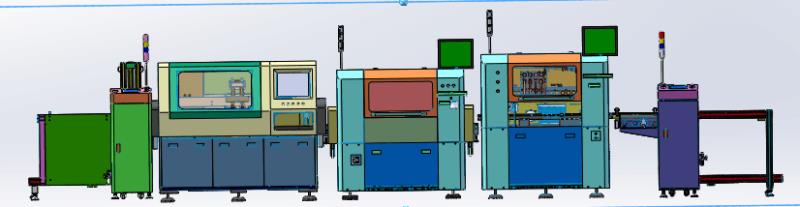
The machine shown in the video belongs to Southern Machinery's vision-guided odd-form inserter family (the S-70LD class platform). It uses radial tape feeders and vibration feeders, an industrial PC with vision guidance, and multiple insertion heads. The vision system reads each part's lead geometry regardless of how it is presented, orients it, checks polarity before placement (rejecting 180°-rotated parts), and seats every lead to a programmed depth — eliminating the three classic manual defects: floating high, misinsertion, and reverse insertion.
For buyers, the practical answer is simple: if operators are still hand-plugging odd-form parts and your wave soldering line is the bottleneck, this machine replaces that labor with repeatable, feeder-driven automation.
Typical applications
1. Power supply and ballast PCBA. Transformers, radial E-CAPs, inductors and fuse holders are dense, high-value odd-form content on power boards. Vision-guided insertion with radial tape feeding keeps polarity correct and pins fully seated — the two failure modes that send power supplies back for rework.
2. Home appliance control boards (air conditioner, induction cooker, microwave, rice cooker). High-volume per SKU, standard component families, and multiple PCB variants sharing the same transformer/relay/terminal-block set. That mix is the sweet spot for odd-form automation: the same feeders and programs serve several board numbers.
3. LED lighting and driver boards. Radial E-CAP capacitors, inductors and lamp components in radial tape can be inserted automatically at consistent depth, protecting the LED driver's reliability and reducing handling damage.
4. Automotive and vehicle electronics (car audio, vehicle power supply). Connectors and relays with 6–10 pins are exactly the parts where one non-seated pin becomes a field failure. Automatic insertion force control and polarity checking are worth more here than anywhere else.
5. Industrial controls and instrumentation. Terminal blocks, relays and fuse holders in medium runs (500+ boards per run, repeat orders) — the volume point where manual insertion cost and defect rates start hurting profitability.
How it fits into a complete PCB assembly line
A radial feeder odd form insertion machine is not a standalone gadget; it is a station in the THT / DIP portion of the line, and Southern Machinery positions it as part of a full SMT–THT ecosystem:
- Upstream (SMT side): solder paste printing, SPI, pick-and-place, reflow, AOI — boards arrive at the DIP section already SMD-populated.
- THT insertion block: the S-70LD class odd-form inserter (inline, SMEMA handshake, connects directly to the conveyor) sits alongside the S-3010B radial insertion machine for standard radial components. The S-3010B covers high-speed radial work (rated 22,000 CPH; lead spans 2.5–10.0 mm; 0–360° insertion in 1° increments; vision coordinate correction), while the S-70LD handles the odd-form family at 4,000 CPH with ±0.05 mm placement accuracy. Together they clear the manual bench.
- Downstream: inserted boards flow into wave soldering (Southern Machinery's S-WS350B lead-free dual wave or S-WS450), then cleaning, then AOI.
- Support equipment: S-680A reel scrap tape cutter for feeder tape waste, stencil cleaning, board handling conveyors and ESD storage keep the surrounding processes automated.
Because the odd-form inserter is designed as an inline station that accepts boards via SMEMA and returns them to the same conveyor, it integrates with existing wave soldering, cleaning and conveyor infrastructure — you upgrade the bottleneck, not the whole line.
Key selection parameters
If you are evaluating an odd-form insertion machine with radial feeding, verify these categories with the supplier — and compare against the documented S-70LD reference platform below:
- Number of insertion heads and feeders — determines how many different components can be loaded simultaneously. S-70LD reference: 4 heads, 4 feeders (tape or vibration plate, adjustable).
- Insertion speed and accuracy — stated in CPH and mm. S-70LD reference: 4,000 CPH (3,800 CPH for radial resistor insertion), ±0.05 mm.
- Component envelope — minimum/maximum body size and height. S-70LD reference: 3×3 mm to 30×30 mm, up to 50 mm tall.
- PCB envelope and thickness — the board sizes your line actually runs. S-70LD reference: 50×50 mm to 300×300 mm, 0.8–5.0 mm.
- Vision and polarity checking — does the system verify lead geometry and reject reversed parts?
- Feeding flexibility — tape, vibration bowl, tube; changeover time between component families.
- Integration — SMEMA inline handshake, conveyor compatibility, upstream-of-wave-solder layout.
- Utilities and footprint — power, air pressure, noise, machine weight, floor space. S-70LD reference: 220V AC 0.8 kVA, 0.4–0.6 MPa air, ≤75 dB, ~1,000 kg.
Never buy on a datasheet alone — ask for cycle-time validation on your own boards and component set.
ROI and quality perspective
The "10x cost saving" in the video title is the machine's central economic argument, and the mechanics behind it are concrete:
- Labor: a hand-inserted odd-form connector takes roughly 4–10 seconds depending on operator familiarity and part orientation. Over a run of 5,000 boards with 4 odd-form parts each, that variability alone can add 8–16 hours of unplanned labor per shift. Feeder-driven automation replaces that with a fixed cycle time.
- Rework: odd-form defects are usually caught only at AOI or functional test — after wave soldering and cleaning. Rework means desoldering, clearing through-holes, reinserting, re-soldering: 3–5 minutes per board, often damaging adjacent components.
- Field failures: for a transformer with 6–10 pins, a single non-seated pin can cause a field failure that costs 20–50× the board's assembly value to repair. Consistent insertion force and polarity checking are the quality insurance.
- Workforce reality: younger operators are mobile, training costs keep rising, and output currently depends on personal proficiency. Automation decouples throughput and quality from the headcount you can actually hire.
The buyer's honest math: the wage is visible; the rework, throughput loss and quality variance are not. Southern Machinery's case for odd-form automation is that the hidden costs — not the visible wage — are what justify the machine.
FAQ
What is a radial feeder odd form insertion machine?
A THT auto insertion machine that feeds odd-form components (transformers, relays, connectors, radial capacitors) from radial tape or vibration feeders and inserts them into plated through-holes automatically, using vision guidance to locate, orient and seat each part.
Which components can it handle?
Odd-form and radial-lead parts that do not fit standard SMD or axial handling: transformers, relays, connectors, fuse holders, terminal blocks, radial E-CAP capacitors, inductors, lamps and optoelectronic components — typically 3×3 mm to 30×30 mm bodies (S-70LD reference envelope).
How does odd form auto insertion reduce PCB assembly cost?
It replaces manual insertion labor with a fixed automated cycle, eliminates rework from floating-high, misinsertion and reverse-insertion defects, and removes throughput dependence on operator skill and availability — the basis of the 10x cost-saving claim demonstrated in the video.
Can it integrate with an existing wave soldering line?
Yes. The S-70LD class odd-form inserter is an inline station that accepts boards via SMEMA handshake and returns them to the same conveyor upstream of wave soldering, so existing wave soldering, cleaning and conveyor infrastructure can remain unchanged.
What is the difference between a radial insertion machine and an odd form insertion machine?
A radial insertion machine (e.g., S-3010B) is optimized for high-speed insertion of standard radial-taped components such as capacitors, transistors, LEDs and key switches (rated 22,000 CPH). An odd-form insertion machine (e.g., S-70LD) handles non-standard, special-shaped components at lower speed (4,000 CPH) but with vision guidance and polarity checking. Many THT lines use both.
How do I get a catalog and quotation?
Contact Southern Machinery directly — email jasonwu@smthelp.com. The full machine catalog is available at file.autoinsertion.com, and product images can be found at ph.smthelp.com.
Talk to Southern Machinery
Southern Machinery (Shenzhen, China) has supplied SMT, THT and PCB assembly automation to 237+ global customers since 2011. For a radial feeder odd form insertion machine quotation, configuration advice, or a machine catalog:
- Email: jasonwu@smthelp.com
- Catalog downloads: https://file.autoinsertion.com
- Product images: https://ph.smthelp.com
- Website: https://www.smthelp.com
Comments