
Southern Machinery Odd Form Component Insertion: 10x Cost Saving for Smart EMS PCB Assembly
Southern Machinery's vision-guided odd-form insertion platform automates transformers, relays, connectors, fuse holders, and terminal blocks on the DIP line — the machine family demonstrated in this 10x cost-saving video for Smart EMS PCB assembly. Hand-inserting these parts takes 4 to 10 seconds each and hides rework until AOI or function test; a vision-guided inserter seats every lead to programmed depth and rejects reversed parts before soldering. This buyer's guide covers what the machine is used for, typical applications, integration with existing wave-soldering lines, key selection parameters, and the ROI and quality case — from the Shenzhen-based SMT/THT equipment maker serving 237+ global customers.
Sep 6, 2026 · Updated Sep 6, 2026 · Southern Machinery
Southern Machinery Odd Form Component Insertion: 10x Cost Saving for Smart EMS PCB Assembly
Video reference: 10x cost saving to insert Odd Form Electronic components for Smart EMS factory PCB assembly — Southern Machinery product demo, THT auto insertion.
If your DIP line still relies on operators to hand-insert transformers, relays, connectors, fuse holders, or terminal blocks, those few seconds per component are quietly the most expensive part of your PCB assembly cost. Odd-form parts do not come on standard radial or axial tape, their lead pitches vary, and their bodies are asymmetrical — which is exactly why they are still manual on many lines.
Southern Machinery, the Shenzhen-based SMT and THT equipment manufacturer founded in 2011, builds vision-guided odd-form insertion machines — the platform demonstrated in this video — that place these components automatically and seat every lead to a programmed depth. With more than 237 global customers across EMS and PCB assembly factories, Southern Machinery positions this class of machine as a step-change in DIP-line economics: the video's headline claim is a 10x cost saving versus manual odd-form insertion.
This article explains what these machines do, where they pay for themselves, and how to evaluate one for your line.
What is this machine used for?
An odd-form (special-shaped) insertion machine automates the through-hole placement of components that standard radial and axial inserters cannot handle — parts that arrive in trays, tubes, vibration bowls, or loose bags rather than on uniform tape. In Southern Machinery's lineup this role is filled by the S-70LD Odd Form Insertion Machine, the vision-guided platform used in this demo.
The machine works like this: an industrial computer with a vision system recognizes each part's lead geometry regardless of how the part is presented, orients it correctly, and inserts it into the plated through-hole at a controlled force. Because the vision system checks polarity and lead position before placement, a 180-degree-rotated (reverse-inserted) part is detected and rejected instead of being soldered into the board.
Verified platform specifications of the S-70LD:
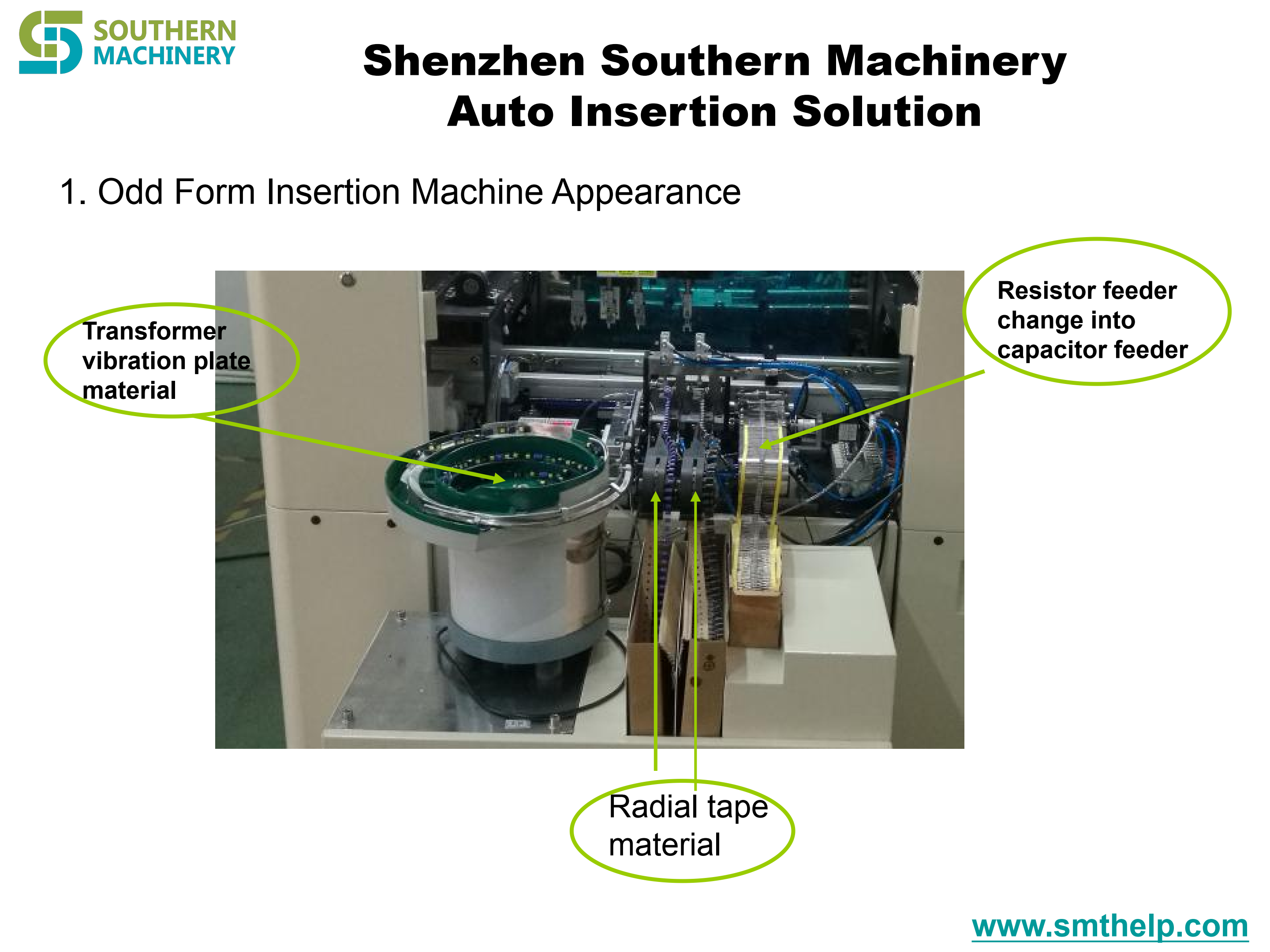
- 4 insertion heads and up to 4 feeders (tape or vibration plate, adjustable)
- Insertion speed: 4,000 CPH rated (3,800 CPH noted for radial resistor insertion)
- Insertion accuracy: ±0.05 mm
- Component size: 3×3 to 30×30 mm; component height up to 50 mm
- PCB size: 50×50 to 300×300 mm; PCB thickness 0.8–5.0 mm
- Machine weight: ~1,000 kg; power supply 220V AC, 0.8 kVA; air pressure 0.4–0.6 MPa; noise ≤75 dB
In plain buyer terms: this is the machine that removes the last big pocket of manual labor from a THT/DIP assembly line — the odd-form bench.
Typical applications
Odd-form insertion automation makes economic sense when the same component families repeat across your boards. Common real-world scenarios:
- Power supplies and adapters — transformers, power inductors, and large radial E-CAP capacitors are heavy, awkward parts that are tiring to insert by hand over a shift. A vision-guided inserter seats all pins of a multi-pin transformer to the same depth every cycle.
- Home appliance control boards (air conditioners, induction cookers, rice cookers, washing machines) — relay and connector insertion, often mixed with radial capacitors and resistors on the same board.
- Lighting and LED driver boards — fuse holders, terminal blocks, and lamp/optoelectronic components, where polarity errors cause immediate functional failures.
- Automotive and industrial electronics — vibration-rated connectors and relays where a single non-seated pin can become a field failure.
- Mixed consumer electronics — boards that combine a few standard radial parts with several odd-form families, where automating the odd-form portion de-bottlenecks the whole line.
The common thread: boards with 500+ units per run, repeat orders, and a stable set of odd-form component families shared across multiple PCB variants.
How it fits into a complete PCB assembly line
The odd-form inserter is not a standalone island — it is designed to join an existing SMT + THT + wave soldering ecosystem.
- SMT side: after reflow, the board carries its SMD components. Odd-form and other THT parts are added on the DIP side.
- Upstream THT automation: standard radial components (capacitors, transistors, LEDs on tape) are handled by a radial auto insertion machine such as Southern Machinery's S-3010B. The S-70LD then takes over the non-standard parts on the same line.
- Inline by design: the S-70LD accepts boards via a SMEMA handshake and connects to your existing conveyor upstream of wave soldering. Existing wave solder, cleaning, and board-handling infrastructure stay unchanged — no additional handling of the board between insertion and soldering.
- Downstream wave soldering: a lead-free dual-wave machine (e.g., Southern Machinery S-WS350B) solders the inserted leads; consistent seat depth from the inserter means consistent solder joint quality at the wave.
- Supporting equipment: tape-fed odd-form insertion generates carrier-tape waste that a reel scrap tape cutter (S-680A) can dispose of automatically, and the S7000 series covers pin/eyelet terminal insertion where that is part of the product.
Because the machine is programmable per board and supports fine product management, an EMS factory can schedule multiple SKUs across the same line — which is the "Smart EMS factory" operating model Southern Machinery designs around.
Key selection parameters
When evaluating an odd-form insertion machine for your line, work through these categories with your own data — no two DIP lines have identical component mixes:
- Component envelope: length/width and height of the largest and smallest parts you must insert today (and next year). Compare against the machine's component range and clearance above the board.
- Feeding flexibility: does your mix come on tape, in tubes/sticks, in vibration bowls, or loose? Check how many feeders the machine accepts and which feeder types — tape, vibration plate, tube/ladder — are supported per station.
- Number of heads vs. product mix: more heads raise throughput on high-volume single-SKU runs; fewer, well-configured heads may be enough for medium runs. Match the machine to your batch profile, not to the datasheet maximum.
- Vision capability: lead-geometry recognition and polarity checking before placement are what prevent reverse insertion and floating-high defects — confirm the vision system covers your actual parts, including dark or low-contrast bodies.
- Board size and thickness range: the S-70LD's 50×50–300×300 mm PCB range suits many DIP lines, but verify your largest board and thickness.
- Inline integration: SMEMA handshake, conveyor height, and whether installation changes your existing wave solder or cleaning equipment.
- Changeover effort: how fast can you switch between SKUs with different component layouts — program recall, feeder changes, and first-board verification.
- Utilities and footprint: power, air pressure, noise, and floor space versus what your facility can provide.
- After-sales support: spare parts availability, training, and service response — ask about the supplier's parts ecosystem and support structure before you commit.
ROI and quality perspective
Buyers usually start with labor, but the sharper calculation includes quality. Southern Machinery's own analysis of manual odd-form insertion is blunt about where the money goes:
- A hand-inserted connector takes roughly 4 to 10 seconds depending on operator familiarity, part orientation, and presentation. Over a run of 5,000 boards with four odd-form parts each, that variability can add 8 to 16 hours of unplanned labor per shift.
- Manual odd-form insertion produces floating-high parts (not fully seated), misinsertion, and reverse/polarity errors. These are typically caught only at AOI or functional test — after the board has passed wave soldering and cleaning.
- Rework at that stage means desoldering, clearing the through-hole, reinserting, and re-soldering: roughly 3 to 5 minutes per board, often at the cost of adjacent components.
- For a transformer with 6 to 10 pins, a single non-seated pin can cause a field failure that costs 20 to 50 times the board's assembly value to repair in the field.
The S-70LD answers each of these: vision guidance eliminates reverse insertion; consistent insertion force seats every lead to programmed depth, eliminating floating high; and predictable cycle time makes line balancing and throughput forecasting accurate regardless of shift or operator turnover. As Southern Machinery puts it: the wage is visible — the rework, throughput loss, and quality variance are not.
The "10x cost saving" in the video title is Southern Machinery's claim for moving this work from manual to automated insertion. The right way to test it for your factory is to run your own numbers: current labor hours per board for odd-form parts, defect and rework rates at AOI/function test, field-return cost, and the batch sizes you schedule. Factories running 500+ boards per SKU with repeat orders and shared odd-form families are typically where the payback math closes fastest — and where the 10x order-of-magnitude improvement stops sounding like marketing.
FAQ
What components can an odd-form insertion machine insert?
Transformers, relays, connectors, fuse holders, terminal blocks, radial E-CAP capacitors, radial and axial resistors, inductors, and lamp/optoelectronic components — essentially non-standard THT parts that do not fit uniform radial or axial tape and come in trays, tubes, or loose form.
What is the difference between odd-form insertion and radial insertion?
Radial insertion machines (like Southern Machinery's S-3010B) handle standard taped radial components at very high speed with fixed lead spans. Odd-form insertion machines handle non-standard, asymmetrical parts with varying lead pitches using vision guidance and flexible feeding — typically at lower CPH but for parts no radial machine can touch.
Can an odd-form inserter be added to an existing DIP/wave-soldering line?
Yes. The S-70LD is designed as an inline station that accepts boards via SMEMA handshake and connects to the existing conveyor upstream of wave soldering. Existing wave solder, cleaning, and board-handling equipment remain unchanged.
How does the machine prevent reverse-insertion and polarity errors?
The vision system checks lead geometry and polarity before placement. A 180-degree-rotated part is detected and rejected or corrected rather than inserted, and each lead is seated to a programmed depth with consistent insertion force.
Does it handle tube, vibration-bowl, or loose parts?
The platform supports up to 4 feeders that are adjustable between tape and vibration-plate presentation, with tube/ladder feeding options for multi-layer automatic supply — matching how odd-form parts actually arrive from suppliers.
How do I get a specification and quotation for my components?
Send your PCB files or samples, the odd-form component list with packaging type, and your volumes to Southern Machinery. Request the catalog at file.autoinsertion.com and browse machine photos at ph.smthelp.com.
Talk to Southern Machinery about automating your odd-form insertion
Southern Machinery (Shenzhen, China, founded 2011) has served 237+ global customers with SMT, THT, and PCB assembly automation — from insertion machines and wave soldering to board handling and supporting equipment. If transformers, relays, connectors, or other odd-form components are still slowing your DIP line, ask the team to run your component list against the S-70LD platform.
- Email: [jasonwu@smthelp.com](mailto:jasonwu@smthelp.com) (Jason Wu)
- Phone / WhatsApp: +86 13602562576
- Website: www.smthelp.com
- Catalog download: file.autoinsertion.com
- Machine images: ph.smthelp.com
Comments