
Southern Machinery Customized THT Odd Form Feeders: 10x Cost Saving Feeder Design for Smart EMS PCB Assembly
Customized THT odd form feeder design is one of the fastest ways for EMS factories to cut PCB assembly costs. Southern Machinery engineers tape, vibration-plate, and ladder feeders matched to your odd-form components—tra
Aug 21, 2026 · Updated Aug 21, 2026 · Southern Machinery
Customized THT Odd Form Feeder Design: 10x Cost Saving Feeder Engineering for Smart EMS PCB Assembly
Odd-form components—transformers, relays, connectors, terminal blocks, fuse holders, radial capacitors—are the parts that keep manual operators on the DIP line. They do not fit standard SMT tape-and-reel feeders, and until now, most EMS factories have accepted slow hand insertion as the only option.
Southern Machinery (founded 2011, Shenzhen, China; 237+ global customers) takes a different approach: instead of forcing your components into a standard feeder, we design the feeder around your component. A customized THT odd form feeder matches the presentation, orientation, and pitch of your specific part, so an auto insertion machine can feed and place it reliably, at speed, shift after shift. The company's demonstration video—"10x cost saving Customized THT odd form feeder design for Smart EMS factory PCB assembly"—shows exactly how this feeder engineering approach replaces manual odd-form insertion with repeatable automation.
<iframe width="560" height="315" src="https://www.youtube-nocookie.com/embed/oWe8DATr63k?rel=0" title="10x cost saving Customized THT odd form feeder design for Smart EMS factory PCB assembly" frameborder="0" allow="accelerometer; autoplay; clipboard-write; encrypted-media; gyroscope; picture-in-picture; web-share" allowfullscreen></iframe>
What is this machine used for?
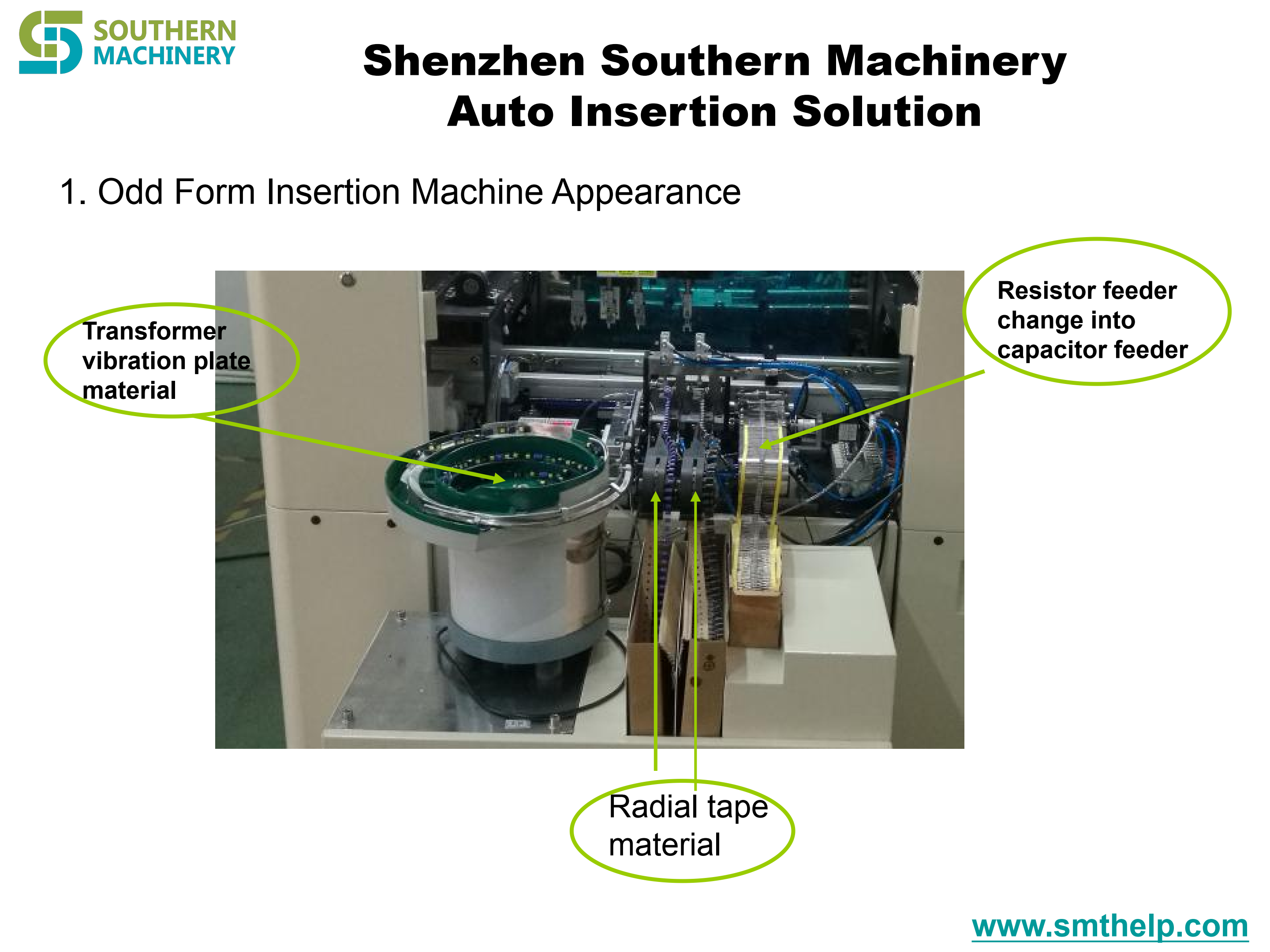
A customized THT odd form feeder is the material-handling front end of an odd-form auto insertion machine. Its job is to take a non-standard through-hole component in whatever package it arrives in—taped, in a tube, in a vibration plate, or loose in bulk—and present it to the insertion head in the correct position and orientation, every cycle.
On Southern Machinery's S-70LD Odd Form Insertion Machine platform, the machine carries up to 4 feeders, configurable as tape feeders or vibration plates, and adjustable to the component. The design engineering extends further: tube material can be handled through ladder-style multi-layer automatic feeding, and custom feeder geometry is built for parts that no off-the-shelf feeder can hold. A vision system then locates the part and checks polarity before insertion—a 180-degree-reversed component is rejected, not inserted.
In short, the machine is used to take the most awkward 5–20% of your THT BOM—the odd-form parts that defeat standard automation—and move them from hand insertion to automatic insertion. That is where the labor cost, quality risk, and throughput loss on a DIP line usually concentrate.
Typical applications
- Power supply assembly — transformers, inductors, and radial E-CAP capacitors fed by tape or vibration feeders, with radial resistors at up to 3,800 CPH on the S-70LD.
- Home appliance control boards — relays, fuse holders, and terminal blocks on air conditioner, microwave, and induction cooker PCBs where board volume is high and manual insertion errors are costly.
- LED lighting and display boards — optoelectronic components, lamps, and radial capacitors assembled in mixed taped/vibration-fed configurations.
- Automotive and vehicle electronics — connectors and odd-form parts on car audio and vehicle power supply boards, where field-failure cost is high and insertion quality must be consistent.
- Industrial and energy-saving lighting — street lamp and floodlight ballast boards with large odd-form components that standard chip mounters cannot handle.
How it fits into a complete PCB assembly line
A customized odd-form feeder does not work alone—it is one module in the full SMT/THT ecosystem:
- SMT front end: components are placed by chip mounters; feeders and nozzles throughout the line are part of Southern's peripheral equipment range.
- THT auto insertion: a radial insertion machine (S-3010B class) handles standard radial parts, while the S-70LD odd-form station with its customized feeders handles transformers, relays, and connectors. Both feed the same DIP conveyor.
- Wave soldering: inserted boards travel through a lead-free dual-wave soldering machine (S-WS350B class), where consistent, fully-seated leads produce reliable solder joints.
- Board handling and cleaning: conveyor systems, pallet/fixture cleaning (SME-5200), and stencil cleaning (SME800) keep the line moving.
- Inspection and material control: AOI/SPI, X-ray chip counting, and smart reel storage close the loop with data for MES and ERP.
The S-70LD is designed as an inline station with SMEMA handshake, so it connects to your existing conveyor upstream of wave soldering without re-engineering the line. Feeders are swapped per SKU, and fine product management supports mixed production across PCB variants.
Key selection parameters
When evaluating a customized THT odd form feeder design, verify these points with the supplier—do not rely on brochure numbers alone:
- Component presentation match: tape, tube, vibration plate, or bulk—the feeder type must match your component's native packaging and your incoming material strategy.
- Component size and geometry envelope: the range of part dimensions and heights the feeder and insertion head can accommodate (e.g., 3×3 to 30×30 mm parts up to 50 mm tall on the S-70LD platform).
- Feeder changeover: how quickly a feeder can be swapped or adjusted when you switch SKUs, and whether multi-layer tube feeding reduces operator attendance.
- Insertion rate and accuracy: rated CPH and positioning accuracy for the part families you actually run (S-70LD: 4,000 CPH, ±0.05 mm—radial resistor insertion 3,800 CPH).
- Vision and polarity checking: whether the system verifies lead geometry and rejects reversed parts before insertion.
- PCB handling: board size and thickness range (e.g., 50×50–300×300 mm, 0.8–5.0 mm) and SMEMA/inline compatibility.
- Utilities and footprint: power, air pressure, noise level, and machine weight for your floor (S-70LD: 220V 0.8 kVA, 0.4–0.6 MPa, ≤75 dB, ~1,000 kg).
- Service and spares: feeder maintenance, spare parts availability, and local support response.
ROI and quality perspective
The cost case starts with what manual odd-form insertion actually costs. Hand insertion is slow—typically several seconds per part—and depends on operator skill that is increasingly hard to find and keep. Common manual defects include floating-high leads, missed insertions, and reversed polarity, each of which triggers 3–5 minutes of rework per board or, worse, a field failure costing many times the board value.
Automating odd-form insertion with a customized feeder changes the economics:
- Labor: operators move from repetitive insertion to line supervision; output no longer depends on headcount or overtime.
- Quality: every part is seated to a programmed depth with consistent force—no floating-high parts, and vision rejects reversed components before they reach the wave.
- Throughput: the machine runs at a steady rated pace (4,000 CPH on the S-70LD) instead of fluctuating with operator fatigue.
- Scalability: production volume can grow without recruiting more hands—the reason Southern's demonstration titles this a "10x cost saving" approach for smart EMS factories.
The buyer's checklist: ask the supplier to feed samples of YOUR components on the actual feeder, show changeover time between SKUs, and quote the feeder configuration—not just the base machine. That is the difference between buying a machine and buying a working odd-form solution.
FAQ
What is a THT odd form feeder?
A THT odd form feeder is a material-handling device that presents non-standard through-hole components (transformers, relays, connectors, terminal blocks) to an auto insertion machine in the correct position and orientation. It can be a tape feeder, vibration plate, tube/ladder feeder, or a customized design matched to a specific part.
Which components can a customized odd form feeder handle?
Typical parts include transformers, relays, connectors, fuse holders, terminal blocks, radial E-CAP capacitors, radial/axial resistors, inductors, and optoelectronic components. Custom feeder design extends this to parts that standard off-the-shelf feeders cannot present reliably.
How fast is odd form auto insertion compared to manual insertion?
An auto insertion machine such as the S-70LD runs at up to 4,000 CPH (3,800 CPH for radial resistor insertion), operating consistently without fatigue. Manual insertion is far slower and varies with operator skill, which is why odd-form automation typically pays back through labor, quality, and throughput improvements.
Does an odd form insertion machine work with my existing DIP line?
Yes. The S-70LD is designed as an inline station with SMEMA handshake, connecting to your existing conveyor upstream of wave soldering without changing your wave solder, cleaning, or board handling infrastructure.
Can I feed components from tubes, vibration plates, and tape on the same machine?
The S-70LD supports up to 4 feeders, configurable as tape or vibration plate, and adjustable to the component. Tube material can be handled through ladder-style multi-layer automatic feeding. Custom feeder designs can combine these approaches for mixed BOMs.
How does the machine prevent reversed or defective insertions?
A vision system locates each part, checks polarity before insertion, and rejects 180-degree-reversed components. Consistent insertion force seats every lead to the programmed depth, eliminating floating-high defects.
How do I get a quote for a customized feeder design?
Contact Southern Machinery directly with your component samples and board files. The engineering team will recommend a feeder configuration and quote the complete odd-form insertion solution—machine, feeders, and tooling.
Contact Southern Machinery
Southern Machinery (founded 2011, Shenzhen, China) is your smart EMS factory partner for SMT, THT, and PCB assembly automation, serving 237+ global customers. For a customized THT odd form feeder design for your components:
- Email: jasonwu@smthelp.com
- Machine catalog: file.autoinsertion.com
- Machine photos: ph.smthelp.com
- Website: smthelp.com
Send your component samples and BOM—the engineering team will design the feeder around your part, not the other way around.
Comments