
Chain Clamps in SMT Machines: How the Board Transport Interface Decides Placement Yield | Southern Machinery
Every PCB in an SMT line is touched by hundreds of components but held by one thing for the entire journey: the chain clamps on the conveyor. This guide explains what chain clamps — chain claws, conveyor claws or chain fingers — actually do inside an SMT machine, from board entry to the discharge outlet, and why their grip decides print registration, placement accuracy and reflow stability. It covers five real application scenarios, how the transport system links the SMT block to THT insertion and wave soldering, the selection parameters that make two quotes comparable, and the ROI case for treating board transport as a process variable. From Southern Machinery, founded 2011 in Shenzhen, China, serving 237+ EMS and OEM electronics manufacturers worldwide.
Sep 28, 2026 · Updated Sep 28, 2026 · Southern Machinery
Chain Clamps in SMT Machines: How the Board Transport Interface Decides Placement Yield
<iframe width="560" height="315" src="https://www.youtube-nocookie.com/embed/FA8uZTMniis?rel=0" title="The Operation of Chain Clamps in SMT Machines" frameborder="0" allowfullscreen></iframe>
Every PCB in an SMT line is touched by hundreds of components and maybe a dozen process heads — but it is held by only one thing for the entire journey: the chain clamps on the conveyor. In the video above, Southern Machinery walks through what the chain clamps actually do inside an SMT machine, from the moment a board enters the conveyor track to the moment it leaves at the discharge outlet. It is a short clip about a small part, and that is exactly why it deserves a closer look. When chain clamps lose grip, nothing downstream works: print registration drifts, components shift under the nozzle, and boards can drop or skew. This guide explains what chain clamps are, where they sit in a full PCB assembly line, and what to specify when you buy or upgrade board-transport hardware.
What are chain clamps in an SMT machine used for?
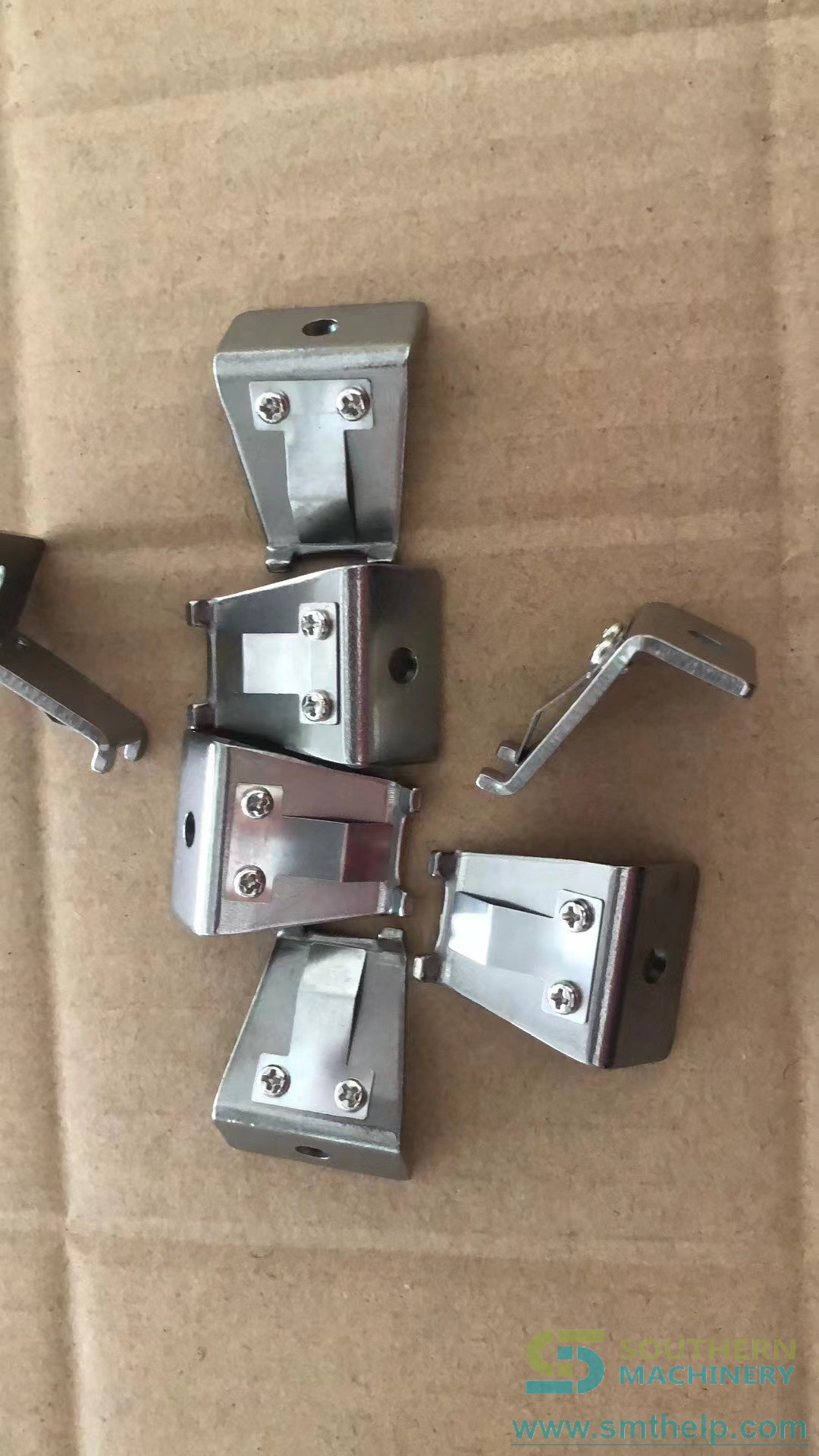
Chain clamps — also called chain claws, conveyor claws or chain fingers — are the gripping elements mounted on the conveyor chain that carries a PCB through an SMT machine. They are not a machine of their own; they are the board-transport interface shared by solder paste printers, pick and place machines, reflow ovens, wave soldering machines and inspection stations.
Their job, in plain terms, is to hold the board in a fixed position while something precise happens to it. As the video explains:
- During feeding, the chain clamps act as precise porters on the conveyor track. When a PCB enters, they grip it with proper spacing and force.
- The clamping is gentle but firm. That combination prevents the PCB from moving during transport — the precondition for high-precision placement.
- Driven by the conveyor, the clamps advance the board along a preset track rather than letting it float or be handled by hand.
- In solder paste printing, they keep the board stable so paste is deposited accurately on the pads.
- At the placement position, they hold the board firmly while the nozzles work at high speed; that stable support is what guarantees placement accuracy.
- After placement, the clamps carry the board through reflow soldering, tolerating high temperatures while keeping the board in position.
- At the end of the machine, they hand the board off to the discharge outlet.
The clamps can be adapted to different PCB formats through automatic or manual adjustment, which is why the same conveyor can run a small control board and a long LED panel without a rebuild.
For a buyer, the practical takeaway is this: chain clamps and transport rails are a process variable, not a consumable accessory. They decide whether the board is exactly where the machine thinks it is.
Typical applications
Chain-clamp transport is infrastructure, so it shows up wherever boards move. Five real scenarios:
- Solder paste printing lines. Print offset is usually blamed on the stencil or squeegee first. In practice, a board that is not clamped squarely under the stencil prints out of registration on every pad, no matter how good the printer is.
- High-speed pick and place. At high CPH the head assumes the board is stationary and in a known coordinate frame. Any clamp slip turns into a placement offset, a tombstone risk or a wrong-part position that passes visual inspection and fails at test.
- Reflow ovens and reflow-capable conveyors. Clamps must keep their grip and their geometry through a hot zone. Deformation-resistant claw material is what stops the board from drifting or sagging mid-profile.
- Wave soldering with pallets or direct board transfer. On a wave machine the transport is also the process fixture: conveyor speed sets dwell time over the wave, and the claws must survive flux, solder splash and repeated thermal cycling. Southern Machinery's published S-WS450 conveyor specification, for example, lists a double hook claw as the standard finger, a 0–2000 mm/min conveyor speed, a conveyor height of 750 ± 50 mm and a finger cleaning system with a brush — the last one exists precisely because claws accumulate flux and solder debris.
- Mixed model and mixed thickness production. When the schedule changes between 0.8 mm and 1.6 mm boards, adjustable clamp spacing and width control decide how long the changeover takes — and whether operators start eyeballing the grip.
How chain clamps fit into a complete PCB assembly line
Think of the line as two blocks connected by one continuous transport system.
SMT block: magazine loader → solder paste printer → SPI → pick and place / chip mounter → reflow → AOI.
THT block: board handling → radial insertion (Southern Machinery S-3010B, or the S3000 radial platform) → odd-form insertion (S-70LD) → pin, eyelet and terminal insertion (S7020 series, S-7000E, S-7000T) → wave soldering → cleaning → AOI / X-ray → depaneling → magazine unloader.
The chain clamp is what links those stations. In a SMEMA-compatible line the board is handed from conveyor to conveyor, and every hand-off is a point where clamp geometry, rail height and rail width have to match. This is why transport components are specified alongside the machines, not after them:
- Upstream: board handling systems (magazine loaders and unloaders such as the SLD250 / SUL250 class) set the pitch and the height that the first clamp must accept.
- Downstream: wave soldering machines such as the S-WS450 and the lead-free dual wave S-WS350B use their own chain and claw systems — the S-WS350B is published with a direct-connected 25B chain for smooth board entry, high-strength aluminum alloy transport rails, an auxiliary guide rail of 40 mm × 80 mm thick square pass and a central support system to prevent guide-rail deformation, plus titanium alloy reinforced claws 2.0 mm thick with deformation resistance up to 20 kg/cm.
- Around the line: claw, chain and net cleaning belongs to the maintenance loop — the Southern Machinery SME-5200 aqueous cleaning system is specified for cleaning wave soldering claws, chains and nets, and ESD anti-static components keep the transport path grounded.
If you are automating THT insertion, the transport question comes first: an insertion machine that inserts into a board which is not held square will produce the same defects as a manual bench, only faster.
Key selection parameters
Never choose a transport system on price alone. These are the categories that decide fit — with the figures Southern Machinery publishes for its own wave soldering conveyors shown as a documented reference point for what a specification looks like.
| Parameter | What it decides | Documented reference (S-WS450 / S-WS350B) |
|---|---|---|
| PCB size range (min–max) | Whether small and large boards both run | S-WS450: min 80 × 60 mm, max 50–450 mm |
| Board thickness range | Clamp opening and board support | Verify against your thinnest and thickest board |
| Conveyor speed range | Dwell time through print, reflow or wave | S-WS450: 0–2000 mm/min; S-WS350B: 0–1.8 m/min |
| Conveyor height | SMEMA hand-off compatibility | S-WS450: 750 ± 50 mm |
| Claw type | Grip quality and board-edge contact | S-WS450: double hook claw (standard) |
| Rail material and rigidity | Long-term straightness under heat and load | S-WS350B: high-strength aluminum alloy, never deformed |
| Rail support | Prevents guide-rail deformation over a long machine | S-WS350B: central support system; auxiliary guide rail 40 × 80 mm square pass |
| Claw material and thickness | Wear life and deformation resistance | S-WS350B: titanium alloy reinforced, 2.0 mm, up to 20 kg/cm |
| Chain type | Smooth board entry and hand-off | S-WS350B: direct-connected 25B chain |
| Width/clamp adjustment | Changeover time on mixed-format builds | Manual or automatic adjustment — confirm which |
| Drive and control | Speed stability and repeatability | S-WS350B: Delta inverter-controlled motor |
| Angle adjustment | Dwell and wave contact geometry | S-WS450: 4–7°; S-WS350B: manually adjustable slide angle |
| Claw cleaning | Prevents flux and solder build-up on the grip surfaces | S-WS450: brush finger cleaning system |
| Sensing and traceability | Board presence, counting, MES data | Intrusion board sensor with production quantity record |
| ESD grounding | Protects sensitive assemblies in transport | ESD anti-static products and grounding practice |
Note that these are published figures for specific Southern Machinery wave soldering models, not a universal specification. For an SMT printer, mounter or reflow conveyor, ask the same questions and expect different numbers — the categories above are what make the two quotes comparable.
ROI and quality perspective
From a buyer's point of view, chain clamps are one of the cheapest places to find yield and one of the most expensive places to ignore it.
The cost of instability. A board that moves a fraction of a millimetre during printing or placement produces defects that show up far downstream — offset paste, shifted components, poor solder joints, or a board that falls from the conveyor entirely. Each of those is measured in rework time and, if it escapes to the customer, in field failure. Southern Machinery's published THT analysis puts single-board rework at roughly 3–5 minutes per board after wave soldering and cleaning, while a non-seated pin that escapes to the field can cost many times the value of the board assembly. Transport stability is upstream of all of it.
The cost of changeover. On a high-mix schedule, manual clamp and rail adjustment is one of the hidden setup costs. If the transport is not designed for quick width and spacing changes, every product change eats operator time — and every manual adjustment is a chance to set the grip wrong.
The cost of maintenance. Flux, solder splash and debris accumulate on claws and chains. A transport system with a self-cleaning or brush-cleaning feature, and a cleaning routine that covers chains, claws and nets, keeps the grip consistent instead of drifting subtly from one shift to the next.
The return. A stable, correctly specified transport system does not add a process step; it protects every process step you already paid for. That is the ROI argument: it raises the effective yield of the printer, the mounter, the inserter and the wave solder simultaneously — for the cost of a mechanical subsystem.
Frequently asked questions
What are chain clamps in an SMT machine?
Chain clamps (chain claws or chain fingers) are the gripping elements on the conveyor chain that hold and transport a PCB through solder paste printing, component placement, reflow soldering and inspection. They position the board with controlled spacing and clamping force rather than letting it move freely.
How do chain clamps affect placement accuracy?
Placement accuracy depends on the machine knowing exactly where the board is. If the clamps allow any movement during transport or during nozzle contact, the board is no longer at the programmed coordinates, and the result is placement offset, tombstoning or poor joints. Stable clamping is a precondition for high-precision placement.
Can one SMT conveyor handle different PCB sizes and thicknesses?
Yes, within its specified range. Chain clamps can be adapted to different board formats through automatic or manual adjustment. The practical limits are the machine's minimum and maximum PCB size, the board thickness range the clamp opening supports, and how fast the width and spacing can be changed between products.
Why do boards sometimes shift or drop on a chain conveyor?
Common causes are incorrect clamp spacing or width for the board, worn or deformed claws, flux and solder debris reducing grip, insufficient rail support allowing deformation, and hand-off mismatch between two conveyors at different heights or pitches. Regular inspection of claws, chains and rails addresses most of these.
What should I specify when buying transport hardware for a new line?
Start with your PCB size and thickness range, then the conveyor speed range, height (for SMEMA hand-off), claw type and material, rail material and support, chain type, adjustment method, cleaning features, and whether you need board-presence sensing and production counting for traceability.
Does the transport system matter for THT and wave soldering as well as SMT?
Yes. On wave soldering machines the conveyor is also the process fixture — conveyor speed sets dwell time over the wave, and the claws must survive flux and repeated thermal cycling. Southern Machinery publishes claw, rail and chain specifications for its own wave soldering models for exactly this reason.
Talk to Southern Machinery about your board transport and assembly line
Southern Machinery has been building SMT and THT PCB assembly equipment from Shenzhen, China since 2011, and today serves 237+ EMS and OEM electronics manufacturers worldwide with insertion machines, wave soldering systems, board handling, cleaning equipment, inspection and spare parts.
- Email: jasonwu@smthelp.com
- Machine catalog and documentation: file.autoinsertion.com
- Product photos and images: ph.smthelp.com
- Company: smthelp.com
Whether you need the transport hardware reviewed as part of a new SMT line, a wave soldering machine with a specified claw and chain configuration, or THT insertion equipment that depends on the same stable board handling, our team can help you match the specifications to your boards. Send us your PCB size and thickness range and we will tell you what the transport system needs to do.
Comments