
S-902 Automatic SMD Counter by Southern Machinery
The S-902 Automatic SMD Counter is an optical counting machine for SMT material warehouses: it reads the guide holes in carrier tape with a fibre-optic sensor and reports the exact quantity on a reel, from -99,999 to +99,999 pieces. Instead of a hand tally two operators can disagree about, it gives the same reel the same number every time, so kitting, issuing and stock-taking stop depending on who counted. It handles pitch from 1 mm and tape width from 4 mm, accepts reels up to 600 mm, offers 18 speed levels and two counting directions as standard, and adds empty-pocket detection, barcode reading and label printing as options. This guide sets out the verified specifications from Southern Machinery's own product document, the unreconciled conflicts with the operation manual, how optical and X-ray counting divide the work between them, and a payback formula you can run with your own wage numbers.
Sep 28, 2026 · Updated Sep 28, 2026 · Southern Machinery
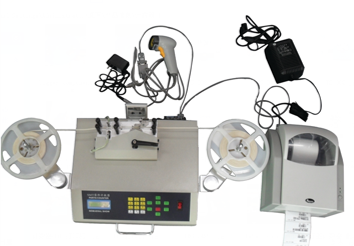
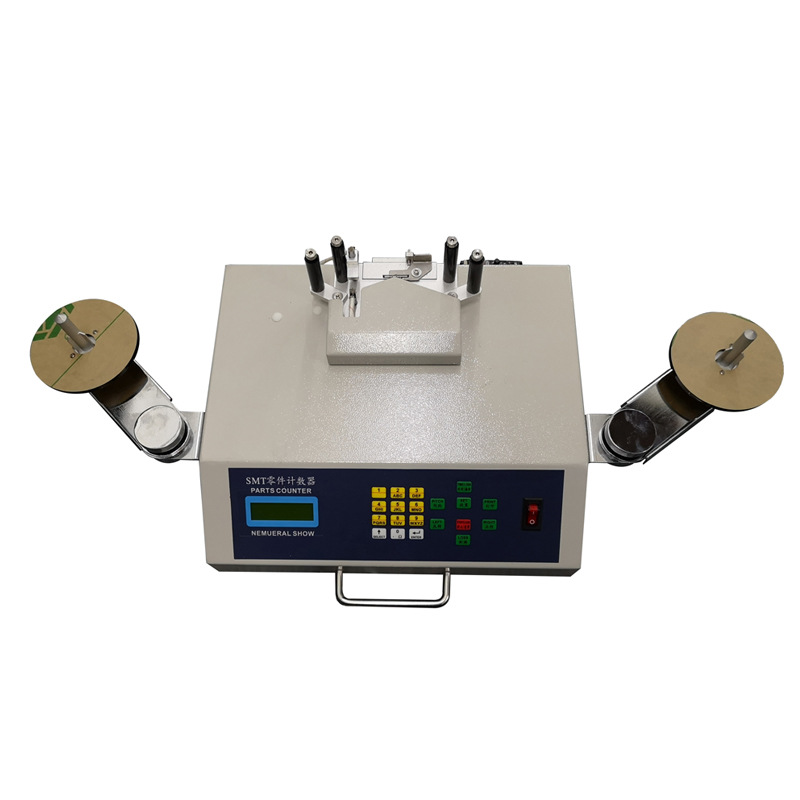
The S-902 Automatic SMD Counter is an automatic optical component counter for SMT material warehouses. It reads the guide holes in carrier tape with a fibre-optic sensor and reports the exact quantity on a reel — anywhere from −99,999 to +99,999 pieces — instead of trusting a hand tally or the label the reel arrived with. Southern Machinery builds it for the warehouse step that feeds every pick-and-place line: knowing what is on the reel before it is issued.
What Is the S-902 Automatic SMD Counter Used For?
The S-902 is a counting machine for SMT material warehouses. It answers one question — how many components are on this tape-and-reel — and it answers it the same way on Monday and on Friday, to whoever is holding the reel. The product document describes the function as automatic counting and calculation of SMD components, suited to material management and warehouse management at an SMT factory.
Typical applications in an EMS, ODM, automotive, medical or industrial electronics plant:
- Goods receipt and incoming verification — confirm the delivered quantity instead of assuming the label is a measurement.
- Material issuing and kitting — set a target quantity and let the machine stop itself at that number.
- Stock-taking and cyclical counting — count a whole reel in manual mode, in either direction.
- Returned reels — a partial reel coming back from the line carries a stale label; the counter produces a measured number and a new printed label.
- Reel storage preparation — counted, labelled reels are what an automated reel storage rack and a warehouse system can trust.
Which components can the S-902 count?
Any SMD component supplied on carrier tape. The product document lists capacitors, resistors, diodes, ICs, inductors, USB connectors and LED beads. The limit is the tape rather than the part: component pitch from 1 mm to 56 mm and tape width from 4 mm to 56 mm, both listed as customizable. Note the discrepancy — the operation manual lists a narrower set, pitch from 2 mm and width from 8 mm. Both ranges are disclosed below rather than quietly reconciled.
Where does a counter sit in a PCB assembly line?
Not in the line — upstream of it. A counter never touches the board, yet a wrong count stops the placement machine mid-order and hides a shortage until the last panel. Verifying the quantity at the point of issue is the cheapest place to catch that error.
Southern Machinery supplies SMT and THT PCB assembly equipment as a line rather than as isolated machines: material handling, SMT component counting machines, board handling, screen printing, placement, reflow, wave soldering, inspection and dispensing. The S-902 belongs to that first group, and it is the same catalogue family as the SMD component counter for tape-and-reel counting and the SS-SMDC SMD material counter.
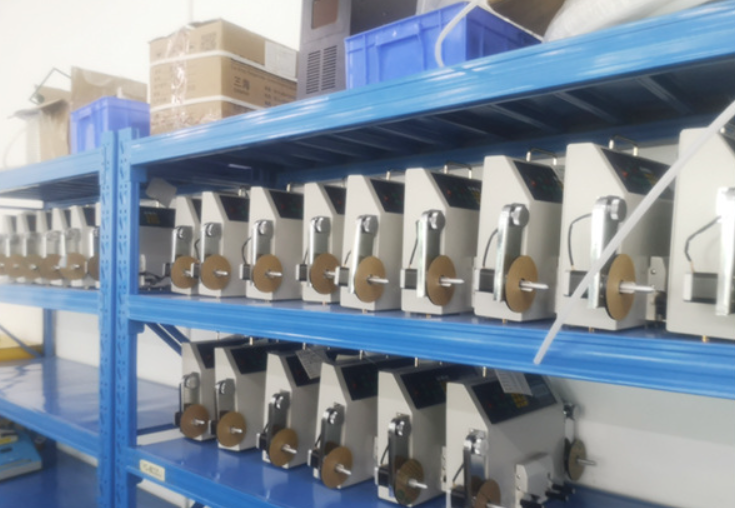
How Does the S-902 Produce a Number Nobody Argues With?
Set the pitch, then let the tape run
Counting follows the tape's own manufacturing standard. Carrier tape is punched with guide holes at a fixed pitch, and the relationship between holes and components is set by the packaging standard. The S-902 counts the correspondence between the components and those guide holes with an optical fibre head.
The cycle described in the operation manual is short: press the pitch key and enter the tape pitch (02, 04, 08 and so on), choose the mode, clip the tape between the blocking plate and the counting gear with the first component aligned to the V-notch, zero the display, then start clockwise or anticlockwise depending on which tray the reel sits on. The quantity on the display is the reel quantity, and with the optional printer the label carries it.
Automatic mode and manual mode do different jobs
Automatic (A) mode is for issuing a set quantity — preset the number and the motor stops when the count reaches it. Manual (M) mode is for stock-taking, where the operator stops the machine. Two standard functions sit alongside them: speed across 1 to 18 levels, adjustable while the machine is stopped, and counting in two directions, displayed as positive and negative so a reel can be wound back without losing the running total. The manual notes that in manual mode the preset value has no effect — the single detail that convinces most operators their machine is broken.
Optical or X-Ray Counting: Which Does Your Warehouse Need?
Southern Machinery supplies both counting technologies, so the honest answer depends on what you are protecting. Optical counting runs the tape past a sensor. X-ray counting images the reel and counts the parts where they sit, without opening or unwinding it — see the AX6000 X-ray chip counter.
- How it reads — Optical (S-902): counts the guide holes in the carrier tape. X-ray counter: images the reel and counts the parts inside the pockets. Hand tally: a person counts parts or reads the reel label.
- Reels handled — Optical: any reel the tray accepts, up to 600 mm. X-ray: whole reels, loaded without unwinding. Hand tally: any reel, one at a time.
- Sees inside a sealed reel — Optical: no, it reads the tape as it runs. X-ray: yes, with no need to open or run the tape. Hand tally: no.
- Finds an empty pocket — Optical: yes, with the optional leak-detection head. X-ray: yes, as part of the image count. Hand tally: only if the person happens to see it.
- Repeatability — Optical: same reel, same number. X-ray: same reel, same number. Hand tally: depends on who counts, and how tired they are.
- Best fit — Optical: issuing, kitting and day-to-day stock-taking. X-ray: incoming verification and high-value reels. Hand tally: nothing, once volume grows.
Three questions that decide it
Do you count sealed reels or returned partial reels? Sealed reels favour the see-through method; returned partials are easy either way. What is the value of a typical reel? On low-value passives a counting error is an annoyance; on an expensive IC it is a write-off. How many reels per day? The slower method becomes the wrong answer at volume.
Most warehouses do not need to choose. The reels counted every day are cheap and numerous; the reels that need looking through are few and expensive. Routing the routine volume to an optical counter and the high-value incoming reels to X-ray verification is a routing decision, not a purchasing decision — and it is the one worth making first.
What Should You Confirm Before You Order an S-902?
The specification list below is transcribed from Southern Machinery's own S-902 product document.
- Brand / model — Southern Machinery · S-902
- Function — automatic counting and calculation of SMD components
- Counting principle — optical sensing of the carrier-tape guide holes
- Counting range — −99,999 to +99,999 pcs
- Counting directions — clockwise and anticlockwise, displayed as positive and negative
- Component pitch — 1, 2, 4, 8, 10, 12, 16, 24, 32, 44, 56 mm and others, customizable
- Tape width — 4, 6, 8, 12, 16, 24, 32, 44, 56 mm, customizable
- Maximum reel diameter — 600 mm
- Speed levels — 1 to 18, adjustable while the machine is stopped
- Operating modes — automatic (A) for issuing a set quantity; manual (M) for stock-taking
- Target quantity preset — yes, the motor stops at the preset value in automatic mode
- Empty-pocket detection — optional leak-detection head; alarms and stops at a gap in the tape
- Barcode reading and printing — optional scanner and label printer
- Machine size (L×W×H) — 765 × 300 × 190 mm
- Weight — 10 to 11 kg
- Voltage — AC 220 V / AC 100 V, 50/60 Hz
- Interface language — English
- Certification — CE certified, meets EHS requirement
Where the documents disagree
Three Southern Machinery documents describe this counter, and they do not agree on every number. The operation manual records a smaller machine (500 × 300 × 180 mm), a narrower pitch set with no 1 mm, a narrower tape set with no 4 mm or 6 mm, and a universal AC 70–260 V input drawing 40 W; the customer nameplate is marked 100–240 VAC and SMZ 901. Counting range is consistent across sources. Treat the model code on the nameplate, the physical dimensions and the power marking as to be confirmed on your own unit — ask before you order, and a counting rate in components per hour is not specified in source — contact Southern Machinery to confirm, because no manufacturer figure is published for this machine.
How Fast Does an Optical Counter Pay for Itself?
Counting labour scales with inventory, not with orders: more stock means more reels, and more reels means more counting hours. Four lines of arithmetic are enough to size the wage bill you already pay.
Monthly counting labour
  = reels per day × minutes per reel ÷ 60
    × loaded hourly wage × working days per month

Payback (months) = machine investment ÷ monthly labour released
Worked example — illustrative only, not a quotation. Take a warehouse counting 60 reels per day at 6 minutes per reel by hand, a loaded wage of USD 6.00 per hour and 22 working days per month:
- Counting hours per day: 60 × 6 ÷ 60 = 6 hours
- Labour cost per day: 6 × 6.00 = USD 36
- Labour cost per month: 36 × 22 = USD 792
- If the machine investment were USD 3,000: 3,000 ÷ 792 ≈ 3.8 months
Every input above is an example — depends on configuration, and subject to final technical confirmation. Southern Machinery does not publish a counting rate for the S-902, so the minutes-per-reel figure must come from your own stopwatch, and the payback covers labour released only — it excludes scrap avoided, stock accuracy and the cost of a stopped line, which usually dwarf the wage saving.
For scale, the counting range covers the following if you divide it by a reel quantity. This is arithmetic, not a specification: 1,000 pcs per reel gives 99 reels in one positive pass; 2,500 pcs gives 39 reels; 5,000 pcs gives 19 reels; 10,000 pcs gives 9 reels. Your real reel fill rates will differ.
Frequently Asked Questions
Which components can the S-902 count? Any SMD component supplied on carrier tape — the product document lists capacitors, resistors, diodes, ICs, inductors, USB connectors and LED beads. Pitch runs from 1 mm to 56 mm and tape width from 4 mm to 56 mm per the product document, both customizable; the operation manual lists a narrower set, from 2 mm pitch and 8 mm width.
What is the counting range? −99,999 to +99,999 pieces, and this is one of the few parameters on which every source agrees. Reverse-direction counting displays as a negative number, which is how a reel is wound back without losing the running total.
What is the difference between automatic and manual mode? Automatic mode issues a set quantity: preset a number and the motor stops when the count reaches it. Manual mode is for stock-taking, where you stop the machine yourself — and in manual mode the preset value has no effect.
How does empty-pocket detection work? On the leak-detection variant, a second fibre-optic pair across the tape compares light reaching the receiver through an empty pocket against light blocked by a seated component, then alarms and stops. The manual gives both an amplifier adjustment procedure and a diagnostic rule: alarms over components mean the signal is too strong; running past empty pockets means it is too weak.
Is the count really exact? The optical count follows the guide holes and the manual states the design intent as zero error. It also states an honest caveat: when the machine stops, inertia can leave the count about one piece either side of the preset target, and the tray can be rotated by hand to land exactly on the number. Treat the ±1 as a stopping effect, not a counting error.
Does it need compressed air? No compressed air is required, as stated in the source document. Confirm the power marking on your own nameplate before installation, because the three documents describe the input differently in wording.
Talk to Southern Machinery About Your Reel Mix
Southern Machinery has supplied SMT and THT PCB assembly automation equipment since 2011 from Shenzhen, China, serving more than 237 customers worldwide, with spare parts support, installation and training. The official S-902 product document sits alongside the SMZ-901 counter document and the full chip counter range.
Send four numbers — reels counted per day, minutes per reel by hand, loaded hourly wage and working days per month — and Southern Machinery will return the monthly labour figure and a payback period with the arithmetic shown. Or describe your reel mix instead: tape widths, maximum reel diameter, daily reel count and whether you need empty-pocket detection or label printing, and we will come back with a configuration and an honest note on which tape sizes need a customised guide.
Request a counting evaluation at www.smthelp.com or email info@smthelp.com.
Comments