
S-P500 Automatic Spray Fluxing System for Wave Soldering Lines by Southern Machinery
The S-P500 Automatic Spray Fluxing System applies flux ahead of the Wave Soldering preheat zone, with twin atomising Nozzles and over 40% lower air use.
Sep 28, 2026 · Updated Sep 28, 2026 · Southern Machinery

Flux looks like the cheapest material on a THT line, and it is usually the most expensive one to get wrong. Under-spray it and you buy bridging, icicles and cold joints at the wave. Over-spray it and you pay twice: once for the flux you atomised into the exhaust, and again in maintenance — sticky residue on preheat elements, contaminated solder, extra cleaning after soldering. The S-P500 Automatic Spray Fluxing System from Southern Machinery is built specifically for that control point: it applies flux to the underside of the PCB by atomised spray, before the board reaches the preheat zone of a Wave Soldering machine, at a conveyor rate that matches the wave itself.
Southern Machinery is a Shenzhen-based supplier of SMT and THT PCB assembly automation equipment, established in 2011 and serving more than 237 customers worldwide. The company supplies single machines and complete line solutions across SMT, THT auto insertion, Wave Soldering, board handling, cleaning and inspection — which is why a fluxing module that matches the conveyor speed and transfer height of the rest of the line matters as much as the wave machine it feeds.
What is the S-P500 Automatic Spray Fluxing System used for?
Short answer: the S-P500 applies flux to the bottom side of a PCB by atomised spray immediately before the preheat zone of a Wave Soldering machine, so that the flux volume is controlled automatically instead of by a hand-held spray gun or a manually adjusted nozzle.
Longer answer. On a lead-free THT process, flux has two jobs: it removes surface oxides and it promotes wetting as the board crosses the wave. Both jobs depend on how much flux reaches which surface, in what droplet size. A manual or poorly controlled flux step produces the classic failure pattern — flux-starved areas at the far edge of the panel, flooded areas near the nozzle, and a preheat zone that has to be retuned whenever an operator changes the spray pattern.
The S-P500 replaces that with a fixed, powered, conveyorised spray station:
- a twin atomization Nozzle system sprays the underside of the board as it passes;
- for narrow boards, one Nozzle can be shut off manually, so a small panel is not sprayed by both heads;
- flux flow is delivered by an imported pump spray system, with an automatic liquid pressurisation system behind it;
- the spray flow pressure is adjustable by hand, which the published datasheet describes as producing greater spray flow rate and a better atomisation effect;
- an isolation-type spray system is published as reducing air consumption by more than 40 %.
The published positioning of the machine is blunt and worth quoting: it exists because factories waste flux every year and because excess rosin raises the maintenance difficulty of the Wave Soldering machine. The stated purpose is to reduce rosin waste and save cost in flux.
Where it sits in the process
Board loading / destacker
        ↓
SMT stage (if mixed-technology board): stencil printing → Pick and Place → Reflow Oven
        ↓
THT stage: axial / radial / odd-form insertion and component preparation
        ↓
FLUX APPLICATION  ← S-P500 Automatic Spray Fluxing System
        ↓
Preheat zone → Wave Soldering → outfeed, cooling and handling → cleaning / AOI
Why flux application is both a cost control and a quality control
Flux consumption is one of the few line costs that scales directly with every board produced, which makes it a favourite target in cost-reduction programmes — and a favourite source of process drift when it is attacked blindly. Three published design decisions in the S-P500 map directly onto that tension.
1. Atomisation instead of flooding. A high-atomising Nozzle produces a fine, even deposit. The published Nozzle options allow the spray range and shape to be adjusted, and the flow to be adjusted separately from the air. That is what allows a factory to move from "enough flux to be safe" to "the flux this board actually needs".
2. Nozzle shut-off for narrow boards. On a mixed-technology line running narrow panels alongside full-width panels, a fixed twin-Nozzle system sprays more flux than the narrow panel can use. The manual shut-off published for the S-P500 is a small feature with a direct consumable impact.
3. Air consumption published as more than 40 % lower. Compressed air is not free: it is generated, dried, filtered and then consumed continuously by an atomising spray system running all shift. The datasheet also states that the machine's air requirement is not high, which reduces air-filter cost. For a plant that reports energy and utility consumption, this is a measurable line item rather than a marketing claim.
4. Two alarms that protect uptime. The published configuration includes an under-voltage alarm and an automatic flux-change reminder. On a production line, a flux starvation event that is discovered at the wave is scrap; the same event discovered by an alarm is a two-minute top-up.
Published specifications — S-P500 / S-P500A
Every value below is reproduced from Southern Machinery's published S-P500 Automatic Spray Fluxing System datasheet. Nothing has been estimated, extrapolated, or filled in from a similar machine.
| Parameter | Published value |
|---|---|
| Model | S-P500 / S-P500A |
| Dimensions | L1200 mm × W700 mm × H1100 mm (fan height 250–350 mm additional) |
| Weight | Approx. 100 kg |
| Control | PLC + industrial button operation; relay control (type A configuration runs without PLC control) |
| PCB transmission height | 750 ± 50 mm |
| Transportation speed | 0–2000 mm/min |
| Transfer direction | Left to right (right to left can be customised) |
| PCB edge space | ≥ 3 mm |
| Track width modulation | MAX 50–320 mm |
| Amplitude modulation mode | Manual |
| Nozzle number | 2 / 2 |
| Nozzle type | High-atomising imported Nozzle |
| Driving mode | Stationary |
| Component height | Up: 80 mm / Down: 50 mm (customisable) |
| Capacity | No limit |
| Pump | Standard |
| Exhaust air requirement | More than 15 m³/min |
| Exhaust fan | Matching unit supplied |
| Power supply | AC380V / 220V, 50–60 Hz |
| Total power | 0.05 kW |
| Air pressure | 0.4–0.6 MPa |
Reading the 0–2000 mm/min transport speed. This is the same published transport range as Southern Machinery's Wave Soldering machines, which means the fluxer can be speed-matched to the wave instead of becoming the slowest link at the start of the soldering section. It also matters for throughput arithmetic: at 0–2000 mm/min, the fluxing station is a pass-through step, not a batch station.
Reading the 0.05 kW total power. The machine's own electrical load is negligible; its utility signature is compressed air and exhaust, not electricity. Buyers who plan utilities should budget air and extraction capacity, not power.
Reading the footprint and the fan. The 1200 × 700 mm body carries a separate exhaust fan assembly with a published height of 250–350 mm. That is the part of the installation most often missed in floor-planning: the machine needs vertical and duct space above the conveyor, not just floor space.
What the published datasheet does not state
Transparency helps a buyer more than a longer brochure. The published S-P500 datasheet does not state:
- a SMEMA interface specification or the exact handshake signals to the adjoining machines;
- the flux tank capacity, or flux consumption per board or per hour;
- a supported board thickness range;
- an ESD / anti-static construction specification;
- Nozzle service life or a recommended replacement interval;
- any certification mark (no CE, UL or similar claim appears on the sheet);
- price or delivery.
If any of these is decision-critical for your line — and for most EMS buyers the SMEMA handshake and the flux tank capacity are — ask Southern Machinery for the values in writing against your configuration rather than assuming them.
Choosing the flux Nozzle: the published ST-6 family
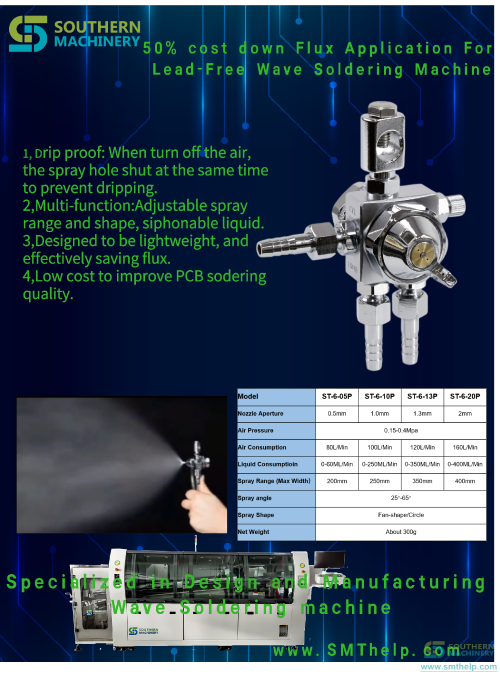
The Nozzle is the component that actually determines droplet size, spray width and liquid consumption, and it is a consumable. Southern Machinery publishes a separate Wave Soldering flux Nozzle datasheet for the ST-6 family, which is the Nozzle type used for this process step. Published data:
| ST-6-05P | ST-6-10P | ST-6-13P | ST-6-20P | |
|---|---|---|---|---|
| Nozzle aperture | 0.5 mm | 1.0 mm | 1.3 mm | 2 mm |
| Air pressure | 0.15–0.4 MPa | 0.15–0.4 MPa | 0.15–0.4 MPa | 0.15–0.4 MPa |
| Air consumption | 80 L/min | 100 L/min | 120 L/min | 160 L/min |
| Liquid consumption | 0–60 mL/min | 0–250 mL/min | 0–350 mL/min | 0–400 mL/min |
| Spray range (max width) | 200 mm | 250 mm | 350 mm | 400 mm |
| Spray angle | 25°–65° | 25°–65° | 25°–65° | 25°–65° |
| Spray shape | Fan-shape / circle | Fan-shape / circle | Fan-shape / circle | Fan-shape / circle |
| Net weight | Approx. 300 g | Approx. 300 g | Approx. 300 g | Approx. 300 g |
Published construction and function notes for the ST-6: stainless steel body; drip-proof — when the air is turned off, the spray hole closes at the same time to prevent dripping; adjustable spray range and shape; siphon-capable liquid feed; lightweight design intended to save flux. The Nozzle has separate adjustments for spray range and flow, plus a needle-and-Nozzle aperture pairing.
How to read the table for selection. Wider apertures buy spray width and liquid volume, and pay for it in air. A plant running 200–250 mm wide panels does not need the 400 mm spray range of the 2 mm aperture, and running the larger Nozzle on narrow work is exactly the over-application case that produces excess residue and dross. Match the aperture to the widest board you actually run, then trim the flow on the adjustment rather than buying headroom you will pay for in consumables and compressed air every shift.
Typical applications
The fluxing step is common to every THT soldering process, so the S-P500 fits where boards are wave soldered in volume:
- Power supply and ballast production — boards with mixed SMT and THT content where flux residue and cleanliness already matter for safety and long-term reliability.
- LED lighting and drivers — high-volume PCB panels where flux cost per board is a direct cost of goods item.
- Home appliance control boards — air conditioners, induction cookers, microwave and small-appliance PCBA, running wide panels with large THT components.
- Automotive electronics — under-hood and body electronics where joint consistency and residue control feed into end-of-line inspection.
- Industrial control, metering and instrumentation — long-life products where solder defects are found in the field, not at the line.
- EMS and ODM factories running high-mix production — where the flux station has to accept a 320 mm panel on one job and a narrow panel on the next without a manual re-setup.
How the S-P500 integrates into a complete PCB assembly line
A fluxer is a line module, not a stand-alone machine, and the transfer chain it belongs to is the same one Southern Machinery builds end to end:
- Line entry — magazine loaders, bare board vacuum loaders or destackers present boards to the line.
- SMT stage — stencil printing, Pick and Place mounting, SPI verification and Reflow Oven soldering for the surface-mount content.
- THT stage — axial, radial and odd-form insertion, plus component preparation (lead cutting and forming).
- Flux application — the S-P500 Automatic Spray Fluxing System applies flux immediately upstream of the preheat and wave.
- Wave Soldering — the wave machine forms the joints; the S-P500's 0–2000 mm/min transport range lets it run at the same cadence as the published wave conveyor range instead of throttling the start of the soldering section.
- Outfeed, cooling and transfer — powered outfeed conveyors carry the hot assembly away from the exit under controlled motion, and board handling modules move it to the next operation.
- Post-soldering process — lead trimming, cleaning, AOI and board handling bring the assembly to final inspection and packing.
The engineering details that decide whether this chain actually runs without manual intervention are the same three every time: transfer height (the S-P500 publishes 750 ± 50 mm PCB transmission height and adjustable speed and height), rail reference side (the track fixed side of the adjacent machines must agree with the fluxer's), and handshake (SMEMA compatibility with the machines either side — confirm this in writing, because the published S-P500 sheet does not specify it).
Key selection parameters to confirm before ordering
| # | Parameter to confirm | Why it matters |
|---|---|---|
| 1 | Widest and narrowest PCB you run | Published track width range is MAX 50–320 mm; narrow panels need the single-Nozzle option used well |
| 2 | PCB edge clearance | Published minimum edge space is ≥ 3 mm |
| 3 | Component height above and below the board | Published up: 80 mm, down: 50 mm, customisable — a tall transformer may exceed it |
| 4 | Conveyor transfer height | Published 750 ± 50 mm; must match the wave machine and the upstream inserter |
| 5 | Transfer direction (L→R or R→L) | Right-to-left is a customisation, not a field change — decide before the order |
| 6 | Track fixed side versus adjacent machines | Rail reference mismatch causes jams and edge damage downstream |
| 7 | Flux chemistry in use | Alcohol-based, water-soluble and no-clean fluxes place different demands on pump, seals and Nozzle material |
| 8 | Exhaust capacity | Published requirement is more than 15 m³/min, with a matching exhaust fan |
| 9 | Compressed air supply and quality | Published air pressure 0.4–0.6 MPa; dry, filtered air protects the pump and atomisation |
| 10 | Power configuration | Published AC380V / 220V, 50–60 Hz, total power 0.05 kW |
| 11 | SMEMA interface requirement | Not specified on the published sheet — confirm signal type and connector before installation |
| 12 | Flux storage, top-up and change procedure | The machine publishes an automatic flux-change reminder; agree the tank capacity and refill method you will live with |
| 13 | Floor space plus vertical/duct clearance | Body is 1200 × 700 mm with an additional 250–350 mm fan height |
ROI, quality and throughput: where the value actually sits
Flux cost. Flux is consumed per board, every shift, forever. Because the S-P500 atomises instead of flooding and allows Nozzle shut-off on narrow work, the mechanism for saving is volume control at the point of application. The size of the saving is arithmetic a buyer can do privately: litres consumed per shift × flux price × shifts per year, multiplied by the reduction actually achieved on their boards. The published datasheet states the purpose of the machine — reduce rosin waste and save cost in flux — but it does not publish a percentage, and no credible supplier can give you one without your board data.
Maintenance cost. The second saving is less visible and usually larger than the first. Excess rosin is published as the reason the maintenance difficulty of the Wave Soldering machine rises: it contaminates the preheat zone, the solder, and the area around the pot, and it converts a planned maintenance task into a reactive one. Controlled application is a maintenance-cost reduction, not only a consumable-cost reduction.
Utility cost. Published air consumption reduction of more than 40 % in an isolation-type spray system, plus the stated low overall air requirement, is a permanent operating saving on a machine that runs continuously.
Quality and first-pass yield. Uniform atomised flux produces even wetting across the panel, which shows up downstream as fewer bridging and icicle defects and as less residue to remove in cleaning. On a line where cleaning is a separate, costed process step, a better-controlled flux deposit reduces the load on it.
Throughput. The fluxing station transports at 0–2000 mm/min, so it does not become the rate-limiting step ahead of the wave. Adding flux automation to a line removes a manual task from the shift and, with it, the variance that comes with a human judgement call made several thousand times a day.
FAQ
What does the S-P500 Automatic Spray Fluxing System do? It sprays flux onto the underside of a PCB before the preheat zone of a Wave Soldering machine, using a twin atomising Nozzle system fed by an imported pump, at a conveyor speed of 0–2000 mm/min.
Will it work with my existing Wave Soldering machine? The published machine is an independent conveyorised module with adjustable speed and height, so it is normally specified to sit immediately upstream of the wave machine rather than being integrated into it. The two details to confirm in writing are the transfer height (published 750 ± 50 mm) and the SMEMA handshake, which the published sheet does not specify.
What is the difference between the S-P500 and the S-P500A? Both are published under the same specification table. The control row lists PLC with industrial button operation, plus relay control, and the feature list notes that the type-A configuration runs without PLC control. If your specification requires PLC control, state it explicitly at the enquiry stage.
Which flux types can it spray? The datasheet describes the machine as an automatic spray fluxing system for Wave Soldering and does not publish a flux chemistry compatibility matrix. Because flux chemistry affects pump, seal and Nozzle material selection, supply the flux type and brand you intend to use when requesting a configuration.
What compressed air and exhaust does it need? Published air pressure is 0.4–0.6 MPa, and the exhaust air requirement is more than 15 m³/min with a matching exhaust fan. Total electrical power is 0.05 kW on AC380V or 220V, 50–60 Hz.
What is the ST-6 flux Nozzle and how often should it be replaced? The ST-6 is the published stainless steel flux Nozzle family for this process step, available with 0.5 mm, 1.0 mm, 1.3 mm and 2 mm apertures. The published data does not include a replacement interval, so treat the Nozzle as a monitored consumable: adjust it, keep it clean, and replace it when spray pattern uniformity changes.
Can I retrofit flux automation to a line that currently sprays flux manually? Yes — this is the most common use case for the machine, because the problems it addresses (flux waste, residue-driven maintenance, operator-to-operator variation) are the exact symptoms of a manual flux step. Send your board widths, transfer height, flux type and a photo of the wave infeed area.
Get configuration advice from Southern Machinery
Send Southern Machinery your PCB width range, board thickness, component heights, flux type and the transfer height of your Wave Soldering infeed, and the team will come back with a configuration recommendation for the S-P500 Automatic Spray Fluxing System — including the Nozzle aperture and the transfer details your line needs.
- Email: jasonwu@smthelp.com
- Phone / WhatsApp: +86 13602562576
- Machine photos and product albums: https://ph.smthelp.com
- Product catalogues and datasheets: https://file.autoinsertion.com
Southern Machinery (Shenzhen, China, established 2011) supplies SMT and THT PCB assembly automation equipment and whole-line solutions covering SMT, THT, Wave Soldering, board handling, cleaning and inspection, and has served more than 237 customers worldwide.
Comments