
Lead-Free Reflow Oven S-8800: A Buyer's Selection and Line-Integration Guide | Southern Machinery
The S-8800 lead-free Reflow Oven is Southern Machinery's high-end reflow platform for SMT lines running lead-free alloys. This guide explains what the S-8800 is used for, the process reality that decides whether a reflow oven is good enough, how the machine drops into a complete PCB assembly line, and the parameters an EMS or OEM buying team should confirm before specifying. It also states plainly which figures Southern Machinery does and does not publish for this model, so your team can request exactly the right data for a defensible capital-equipment decision.
Sep 27, 2026 · Updated Sep 27, 2026 · Southern Machinery
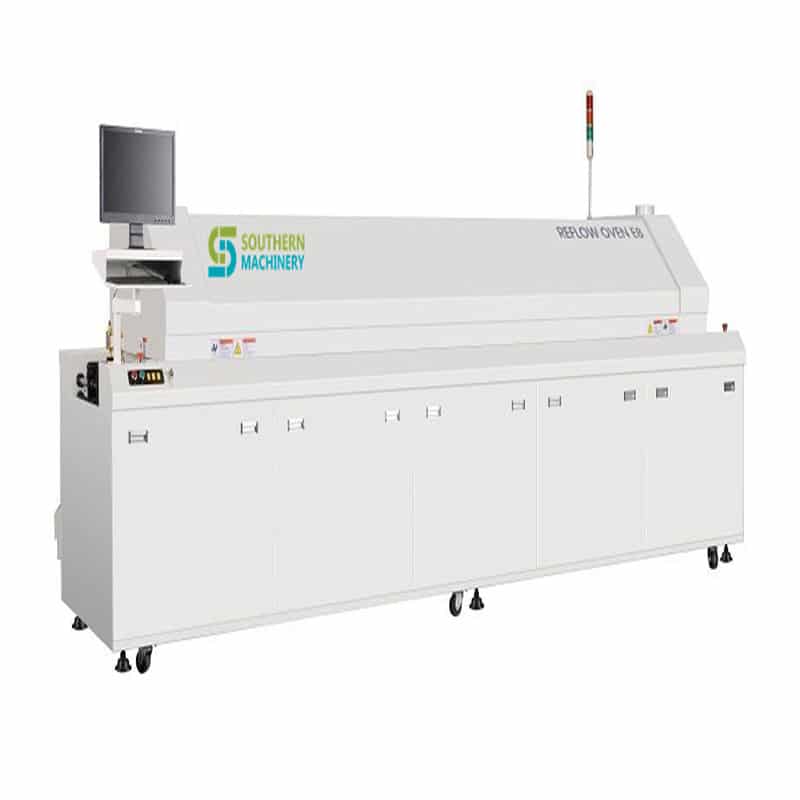
Lead-Free Reflow Oven S-8800: A Buyer's Selection and Line-Integration Guide | Southern Machinery
A lead-free Reflow Oven is the machine that decides whether an SMT line's thermal budget is repeatable — board after board, shift after shift. Paste printing and Pick and Place get the attention, but it is the reflow profile that turns a placed board into a soldered assembly. Get it wrong and the defects do not appear at the Reflow Oven; they appear later at AOI, in functional test, or in the field.
The S-8800 is a lead-free Reflow Oven from Southern Machinery — a Shenzhen-based SMT and THT PCB assembly equipment manufacturer founded in 2011 and serving 237+ customers worldwide. This guide explains what the S-8800 is used for, where it fits in a complete PCB assembly line, which parameters your team should confirm before specifying, and — importantly — exactly what Southern Machinery publishes about this model and what it does not.
What is the S-8800 lead-free Reflow Oven used for?
The S-8800 is used to reflow solder paste on SMT-assembled PCBs — it forms the electrical and mechanical joints between surface-mount components and the board. A panel or board travels through the oven on a conveyor while controlled heating and cooling zones apply a time–temperature profile: preheat, soak, reflow above the alloy's liquidus, then controlled cooling.
Southern Machinery positions the S-8800 as a high-end lead-free reflow platform, built to meet increasingly diverse processes and to keep up with where the industry is heading. The company's published description states that the machine is intended for communications, automotive electronics, home appliances, computers and other consumer electronics production.
If you are replacing an ageing oven, adding a second reflow line, or moving a mixed-technology factory onto a lead-free process, this is the machine class you are shopping in. If you are not yet sure whether you need reflow, Wave Soldering, or both, the S-8800 question usually starts with your board mix.
Why the Reflow Oven is the hardest thermal job on an SMT line
Lead-free soldering raised the bar for every reflow oven in the world. Lead-free alloys melt noticeably higher than the SnPb alloys they replaced, which pushes peak temperatures up and, at the same time, narrows the process window between "fully reflowed" and "component damaged." That single change is why a factory can print and place perfectly and still lose yield at the oven.
Three things follow from it:
- Zone count and heating length matter more than peak temperature. You need enough heated length to ramp, soak and reflow at your required conveyor speed — not just a hot chamber. An oven with too little heating length forces you to slow the conveyor, which cuts throughput and can distort the profile.
- Stability under load is the real specification. What matters is not the setpoint on a cold, empty oven, but whether that setpoint holds when a heavy, thermally demanding board enters the tunnel and pulls heat out of the zones.
- Cooling is part of the metallurgy, not an afterthought. How fast a joint cools affects grain structure, joint appearance and long-term reliability. An oven whose cooling section is undersized cannot deliver the cooling slope a qualified profile calls for.
None of this is specific to one brand. It is the checklist that separates a reflow oven you can qualify from one you spend a year fighting.
Typical application scenarios for the S-8800
- EMS and ODM factories running mixed, lead-free SMT production — consumer, industrial and computing boards on a shared line, where the profile library has to change with the product.
- Automotive electronics — programs with PPM targets and process-audit expectations, where a recorded, repeatable profile is part of the evidence package.
- Home appliance and white-goods control boards — volume production where the oven must hold a profile all shift, not just at first article.
- Communications and networking equipment — larger boards and heavier assemblies that stress an oven's thermal compensation.
- Household, computer and consumer electronics — the cost-sensitive, high-mix end of the market where changeover speed and energy consumption drive the payback calculation.
- Factories adding lead-free capacity — a second reflow tunnel to remove the oven as a line bottleneck.
How the S-8800 integrates into a complete PCB assembly line
A Reflow Oven is one station in a chain, and it only performs if the stations around it do their jobs:
- Solder paste printing — a stencil printer applies paste. Paste volume and shape set the floor for joint quality; SPI (for example Southern Machinery's SH8650 3D SPI) verifies it before placement.
- Pick and Place — components are placed. Placement offset and Feeder health determine how much the reflow process has to forgive.
- Reflow — the S-8800 forms the joints. This is where the profile is executed.
- Inspection — AOI (for example Southern Machinery's S-AO600C or SVL501T) and X-ray confirm the result.
- THT and second-side processing — through-hole components and Wave Soldering take over for mixed-technology boards.
- Board handling — loaders, unloaders, buffers and conveyors keep boards moving between all of the above.
Southern Machinery supplies across that whole chain — SMT, THT, Wave Soldering, board handling and inspection — which matters when you specify a reflow oven, because line integration (conveyor height, SMEMA handshake, board transfer) is where most commissioning delays come from.
Southern Machinery's reflow range is broader than a single model. Alongside the S-8800, the published range includes the S-6600 lead-free Reflow Oven, the STE-800 dual-lane 8-zone lead-free Reflow Oven, WITH-10 LED Reflow Ovens, the S-V8000 vacuum Reflow Oven for void control, and the S-TO4000 tunnel oven for inline infrared drying and curing. Southern Machinery also supplies the KIC Slim 2000 12-channel thermal profiler used to measure and qualify reflow and Wave Soldering profiles.
Key selection parameters to confirm before you specify
The table below is the parameter set that decides whether a lead-free Reflow Oven will qualify for your product mix. It is written as a confirmation list: bring these answers to Southern Machinery and you will get a configuration that matches your boards rather than a generic quotation.
| Parameter | Why it decides the outcome | Confirm |
|---|---|---|
| Heating zones (top / bottom) and total heating length | Determines whether the required profile can be reached at your conveyor speed | Zone count and heated length in mm |
| Temperature setting range and control precision | Headroom above the alloy liquidus, and how tightly the setpoint is held | Setpoint range and stated deviation |
| Thermal stability under load | Whether zones recover when a heavy board pulls heat out | Load / no-load deviation figures |
| Conveyor type, speed range and speed tolerance | Mesh-and-chain versus rail; throughput ceiling; profile repeatability | Speed range, tolerance, drive type |
| Max PCB width, lane count, component clearance | Board size mix, dual-lane throughput, tall component handling | Max width, single/dual lane, top/bottom clearance |
| Cooling zones, cooling length, board exit temperature | Cooling slope, joint quality, safe downstream handling | Cooling configuration and exit temperature |
| Control platform and data logging | Changeover speed and traceability for audit-driven customers | PC/PLC control, profile memory, logging, MES interface |
| Line interface | Drop-in integration with existing printers, mounters and handlers | SMEMA interface, conveyor height, transfer direction |
| Exhaust and flux management | Keeps flux residue and condensate under control | Exhaust volume and ducting requirements |
| Electrical supply and warm-up power | Facility capacity and start-of-shift readiness | Voltage, phase, warm-up and running power |
| Footprint and weight | Floor space and floor loading in a crowded SMT room | Machine dimensions and weight |
| Safety and alarms | Operator safety and scrap prevention | Over-temperature protection; over-temperature, speed and board-drop alarms |
| Documentation and support | Compliance evidence and uptime | Declared standards, manuals, spare parts and training |
A practical note: for the last row, ask in writing. Any supplier should be able to state which standards a machine is declared against, and any buyer should treat "similar to imported models" as a starting claim, not evidence.
What Southern Machinery publishes about the S-8800 — and what you must confirm
This is the part most equipment articles skip, so here it is plainly.
What Southern Machinery publishes for the S-8800
Southern Machinery's product page for the S-8800 describes it as a high-end lead-free reflow oven designed to meet increasingly diverse processes, suitable for communications, automotive electronics, home appliances, computers and consumer electronics. The page states that its core components use imported top brands, that it is engineered for a low failure rate and a service life of more than a decade, that its safety design follows international design rules and sits close to imported reflow ratings, and that its software, hardware and production processes are mature and stable. Those are the manufacturer's stated design and quality claims for the platform.
What is not published for the S-8800
The public product page does not publish a numeric datasheet for this model — no zone count, heating-zone length, temperature range, control precision, conveyor speed, maximum PCB width, power rating or machine dimensions. Those numbers are not something we will guess at or fill in from a sibling model, because they decide whether the machine is right for your product mix, and a wrong assumption here is expensive.
How to close the gap
Send your board data and Southern Machinery will return the configuration and the figures that go with it:
- Board sizes (length × width) and panel dimensions
- Board thickness and layer count
- Component mix, tallest component above and below the board
- Your target alloy and any customer-mandated profile requirements
- Required conveyor speed or hourly throughput
- Line position: standalone, in-line, or replacing an existing oven
- Facility limits: available power, exhaust, and floor footprint
For reference on how a fully published lead-free reflow datasheet is structured, Southern Machinery's published specifications for other reflow platforms in the range state, for example, 8 top / 8 bottom zone configurations with a 3,121 mm heating length and 10 top / 10 bottom configurations with a 3,891 mm heating length, PLC plus PC control, chain-and-mesh conveying and an SMEMA interface. Those figures belong to those models — they are shown here only so you know what data to expect back for the S-8800.
ROI, quality and throughput perspective
Reflow does not usually get judged on the same ledger as an insertion machine, but it belongs on the capital plan for four reasons:
- First-pass yield. A repeatable profile is the cheapest yield improvement available in SMT. Rework, touch-up and scrap on thermally marginal boards cost far more than the difference between two ovens.
- Changeover time. High-mix factories lose capacity between products. An oven with a stored profile library and a documented setup routine shortens the gap between "last good board" and "first good board."
- Energy and warm-up. Reflow runs all shift, so running power and warm-up time are recurring costs. Compare them across the machines you shortlist rather than treating them as fixed.
- Traceability. For automotive and medical customers, a logged profile record is not a nice-to-have. An oven that records zone temperatures, production statistics and alarms turns a process question into a data answer.
The honest framing for a reflow oven is this: you are not buying heat, you are buying repeatability. Repeatability is what protects yield, protects the schedule, and protects you in an audit.
The four cost lines that decide payback
Yield loss, changeover time, energy and audit friction are the four places a reflow oven shows up in the accounts. A cheap oven that costs you half a percent of first-pass yield on a high-mix program will outspend a better machine within a year — which is why the parameter list above is worth filling in properly rather than comparing headline prices.
FAQ
What is the S-8800 used for?
The S-8800 is a lead-free Reflow Oven used to reflow solder paste on SMT-assembled PCBs, forming the joints between surface-mount components and the board. It sits between the Pick and Place stage and AOI/X-ray inspection in a standard SMT line.
Is the S-8800 lead-free capable?
Yes. Southern Machinery offers it as a lead-free reflow platform. Because lead-free alloys require higher peak temperatures than leaded alloys, confirm the temperature range and profile capability against your specific alloy and board before ordering.
How many heating zones does the S-8800 have?
Southern Machinery does not publish a zone count for this model on its public product page, so we will not quote one. Send your board and throughput data and Southern Machinery will confirm the configuration — the published range also includes 8-zone and 10-zone lead-free reflow platforms for comparison.
What board sizes can the S-8800 handle?
Maximum and minimum PCB width, panel dimensions and single- versus dual-lane operation should be confirmed from the model datasheet against your board mix. This is the parameter set we ask for first when preparing a quotation.
How do I verify the reflow profile once the oven is installed?
Profile verification is done with a multi-channel thermal profiler — Southern Machinery supplies the KIC Slim 2000 12-channel profiler — by attaching thermocouples to a representative board and running it through the oven at production speed. Industry documents such as IPC/JEDEC J-STD-020 and IPC-7801 describe reflow temperature classification and reflow oven process control as general industry references; the applicable profile limits for your product should always come from your alloy supplier and your customer's requirements.
Does Southern Machinery supply only the oven, or the whole line?
Southern Machinery supplies SMT and THT PCB assembly automation equipment as individual machines or as complete line solutions — stencil printing, Pick and Place, Reflow Oven, Wave Soldering, THT auto insertion, board handling, cleaning and inspection.
Next step: get a configuration recommendation for your boards
If the S-8800 is on your shortlist, the fastest way to a real answer is to send your board data. Southern Machinery will come back with a recommended configuration and the published figures that apply to it.
- Contact Southern Machinery for configuration advice, datasheets and a quotation: jasonwu@smthelp.com | +86 13602562576 | https://www.smthelp.com
- Browse the product catalogue and PDFs: https://file.autoinsertion.com
- See machine photos by model: https://ph.smthelp.com
Southern Machinery Sales And Service Co., Ltd — founded 2011, based in Shenzhen, China, serving 237+ customers worldwide with SMT and THT PCB assembly automation equipment and after-sales support including spare parts, repair, retrofit, training and overhaul.
Comments