
PCB Baking and Storage Management Before SMT Assembly
Moisture and internal stress damage bare PCBs before they reach the line. Verified baking temperatures, storage windows and stacking rules for SMT assembly.
Sep 28, 2026 · Updated Sep 28, 2026 · Southern Machinery
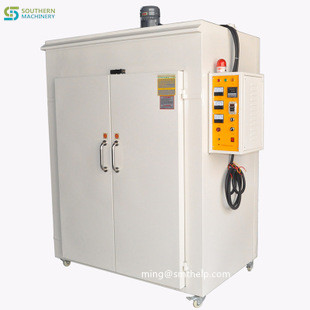
PCB Baking and Storage Management Before SMT Assembly
A bare PCB is not an inert object. Between the fabricator's final process step and the moment it enters your stencil printer, a printed circuit board absorbs moisture from the air and carries internal mechanical stress from lamination, drilling and routing. Neither is visible on the incoming inspection bench, and both surface later — at reflow, or at final test.
PCB baking and storage management is the discipline that removes that risk before it reaches the line. This guide covers what baking does, the storage windows that decide whether a bake is required at all, the documented temperature and time steps, the stacking and cooling method, and how the whole routine connects to a complete SMT/THT assembly line.
What is PCB baking used for?
PCB baking has two jobs, and they are often confused:
- Moisture removal. It dries the moisture absorbed into the board substrate and the pad area. Trapped moisture flashes to steam during reflow, and that vapour is what drives delamination, blowholes and the classic "popcorn" failure.
- Internal stress relief. Baking stabilises board dimensions. In practice, a baked board shows a relatively large improvement in warpage compared with the same board taken straight from the stack.
A third effect follows from the first: drying the pad area improves the soldering effect and reduces the welding and repair rate. Better wetting on a dry pad means fewer touch-ups and fewer boards pulled off the line for rework.
The trade-off is cosmetic and worth knowing: the colour of the PCB may change with baking, affecting appearance. Where your customer accepts a visible shade shift on a finished board, this matters; where the board is hidden inside an enclosure, it usually does not.
Why moisture and internal stress matter on the SMT line
| Symptom on the line | Underlying cause | Where it hits |
|---|---|---|
| Popcorning, delamination, blowholes | Absorbed moisture flashing to steam in the reflow zone | Reflow, and any later thermal cycle |
| Warpage and dimensional drift | Lamination/manufacturing stress plus moisture | Solder paste printing, component placement |
| Poor wetting, non-wetting pads | Oxide growth on a damp pad surface, especially OSP finishes | Reflow, wave soldering |
| Repeat rework and touch-up | All of the above, compounding | Final test, outgoing QC |
A board that arrives warped is not a placement problem, and a board that popcorns is not a profile problem. Both are incoming-material problems that a bake and a storage rule prevent.
PCB storage rules before the line
The management specification that governs unpacking and storage sets the clock that decides whether a bake is needed:
| PCB condition | Rule |
|---|---|
| Sealed, unopened, within 2 months of the manufacturing date | Can go directly online |
| Within 2 months of the manufacturing date | The unpacking date must be marked on the board or package after opening |
| Within 2 months of manufacturing, after opening | Must be used within 5 days |
Once a reel of boards is opened, the clock is running. Marking the unpacking date is what makes the rest of the system auditable — without it, nobody on the floor knows which stack is about to expire.
PCB baking temperatures and times
These are the documented bake steps used to bring a board back into a usable state. Baking is at 120 ± 5 °C throughout; only the duration changes with board age.
| Condition of the PCB | Bake temperature | Bake time before going online |
|---|---|---|
| Sealed board, opened more than 5 days, within 2 months of manufacture | 120 ± 5 °C | 1 hour |
| More than 2 months from manufacturing date | 120 ± 5 °C | 1 hour |
| More than 2 to 6 months from manufacturing date | 120 ± 5 °C | 2 hours |
| More than 6 months to 1 year from manufacturing date | 120 ± 5 °C | 4 hours |
| More than 1 year from manufacturing date | 120 ± 5 °C | 4 hours, then return to the PCB factory for re-spraying before use |
Two follow-on rules matter as much as the table itself:
- A baked PCB must be used within 5 days. The documented window is the 5 days before it enters IR reflow.
- If the board is not used inside that window, it needs another hour of baking before it can be used. Bake time is not a one-off event — it is a restartable clock.
PCB baking method: stacking, cooling and handling
The temperature table is worthless if the boards are loaded wrong. The documented method classifies boards by format size:
Large PCB — 16 PORT and above
- Placed in a flat orientation
- Maximum of 30 sheets in a stack
- The oven is opened within 10 minutes after baking
- Boards are then placed flat and allowed to cool naturally, using a pressure-protection fixture
Small and medium PCB — below 8 PORT
- Placed flat
- Maximum of 40 pieces in a stack; the number of upright positions is not limited
- The oven is opened within 10 minutes after baking
- Boards are placed flat and cooled naturally with a pressure-protection fixture
The two constraints that operators break most often are the stack height and the 10-minute door rule. Stacking past the limit traps moisture at the centre of the bundle and produces uneven drying; leaving boards in a hot chamber past 10 minutes keeps them in a slow, uncontrolled cooling state instead of the flat, natural cooling the method calls for.
The pressure-protection fixture is the third pillar: a stack of thin boards at 120 °C will sag or bow under its own weight if it is not supported as it cools. Cooling is what locks the board flat — so cooling it flat is the point.
Regional and seasonal factors change the recipe
Baking intervals are not only a function of the fabricator's process. Humidity in the region where the boards are stored changes the schedule, and any line running in southern China knows why:
- OSP and pure immersion-gold finished boards generally carry a 6-month shelf life after packaging. The OSP process is generally not recommended where long storage is expected.
- Guangdong and Guangxi see the "returning to the south" humidity every March and April, when the air becomes very wet. Under those conditions the board must be used within 24 hours of exposure to air, and after a normal opening it is best to use it up within 8 hours. Boards that need baking need longer baking.
- Northern regions are generally drier, so storage time is longer and bake time can be shorter.
This is why a bake schedule copied from another plant can be wrong. The right interval depends on your fabricator, your finish, your floor's humidity, and the season.
How this fits into a complete SMT/THT PCB assembly line
PCB baking is one node in the material flow, and it only pays off when the nodes around it are controlled:
- Incoming inspection and dry storage — seal-intact boards go to dry storage rather than a bake oven. A dry box holds a controlled low-humidity environment so partial stacks stay inside their window.
- Bake decision and bake — expired or over-exposed boards go to the batch oven on the table above, then cool flat.
- Stencil printing — a flat, dimensionally stable board is a precondition for consistent paste deposit.
- Placement — warpage directly drives placement offset.
- Reflow — where trapped moisture would have expressed itself.
- THT / odd-form insertion and wave soldering
- Cleaning, coating and curing — where the same oven class reappears for drying and cure.
- Inspection and rework
Southern Machinery builds and supplies equipment across this flow — SMT line equipment, THT automation, wave soldering, board handling, inspection, and the cleaning, coating and thermal equipment that surrounds them — together with the spare parts, training and after-sales support that keep a line running. The company has served 237+ customers worldwide since it was founded in Shenzhen in 2011.
Key selection parameters for a PCB baking / drying oven
If you are specifying an oven rather than using an existing one, these are the parameters to confirm with any supplier. Note that the values themselves must come from your own process window and the supplier's data sheet — not from a generic list:
- Batch chamber or conveyorised. A batch chamber suits bake-and-hold routines like the table above. A conveyorised/inline oven suits continuous drying and curing in the line.
- Temperature uniformity across the usable volume, not just the setpoint. A 120 ± 5 °C recipe is only met if the whole chamber holds the band with boards loaded.
- Usable chamber volume against your real stack. A 30-sheet or 40-piece stack has a footprint; confirm the chamber takes it without forcing a smaller, non-compliant bundle.
- Cooling arrangement. Whether the oven supports the flat, supported natural cooling the method requires, or whether you need a separate cooling/fixture station.
- Recording and traceability. Bake date, bake time and operator record — the evidence your customer audit or IPC/JEDEC J-STD-033 documentation will ask for.
- Power and facility requirements. Confirm against your own electrical supply and exhaust provision with the supplier.
- Board support and fixtures. Sag control for thin boards at temperature.
ROI, quality and throughput perspective
The business case for baking is not "better quality" in the abstract — it is the cost of the failures it removes:
- Scrap and rework. Popcorning and delamination scrap a board after it has already absorbed the cost of paste, components and machine time. A bake is comparatively cheap.
- Line interruption. A warped board that jams a conveyor or misplaces parts stops output; stable boards do not.
- Rework labour. Dry pads solder better, which is the direct route to a lower touch-up rate.
- Scheduling discipline. The 5-day post-bake and post-unpacking windows force FIFO discipline on board stacks. That discipline is worth having on its own, because it also removes "we don't know how old this stack is" from the floor.
- Audit readiness. A recorded bake and storage routine is documentary evidence for moisture-sensitive-material control.
Frequently asked questions
What is PCB baking used for?
PCB baking removes absorbed moisture and relieves internal stress in a bare board. Drying the pad area improves soldering and reduces repair rate, while stress relief stabilises board dimensions and improves warpage.
At what temperature and for how long should PCBs be baked?
The documented bake is at 120 ± 5 °C, with duration set by board age: 1 hour for boards opened more than 5 days or more than 2 months old, 2 hours for boards 2 to 6 months old, and 4 hours for boards 6 months to 1 year old. Boards older than 1 year are baked 4 hours and then returned to the PCB factory for re-spraying.
How long can a PCB stay out of its packaging before it must be baked?
A sealed board within 2 months of manufacture can go straight online. Once opened, a board within 2 months of manufacture must be used within 5 days, and a board opened more than 5 days must be baked before use. A baked board must then be used within 5 days, or re-baked for an hour.
How many PCBs can be stacked in a bake oven?
The documented stacking limit is 30 sheets for a large board (16 PORT and above) and 40 pieces for a small or medium board (below 8 PORT), always placed flat. The oven is opened within 10 minutes after baking and the boards cool flat with a pressure-protection fixture.
Should PCBs be baked before or after assembly?
Before. Baking is a pre-assembly step — it dries the bare board and stabilises its dimensions before stencil printing, placement and reflow. Baking is the step that prevents moisture from flashing to steam inside the reflow oven rather than a cure applied afterwards.
Does humidity in my factory change the bake schedule?
Yes. Colder, drier regions allow longer storage and shorter bakes. In Guangdong and Guangxi, the "returning to the south" humidity in March and April is severe enough that boards must be used within 24 hours of exposure, and best within 8 hours after a normal opening, with longer bakes for boards that need them.
Does Southern Machinery supply PCB baking and dry-storage equipment?
Yes. Southern Machinery supplies the batch oven hardware, dry-storage cabinets such as the SDC-115 dry box for PCBA and component storage, inline drying equipment such as the S-TO4000 tunnel oven, and the surrounding SMT/THT line equipment. Contact us with your board sizes, monthly volume and process window and we will confirm the configuration.
Contact Southern Machinery for configuration advice
Tell us your board sizes, stack format, finish (OSP, immersion gold, HASL), monthly volume and the humidity conditions in your factory, and we will confirm the equipment configuration that fits.
- Jason Wu — jasonwu@smthelp.com
- Browse the catalogue: file.autoinsertion.com
- See machine photos: ph.smthelp.com
- Website: www.smthelp.com
Southern Machinery Sales and Service Co., Ltd — founded in Shenzhen, China, in 2011, serving 237+ customers worldwide with SMT/THT PCB assembly automation equipment, full-line solutions, spare parts, training and global support.
Comments